At the age of seven, my anticipation was solely focused on a singular book release: Egyptology: Search for the Tomb of Osiris (2004). This children’s bestseller, styled as a scrapbook journal from a forgotten expedition, captivated young readers with interactive elements such as envelopes, postcards, and even a piece of “mummy cloth.” The book’s allure lay not only in its textured gold and plastic gemstone cover but also in the tantalizing notion that part of its narrative might be grounded in reality. I believed in the existence of Emily Sands, a supposed archaeologist who disappeared in Cairo in 1926, and whose journals seemed to have been uncovered just for a girl in Seattle, Washington.
The Metropolitan Museum of Art’s Divine Egypt exhibition rekindled that childhood wonder, showcasing over 200 pieces of ancient Egyptian art spanning three millennia. These works, drawn from The Met’s own collection and supplemented by international loans, weave together the complex divine hierarchy with the extraordinary artistry of the period. Let me channel my inner Emily Sands and guide you through the fascinating family dynamics of the gods and goddesses of Ancient Egypt.
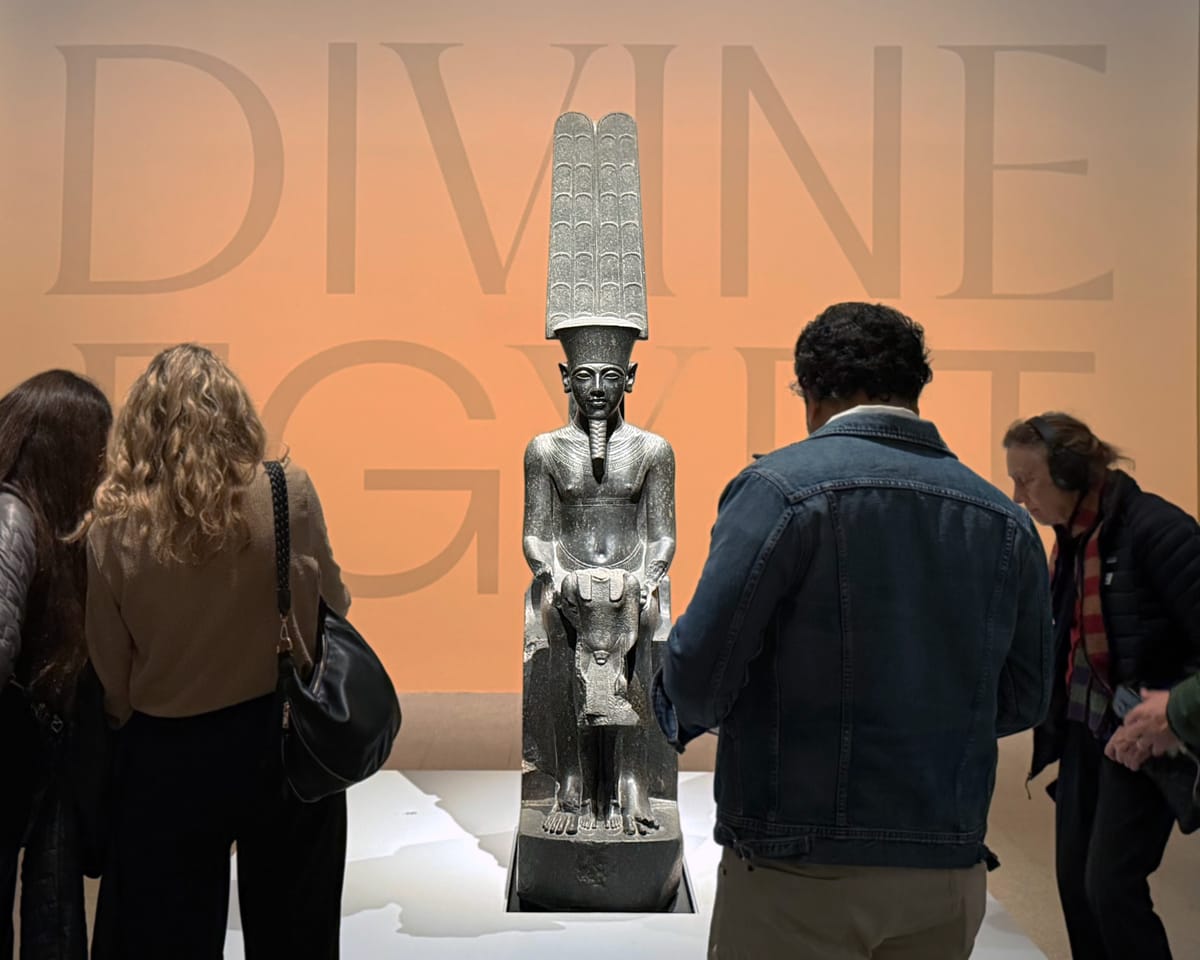
As visitors enter the Divine Egypt exhibit, they are greeted by a striking stone statue of Amun-Re, the god of kings, who cradles Pharaoh Tutankhamun between his shins. This portrayal underscores how the exhibition treats Egyptian deities not merely as figures of worship but as dynamic personalities, akin to the celebrity royals often explored in The Met’s permanent collection. A key deity of the New Kingdom, Amun-Re embodies the confluence of multiple gods, reflecting the formidable power Egypt attained during the 18th Dynasty.
Re, the creator deity, is central to Egyptian mythology, his essence permeating the land as he descends nightly to combat darkness and rise anew each dawn. A statuette from the Late Period–Ptolemaic Period captures Re as an otter-mongoose hybrid, poised and wearing a solar disc headdress. Re’s cyclical journey is aided by Nut, the sky goddess, whose depiction on a well-preserved coffin portrays her as the vessel through which Re is reborn each morning, symbolizing regeneration and sustenance.
Other deities, such as Bastet, Thoth, and Isis, also play vital roles in the pantheon. Bastet, adorned with gold jewelry, symbolizes the protective feline spirit, while Thoth, the god of wisdom, is depicted in multiple forms, including a baboon and an ibis-headed man. Isis, revered as the divine mother and goddess of magic, is central to many myths, particularly in her relationship with Osiris and their son Horus. The exhibition concludes with a golden triad of this divine family, leaving visitors to reflect on the enduring influence of these mythological figures.