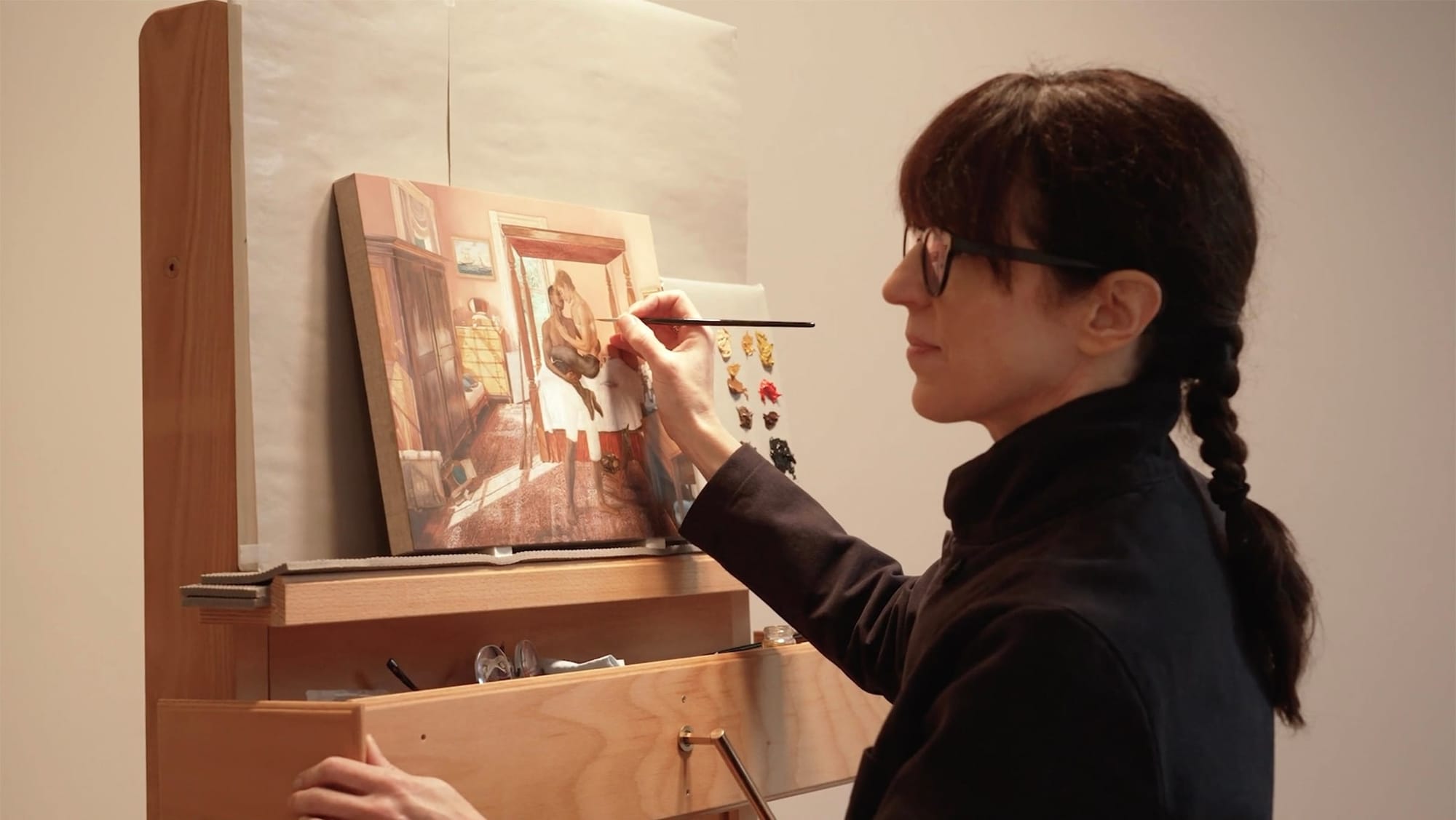
“If paint doesn’t feel good coming off the brush, you pretty much have nothing,” declares artist Hilary Harkness, known for her intricate canvases that explore humanity’s complexities. Her art presents dense narratives on small surfaces, inviting viewers into over-the-top fantasias that challenge historical realities. Having known Harkness socially in the decade between her solo exhibitions, her 2023 show at New York City’s PPOW Gallery left me in awe. Despite her openness, Harkness maintains an aura of mystery, often avoiding the spotlight herself, preferring to highlight others in her talks.
Harkness’s hyperrealist and maximalist style combines beauty, optimism, and humor with human flaws—revenge, power, and more. Her work includes cross-sections of World War II battleships, revealing hidden queer narratives, and examinations of historical figures like Gertrude Stein and Alice B. Toklas. Her paintings draw viewers into a familiar yet otherworldly realm, similar to her conversational style, filled with unexpected insights. Born in 1971, Harkness studied at UC Berkeley and Yale University, with her art exhibited globally, from New York’s FLAG Art Foundation to Madrid’s Museo Thyssen-Bornemisza.
Discussing her childhood in Kalamazoo, Michigan, Harkness recalls witnessing a tornado tear through a department store, possibly inspiring her signature cross-section technique. She initially pursued a pre-med track at UC Berkeley before switching to art under the influence of mentors like Mary Lovelace O’Neal. Harkness’s early paintings often depicted labor, drawing parallels to Pieter Bruegel’s work. Her piece “Golden Gorge” (2007) reflects on the American gold rush’s get-rich-quick allure and its consequential exploitation.
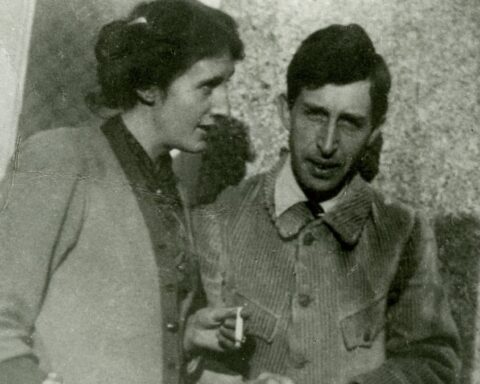
Harkness explores themes of hierarchy, power, and sexuality through her depictions on battleships, where human vulnerability is laid bare. Her ongoing series on Gertrude Stein and Alice B. Toklas focuses on capturing moods rather than literal likenesses. Notably, she rarely creates preliminary sketches, preferring to work directly on her canvases. Recent projects like “Experienced People Needed” (2018) required more planning due to their complexity, but Harkness finds spontaneity often yields more intriguing results.
The Arabella Freeman series explores narratives of a genderqueer Union soldier and a Black Union soldier’s family, inspired by Winslow Homer’s work. Harkness acknowledges the complexities of a White artist depicting Black lives, striving to engage with historical truths while embracing fantastical elements. Her interest in calligraphy emerged from a project with Headmaster Magazine, leading to a transformative workshop in England. For Harkness, painting is a lifelong journey, one that balances mastery with the joy of being a perpetual beginner.