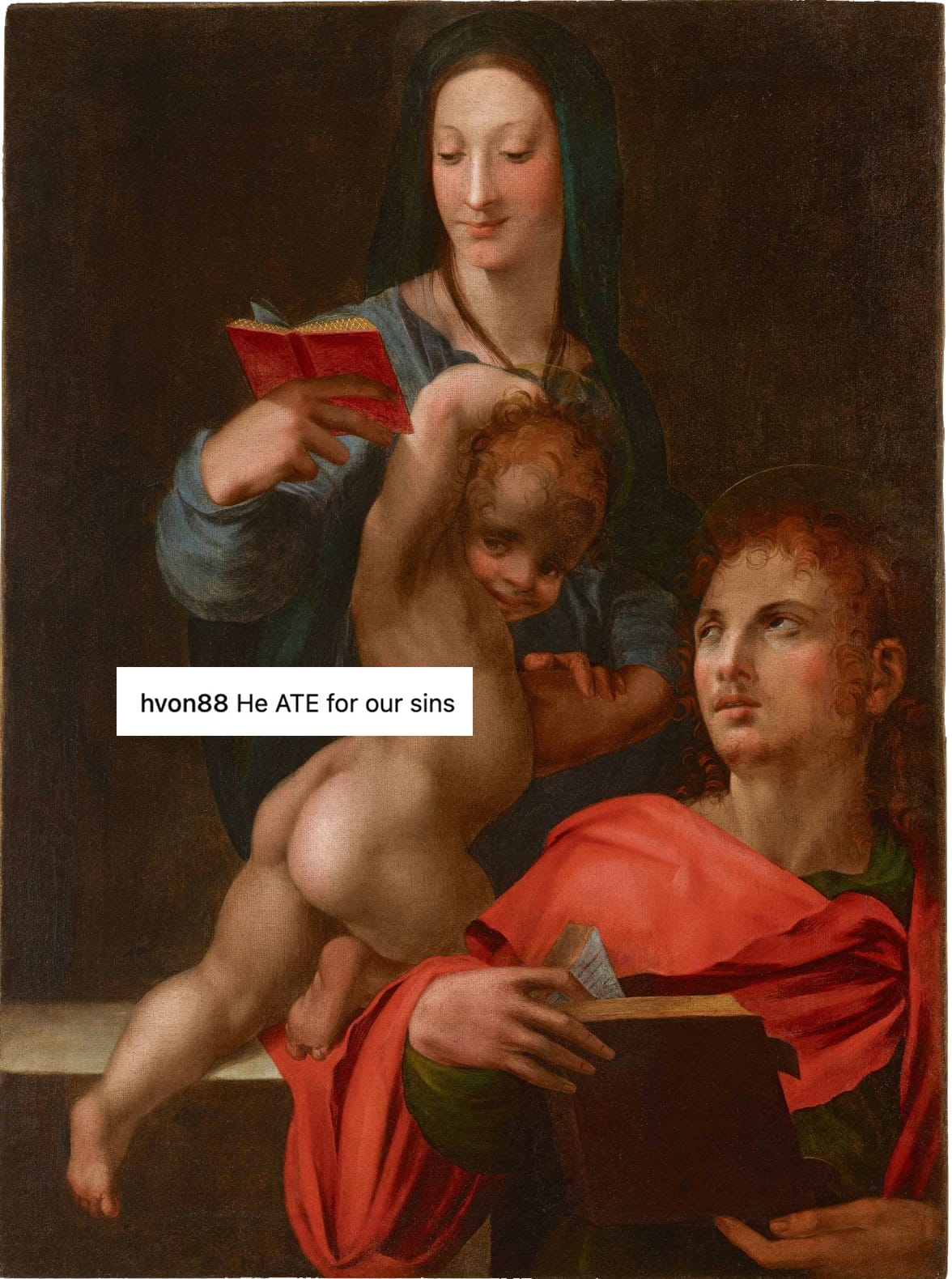
Although ‘looksmaxxing’ might not be found in biblical texts, the term has been humorously applied to describe the latest addition to the Metropolitan Museum of Art’s collection—a Mannerist painting featuring an infant Jesus who captivates viewers with his striking presence.
The museum’s Instagram post of Rosso Fiorentino’s newly identified work, ‘Madonna and Child with Saint John the Evangelist’ (1512–13), has attracted a flurry of incredulous comments. Observers have remarked on the baby Christ’s unusually muscular form, particularly his pronounced posterior, using contemporary language.
While the online response to Fiorentino’s rediscovered piece might seem irreverent, it reflects the essence of the Mannerism movement from 500 years ago, employing stylized language that defies classical norms and speaks to today’s cultural dynamics. Would we witness such descriptions of the Holy Child as a ‘baddie,’ ‘yasssified,’ or ‘caked up’ without the influence of recent cultural trends?
This reaction raises questions about the sacredness of religious imagery in the digital age, where nothing seems off-limits. The Met’s press release highlights the painting as the artist’s earliest known surviving work, portraying the Virgin Mary with an almost cherubic baby Jesus and a newly revealed figure, St. John the Evangelist, previously hidden under layers of paint.
Mary’s calm demeanor contrasts with Jesus’s energetic pose and curious look, showcasing the exaggeration and asymmetry typical of Mannerism. This art movement emerged from the High Renaissance’s harmony, reflecting the societal upheaval of early 16th-century Italy. Fiorentino, a pioneering Mannerist, had several notable commissions, including his early work on the ‘Assumption of the Virgin.’
Identified through Giorgio Vasari’s ‘Lives of the Artists,’ Fiorentino’s ‘Madonna and Child with John the Evangelist’ is a pivotal piece. Max Hollein, The Met’s director, describes it as a rare and ambitious work by a key 16th-century artist, marked by psychological depth.