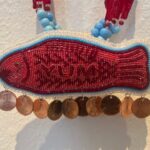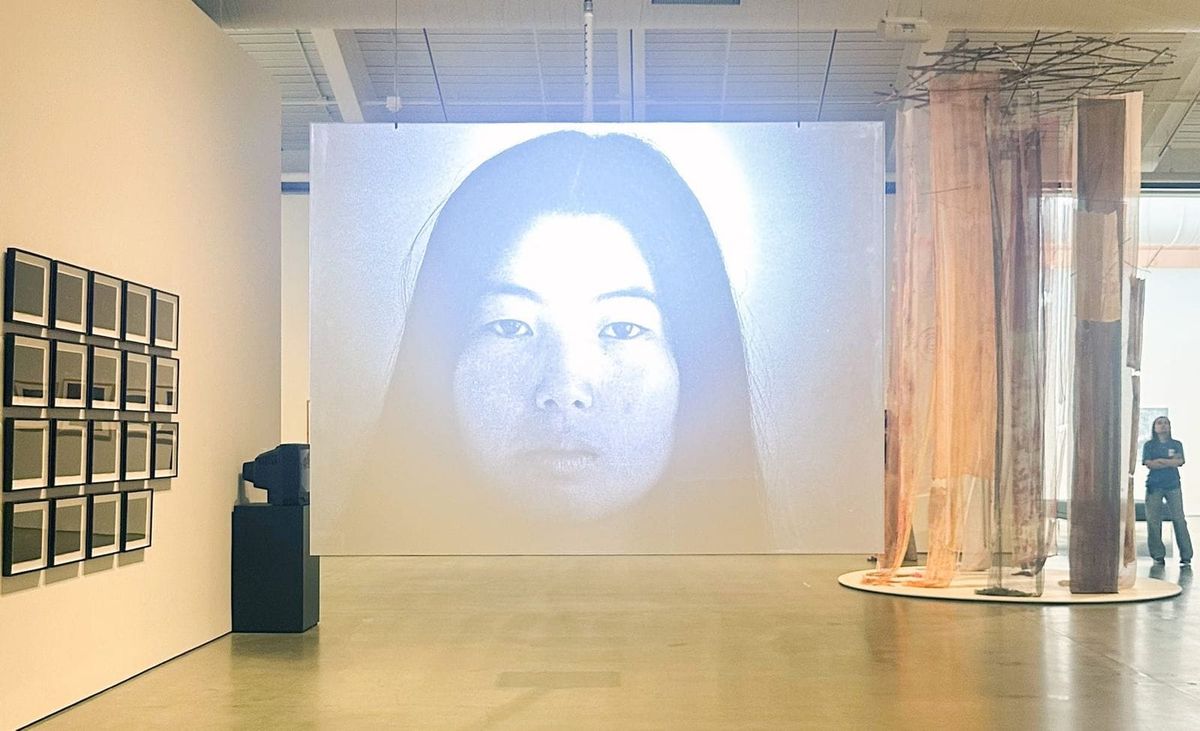
BERKELEY, Calif. — From the outset of “Untitled (Trip & Theresa)” (c. 1970s), the first in a trio of short film experiments, the lively spirit of Theresa Hak Kyung Cha is evident. In the piece, she points to a conceptual exercise on the wall, smiling and dancing as the camera pans out. Seeing Cha smile was unexpectedly moving, leaving a lasting impression throughout the exhibition. This intimate portrait of the artist is central to Multiple Offerings, currently featured at Berkeley Art Museum and Pacific Film Archive (BAMPFA). The exhibition seeks to humanize an artist often overshadowed by her tragic murder and the weighty themes of migration and exile in her work.
Curators Victoria Sung and Tausif Noor highlight Cha’s playful side by pairing archival materials with her artworks, courtesy of the complete archives donated by the Cha family to BAMPFA in 1992. A notable example is “Permutations” (1976), featuring six one-second shots of her sister Bernadette, randomized into a ten-minute video. The humor becomes clear when viewing the sequence of numbers on a nearby sheet. Cha’s work is rich with visual and textual jokes, such as the resemblance between the Korean character ㅌ and the English letter E in “Faire-Part” (1976).
Cha’s art was also deeply physical, evident in her material choices and performance pieces, documented in the archive. Performative rituals like “A Ble Wail” (1975) echo Korean shamanistic practices. In a conversation with Mudang Jenn, a Korean-American mudang, she discussed how diasporic Koreans connect with their homeland through their bodies, a theme Cha frequently explores. Her recurrent use of her body is seen throughout her work, from her thumbprint in “Untitled (Poem to Mother and Father)” (c. 1970s) to the title sequence of “Translations from a Willow Tree” (1976) written on her hand.
Cha’s voice and presence are pervasive, with repeated motifs across her works, such as semi-transparent cloths and envelopes. These elements appear in “Exilée” (1980), created after her 1979 trip to Korea, reflecting on the 16 time zones separating her from her birthplace. Cha’s experimental use of text and language is evident, as seen in “The Word” (1975), where she dissects “Americanism” to critique U.S. contradictions and influence. Her poem “Surplus Novel” (1980) further demonstrates her engagement with language, coiled in a porcelain bowl and only legible through the exhibition label.
My introduction to Cha was through Dictee (1982), her groundbreaking artist-book. Learning about Cha has been like uncovering a hidden lineage, shared among Asian American artists and poets. Multiple Offerings allowed a deeper appreciation of her playful and physical engagement with language. This exhibition not only illuminates historical connections but also offers a personal glimpse into Cha’s humanity, inviting new ways to engage with her work. Theresa Hak Kyung Cha: Multiple Offerings is on display at BAMPFA (2155 Center Street, Berkeley, California) until April 19, curated by Victoria Sung with Tausif Noor.