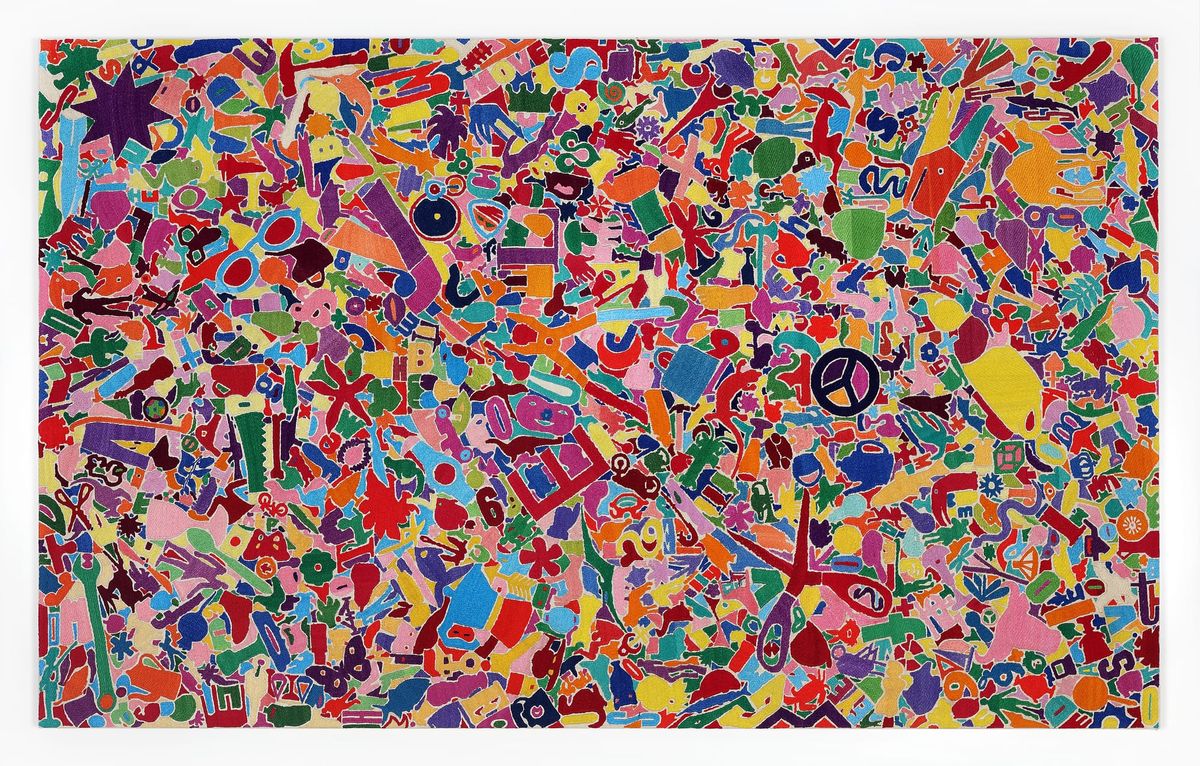
The exhibition Tutto Boetti 1966–1993 at Magazzino Italian Art presents a comprehensive exploration of Alighiero Boetti’s artistic evolution, spanning from his initial experiments in 1960s Turin to the grand works of his later years. Visitors can view around 30 pieces, starting with a core set from the museum’s permanent collection, enriched by loans from the Boetti estate and a notable private collection.
On April 25, a symposium will accompany the exhibition, bringing together esteemed curators, critics, and artists to discuss Boetti’s profound impact on contemporary art. This event is organized in partnership with the Fondazione Alighiero e Boetti in Rome, further highlighting his significance in art history.
The exhibition opens with works from Boetti’s first solo show at the Christian Stein Gallery in Turin in 1967, showcasing his innovative use of industrial materials. Visitors are welcomed by the original invitation card Boetti crafted for his debut, featuring samples like cork and electric wire, reflecting the industrial boom in postwar northern Italy.
Following this early period, the exhibition delves into Boetti’s Roman years, where his focus on duality and authorship became prominent. Notable works from this era include “Da mille a mille” (1975), which allowed assistants creative freedom, and “Mappa” (1983), inspired by his travels to Afghanistan.
Co-founders Nancy Olnick and Giorgio Spanu emphasize the exhibition’s significance, noting their collaboration with Gianfranco Benedetti and the Fondazione Alighiero e Boetti. The comprehensive catalogue, edited by Professor Francesco Guzzetti, serves as both a scholarly resource and a study tool. Tutto Boetti 1966–1993 will be on display at Magazzino Italian Art from April 26, 2026, to April 26, 2028. Register for the symposium on April 25. For additional details, visit magazzino.art.