Editor’s Note: This article was created with support from the Round Earth Media Program of the International Women Media Foundation.
In February, Rawya El Chab arrived for an interview in Brooklyn after teaching her children’s performance class in Sunset Park. Many of the children’s parents are immigrants, and recently, some students have been unusually quiet. When asked, they expressed fears of ICE detaining their family members. This reminded El Chab of her life in 1980s Beirut during Syrian and later Israeli occupations. “We could feel the presence of a force that was censoring our speech,” she recalled.
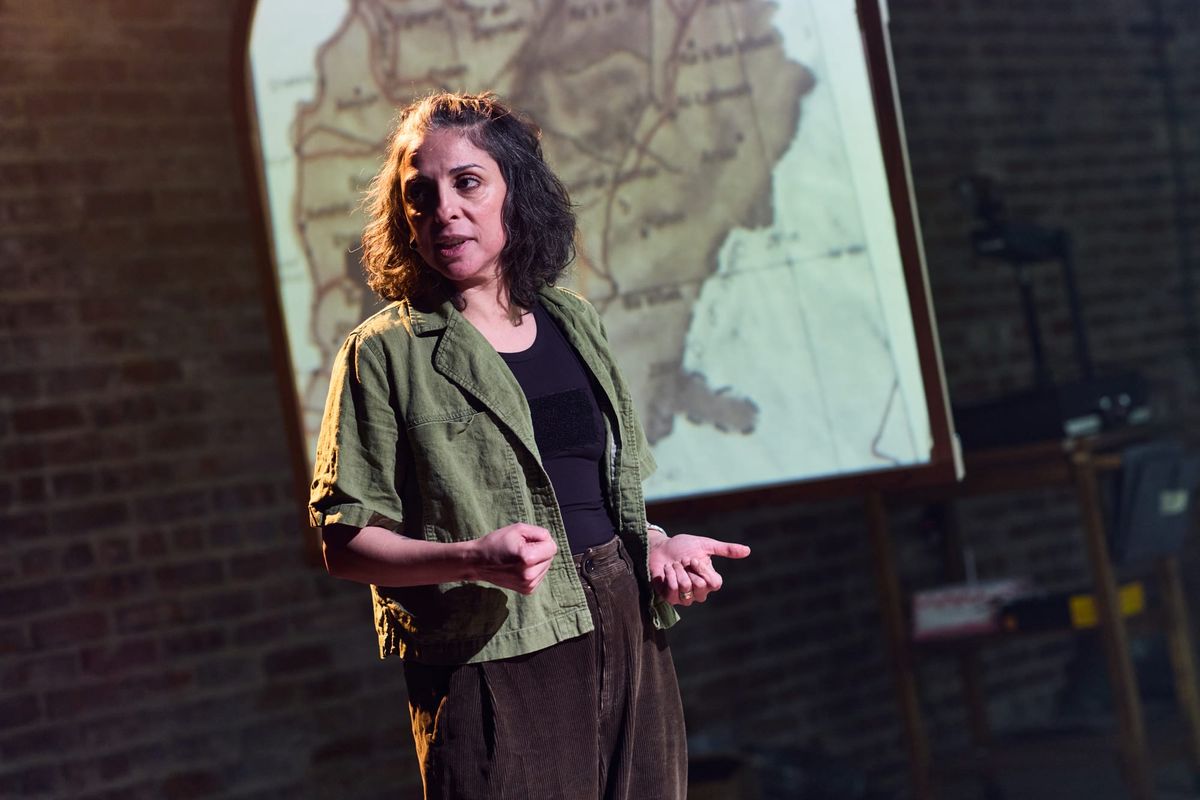
At 45, El Chab has integrated this sense of being watched into her work for two decades. Her career has taken her from interactive theater in Palestinian refugee camps and Lebanese villages to exploring themes of clowning and mortality with the elderly in nursing homes. Her performance, Crossing the Water (2025), staged last winter at The Brick in Brooklyn, begins with her navigating the River Styx, reassuring the audience, “Don’t worry, it’s not the first time I die.”
Mythology and storytelling are pivotal in El Chab’s art. “Storytellers like to travel, and like to carry their stories, and like to hear other people’s stories,” she explained. Her current performance is part of a series examining the rise and fall of the Lebanese Left during the Civil War, the formation of Palestinian resistance, and the Israeli invasion. With war ongoing in southern Lebanon, El Chab feels compelled to challenge the distorted narratives about her homeland.
Her work is deeply personal; when Israel invaded Lebanon in 1982, her father fled to Abidjan in the Ivory Coast, fearing repercussions from the new regime, with El Chab and her mother joining him a year later. The series’ inception was inspired by a conversation about her cousin, Loula Abboud, a Communist fighter mythologized as “the Pearl of the Bekaa.” El Chab first addressed Abboud’s legacy in a 2024 performance blending science fiction and dystopian themes, marking the trilogy’s beginning.
Crossing the Water narrates the Israeli invasion of Beirut and El Chab’s subsequent escape with her mother. Her memories, largely shaped by later accounts, are portrayed by embodying Beirut’s residents and caricaturing politicians. Through her performances, she aims to humanize the emigration experience and resonate with audiences familiar with similar histories. Initially intended for New Yorkers, her work found broader appeal, especially among Lebanese, Palestinian, and Syrian viewers seeking authentic representations of their stories.