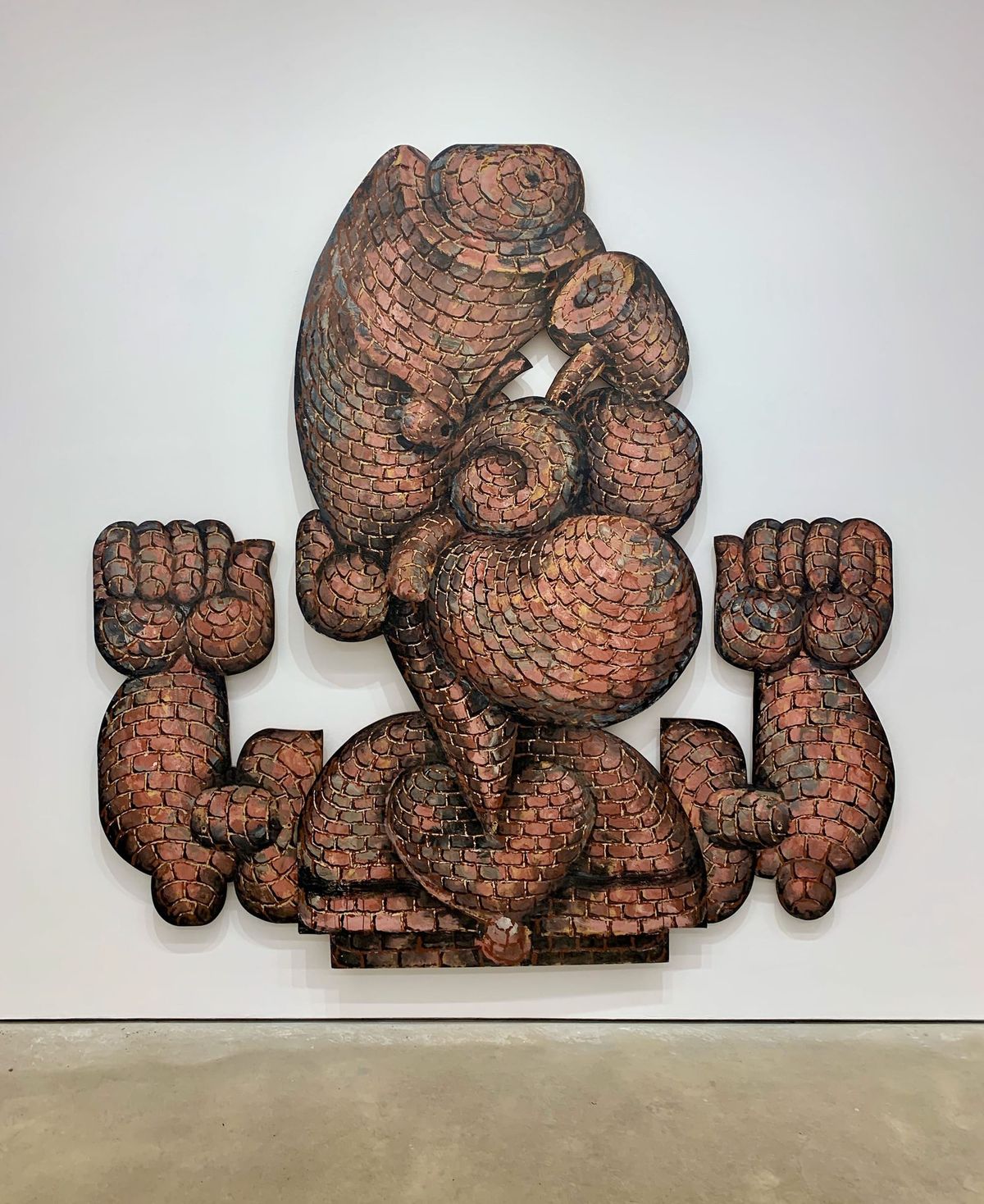
In a unique exhibition at PPOW, late artist Martin Wong presents a series of six painted plywood panels featuring Popeye, the famed cartoon character. These panels, cut like jigsaw pieces, move gently to the rhythm of small motors. Wong creatively transforms Popeye into both architectural and humanoid forms, painting him as curving, weathered brickwork.
Wong’s reinterpretation of Popeye introduces a sociable element that softens his exaggerated features. Under Wong’s artistic touch, Popeye’s prominent hands, nose, elbows, and large earlobes take on a distinctly priapic quality. The exhibition explores a queer narrative, hinting at the underlying homoerotic tension between Popeye and his rival Bluto, disrupting the conventional storyline with Olive Oyl.
This exhibition is a testament to transformation, turning playful ‘flesh’ into sturdier forms and pop culture into a personalized re-envisioning. Wong’s work, both queer and eclectic, reimagines cultural artifacts with enduring creativity. More than two decades after his passing, Wong’s artistic flair continues to ‘pop.’
The exhibition also includes smaller paintings showcasing Wong’s engagement with pop culture. Among his works is the hexagonal ‘Sacred Shroud of Pepe Turcel’ (1989–90), featuring a muscular back. Wong’s larger pieces, such as ‘The Most Beautiful Painting in the World’ (1989), further highlight his ability to bridge cultural divides. This piece features Mutt and Jeff, depicted in brick, enjoying a game of cards.
Wong’s architectural flair is evident in ‘Untitled (Little Lulu and Tubby)’ (circa 1989), where characters appear as castle turrets. The recurring motif of bunnies and skulls in his work reflects Buddhist themes of mortality, adding life to his art. Wong’s fascination with brick stems from his experiences in the gritty 1970s Manhattan, using it to elevate comic characters into monumental figures.
The exhibition ‘Martin Wong: Popeye’ is on display at PPOW (392 Broadway, Tribeca, Manhattan) until May 30. The gallery organized the showcase.