In 1992, Julia Fish and her husband, sculptor Richard Rezac, relocated to a two-story brick storefront on Hermitage Street in Chicago. That move marked the beginning of Fish’s exploration of her home, designed by Theodore Steuben in 1922, starting with the hexagonal tiles in the foyer that connect the interior to the street. Fish has since refined her visual practice into a complex exploration of geometry and architecture, wood grains, and even Johann Sebastian Bach’s fugal music, blending prismatic light with musical notes.
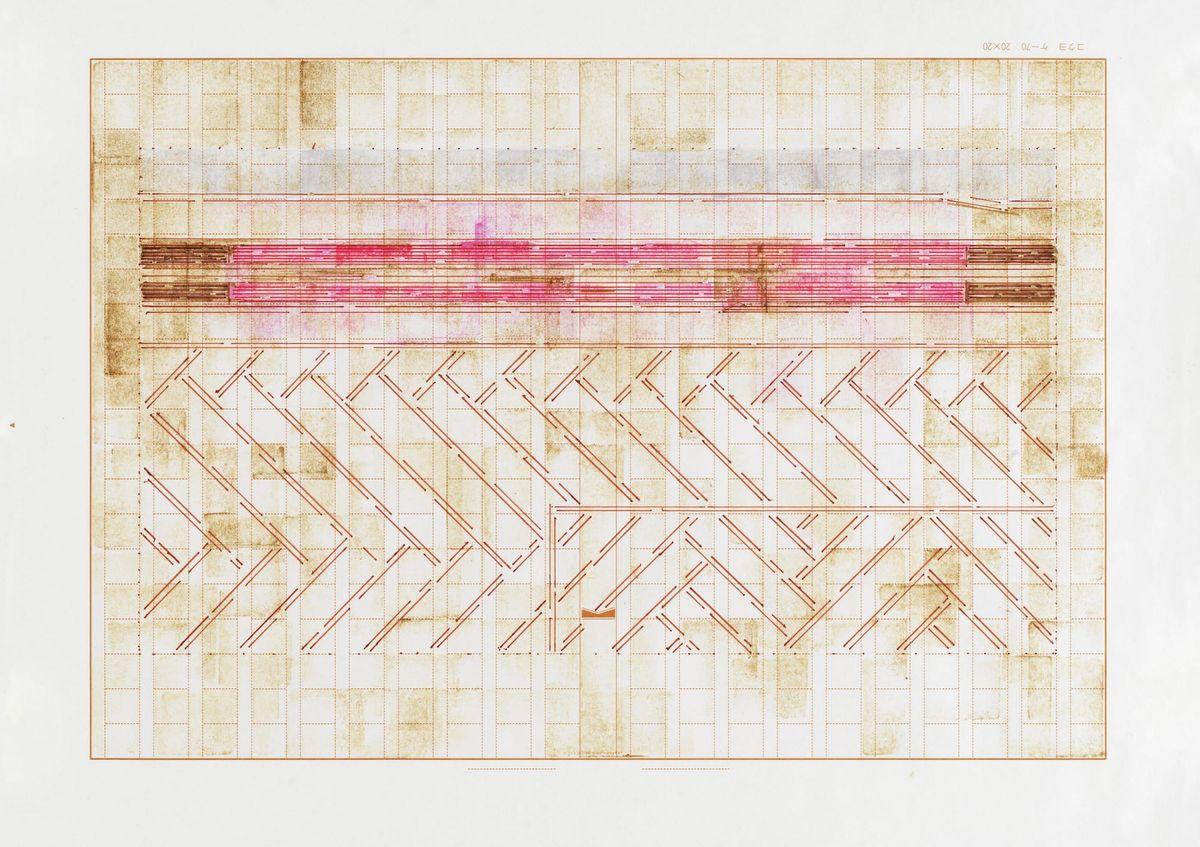
My ongoing engagement with Fish’s work has taught me that understanding her intent is not always necessary. Her art, much like the paintings of Alfred Jensen or the poetry of Louis Zukofsky, offers a profound pleasure in aligning one’s introspective thought with the experience of viewing or reading. This unique enjoyment drew me to her current exhibition, Transcriptions, Apparitions, at David Nolan Gallery, where 25 pieces, including paintings, hand-stamped drawings, and other mixed media, are displayed.
A standout piece from the exhibition is “[ score for ] Trio in red yellow blue, with variations for fifty-nine steps/seven flights/three stairways at 5020 South Cornell Avenue” (2006), created in response to Chicago’s Hyde Park Art Center’s new location. This work, a colored pencil and graphite drawing on graph paper, reflects on history, memory, and time, composed of horizontal rectangles in primary colors that symbolize the 59 steps. While the rationale behind the color choices remains elusive, the pleasure lies in its visual and intellectual engagement.
Fish’s delicate transcriptions capture the fleeting nature of light, place, and historical context, without dwelling on nostalgia. Her work “Study for Threshold – Plan : [ las meninas ] [ spectrum : east to west over grey ]” (2018) on gray paper connects architectural elements with Velasquez’s “Las Meninas,” inviting reflection on art and mortality. Fish’s pieces transcend literal connections, encouraging contemplation of broader themes and the subtlety of visual and tactile experiences.
While Fish makes no grand declarations about her art, there are moments in the exhibition that suggest a mystical pursuit. Her commitment to finding magic in the mundane is unparalleled, akin to Bach’s belief in art as a medium for divine presence. Fish’s focus on fleeting moments of light reveals a world unseen by many, capturing auras and apparitions. Julia Fish: Transcriptions, Apparitions is on view at David Nolan Gallery (24 East 81st Street, Upper East Side, Manhattan) through February 14, organized by the gallery.