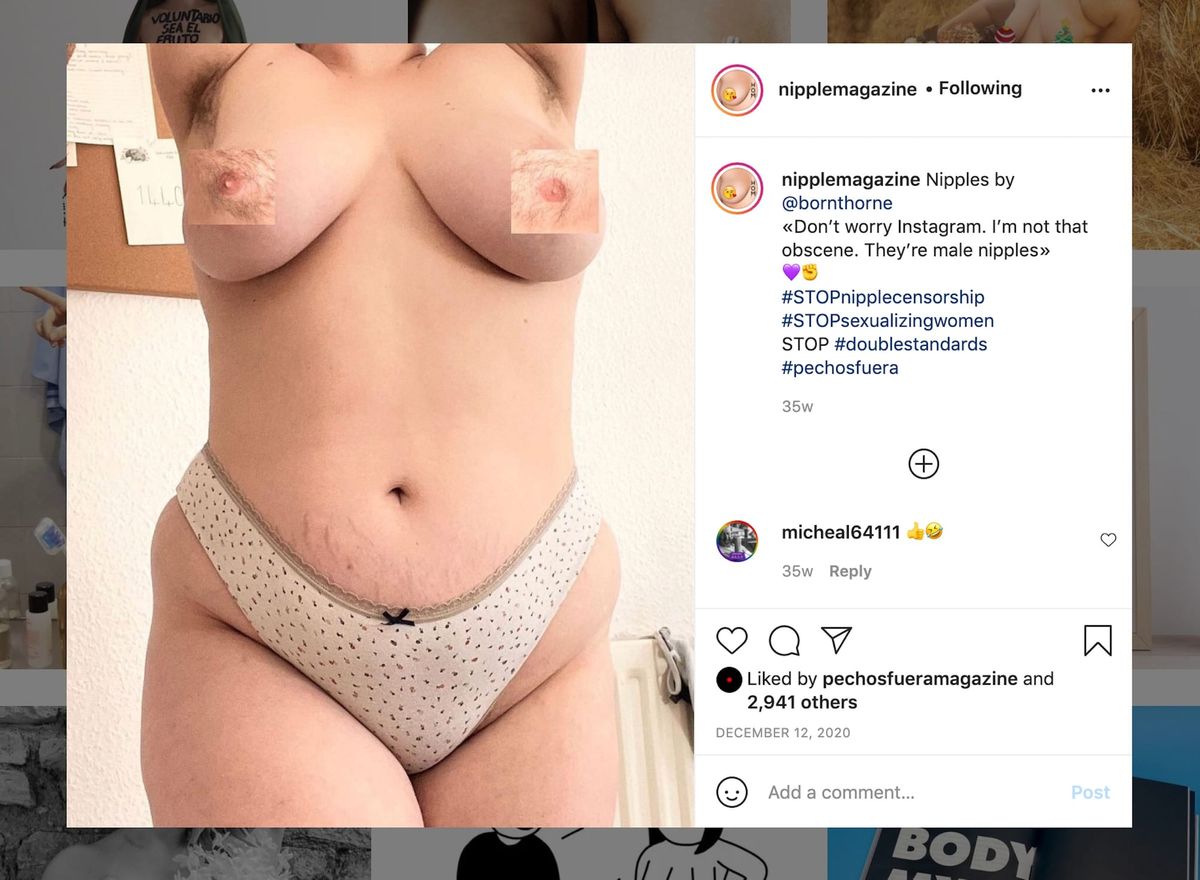
The female nipple: why does this small part of the body create so much trouble online? Why are so many people forced to use pixels, emojis and other tricks to cover something that exists on all bodies? Chances are you have seen, or experienced, the censorship of female nipples on social media, and while it may have felt embarrassing, unfair or merely frustrating at the time, the larger question remains: what are the consequences of censoring the female-presenting body in this way?
Facebook and Instagram have a combined worldwide usership of more than three billion people, and they share just one set of rules. Their “Adult Nudity and Sexual Activity” section equates nudity with sexual activity, leaving little room for interpretation. Much of that policy is devoted to explaining when a female nipple is and is not permitted, effectively treating an exposed female nipple as sexually explicit by default, with only a few vague exceptions such as breastfeeding and “acts of protest.” By placing “uncovered female nipples” alongside “visible genitalia” and “fully nude close-ups of buttocks,” the guidelines make female-presenting bodies twice as likely as male-presenting bodies to be marked obscene simply for showing nipples.
That kind of censorship means content for and about women and female-presenting people is more likely to be suppressed, undermining years of user labor aimed at fulfilling Facebook’s own mission to “ensure that everyone’s voice is valued … in particular those of people and communities that might otherwise be overlooked or marginalized.” So what makes the female nipple controversial? Biologically, the only difference between the male and female breast is the presence of lobes, the glands that produce milk. The rest of the breast — fatty tissue, ducts, areola and nipple — exists in both men and women, and sexual nipple stimulation is common and popular across sexes. The conclusion is hard to avoid: the unequal treatment of women and men over this body part has nothing to do with biology and everything to do with judgment of the female-presenting body.
In 2018, Facebook published an article explaining how it supports content moderators. Ellen Silver, a vice president of operations, described how the company considers context and cultural sensitivities when it comes to language or references. But she also made clear that this level of nuance is not applied to nudity, because the company’s blanket “no nudity” rule is enforced without context. Silver wrote that “It often takes a local to understand the specific meaning of a word or the political climate in which a post is shared …” Yet, she added, “Nudity is typically very easy to establish and can be reviewed within seconds.”
In effect, Facebook admits it gives no thought to an image’s intent or context if nudity is present — and, under its rules, female-presenting bodies are twice as likely to be flagged in the first place. The company has shown that it can make nuanced decisions about language and cultural sensitivity, so it is surely capable of bringing that same nuance to bodies shown in art and activist contexts. In fact, it already has done so in the past.
Years ago, Facebook came under growing pressure to revise its rules to allow breastfeeding images, beginning with the “Nurse-In” protest in 2008. After public outcry, the company repeatedly adjusted its guidelines on breastfeeding imagery, eventually allowing all breastfeeding images in 2014. Representation matters: seeing more women breastfeeding in public helped reduce stigma. If Facebook and Instagram treated all bodies with equal respect, other parts of society might begin to reflect that same respect.
Until that happens, the consequences remain real. This deliberate misunderstanding of the female body affects the health, expression and livelihoods of women and female-presenting people in serious ways. It hinders breast cancer education, fuels harassment, and keeps artists, performers and advocates from being seen, limiting their chances for success. In the process, the censorship reinforces the idea that female bodies are dangerous, obscene and sexual objects that ultimately belong to the viewer.
As long as Facebook and Instagram maintain the view that female nipples are offensive while male nipples are not, they are deciding whose bodies are acceptable in public view and whose are not. Because these platforms matter so much to artists, activists and creators around the world, bodies censored there are pushed out of our zeitgeist, unable to connect, succeed and perform in the ways society demands. If Facebook truly intends to “ensure that everyone’s voice is valued”, it is clearly not valuing the voices of women and female-presenting users calling for change.