The World Press Photo Contest 2015 announced its winners on February 12, drawing from 97,912 images submitted by 5,692 photographers from 131 countries. The volume of entries underscores the contest’s status as a broad reflection of international photojournalism. Submissions were divided into eight categories: general news, spot news, contemporary issues, daily life, portraits, nature, sports, and long-term projects.
Each category offers three prizes and follows specific rules governing both the date range of eligible images and the number of photos each photographer may submit, though most entries must be from 2014. Along with cash awards, the winning photographers will be recognized at an April 24–25 ceremony in Amsterdam, while the selected images will travel to roughly 100 cities worldwide. This year’s exhibition opens in Amsterdam on April 18 at the De Nieuwe Kirk.
Digital manipulation remains a major issue for the judges. As the PhotoShelter blog observed, 20 percent of the submitted photos were disqualified this year for what the jury considered excessive manipulation. Because the contest is rooted in journalistic standards, alterations that go too far can make an image seem non-representative or even untrue. Still, as PhotoShelter author Allen Murabayashi noted, the line separating acceptable editing from “excessive” manipulation remains unclear in an era of easy digital enhancement.
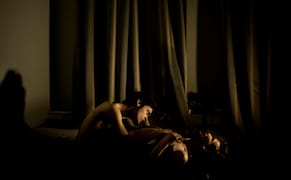
Among the strongest work this year was found in the contemporary issues category. The World Press Photo of the Year went to Danish photographer Mads Nissen for an image of two nude men in an intimate moment. The caption, “Jon and Alex, a gay couple during an intimate moment, St. Petersburg, Russia,” points to political oppression through the picture’s dark, partially obscured presentation of the figures. The photograph captures the repression of homosexuality by showing intimacy alongside concealment.
Also in contemporary issues, the third-place winner in the stories/portfolio subcategory, Blue Sky Days by Belgian photographer Tomas van Houtryve, uses visual distancing to address a political subject. Van Houtryve mounted his camera on a drone, and the resulting images often reduce people to the shadows they cast. The series is quietly but clearly political, reminding viewers that drone operators frequently encounter their targets as silhouettes rather than as flesh-and-blood individuals.
It is easy, though only partly accurate, to imagine press photography as being defined entirely by conflict and politics. The World Press Photo Contest serves as a reminder that documentary photography is meant to record the era, not just its crises. War coverage is vital, but images of nature, sports, and daily life also preserve the present and help shape the historical record for the future.