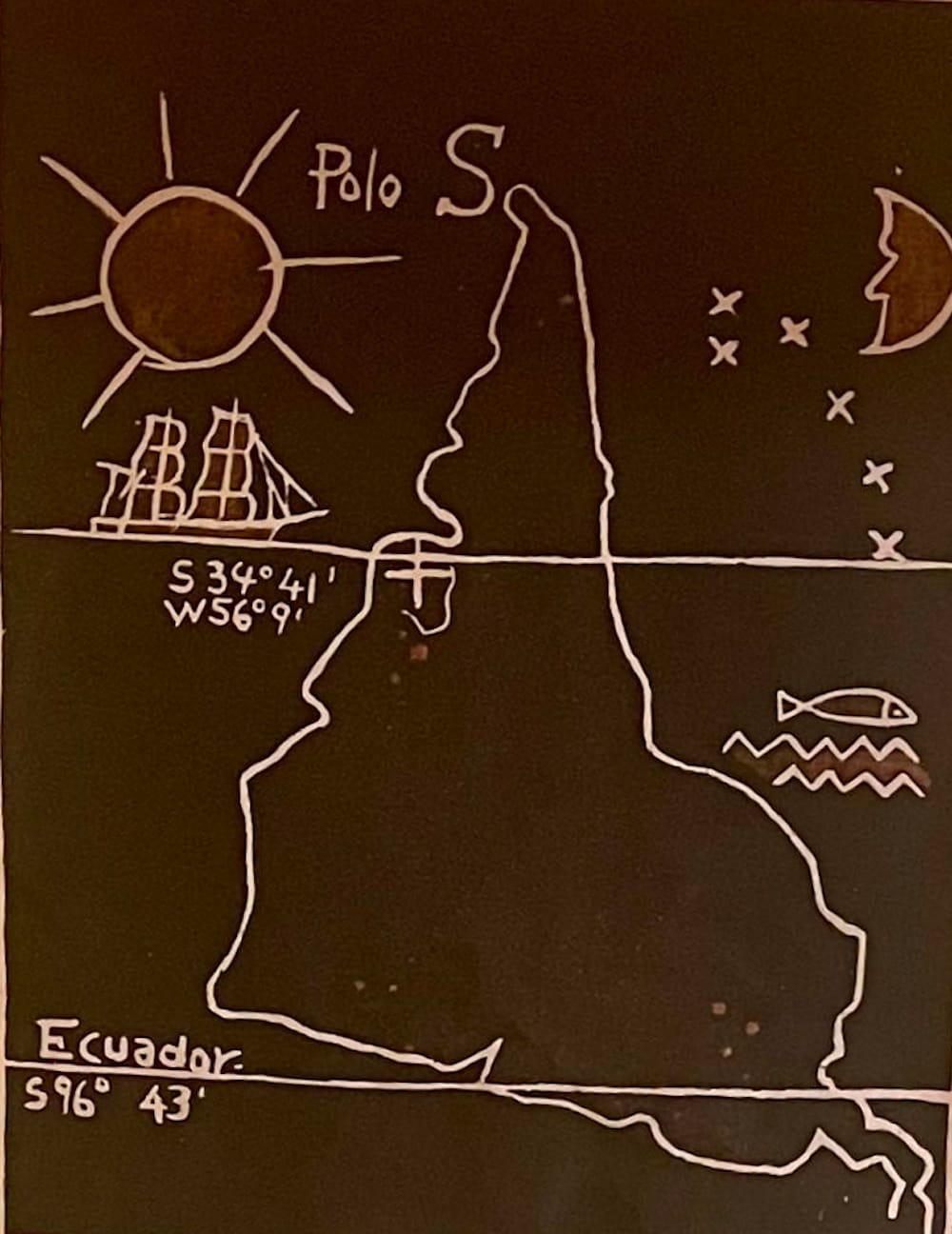
The drawing on the cover of my novel Short War — “América invertida,” or “Inverted Map,” a 1943 work by the Uruguayan painter and sculptor Joaquín Torres García — hangs on a wall in my house. In Uruguay, it also appears on magnets, shirts, hats and notebooks everywhere. I received my copy there 11 years ago as a going-away gift from a friend I met during a semester at Montevideo’s Universidad de la República.
It brings back why I went to Uruguay in the first place: to be taught 20th-century Latin American history, which, from a Latin American point of view, is often inseparable from the history of the United States. I wanted to turn my mental map upside down. “América invertida” was always intended as a statement of purpose.
Born in Uruguay in 1874, Torres García moved to Barcelona at 17, where he designed stained-glass windows for the architect Antonio Gaudí. Over the next four decades, he lived in Spain, France and the United States, and worked alongside an impressive range of artists and cultural figures. He influenced Joan Miró, co-founded the abstractionist group Cercle et Carré with Wassily Kandinsky and Fernand Léger, and became friends with Gertrude Vanderbilt Whitney, who later founded the Whitney Museum.
During those years, Torres García developed and explained a singular style that blended geometric abstraction with figurative impulses. In a review of his 2015 retrospective at the Museum of Modern Art, critic Holland Cotter wrote that his paintings “look like a cross between stained-glass windows and toy chests filled with concrete but symbolic things.” Some of the artist’s favored symbols appear in “América invertida,” including a kindly sun and moon, and a ship sailing, sails full, toward Montevideo, where he returned in 1934.
After his return, he founded the Escuela del Sur, or School of the South, and “América invertida” became its logo. He wanted his students to build an artistic tradition that came from Uruguay and its neighbors, rather than looking north to the United States or across the Atlantic to Europe for inspiration. “Our North,” he declared, “is the South.”
It is harder for me to say where my North is. I am an American citizen and the descendant of Jewish immigrants who chose the United States and were grateful to it. In a 1944 letter from an army camp while preparing to fight in World War II, my great-uncle Leon reminded my then-13-year-old grandfather, “Don’t forget that because of America you are able to hold up your head and say, ‘I am a Jew.’” I take that history seriously.
I also take seriously the United States’ history of blocking other countries’ self-determination. In the 1960s, the US sent its — our — agents to train Uruguay’s police to torture political prisoners. In the following decade, we helped bring about a coup in Chile, and then backed the dictatorship that followed through a covert and illegal program called Operation Condor, which enabled far-right governments in Argentina, Bolivia, Brazil, Paraguay and Uruguay to coordinate brutal repression.
I do not see how I can call myself an American without acknowledging that this is my history, and I do not see how I could understand that history without studying it from the perspective of those who suffered because of my country’s actions. Short War is about an American family divided by the effects of US intervention in Chile. It is a novel about US history told from an American perspective, but before I could write it, I had to spend years teaching myself not only Chile’s history, but the histories of all the countries affected by Operation Condor.
I already had a version of Short War in mind when I went to Uruguay in 2012, and I chose the Universidad de la República partly for its interdisciplinary program focused on the recent past. I wanted very badly to understand my country, and to do that I had to look at it from beyond its borders. “América invertida” accompanied me through that process. I wrote it into my novel and dreamed of placing it on the cover, a dream that designer Emily Mahon made real. I hope — it is nonsensical, I realize, but it is how I feel — that my book makes the drawing proud.