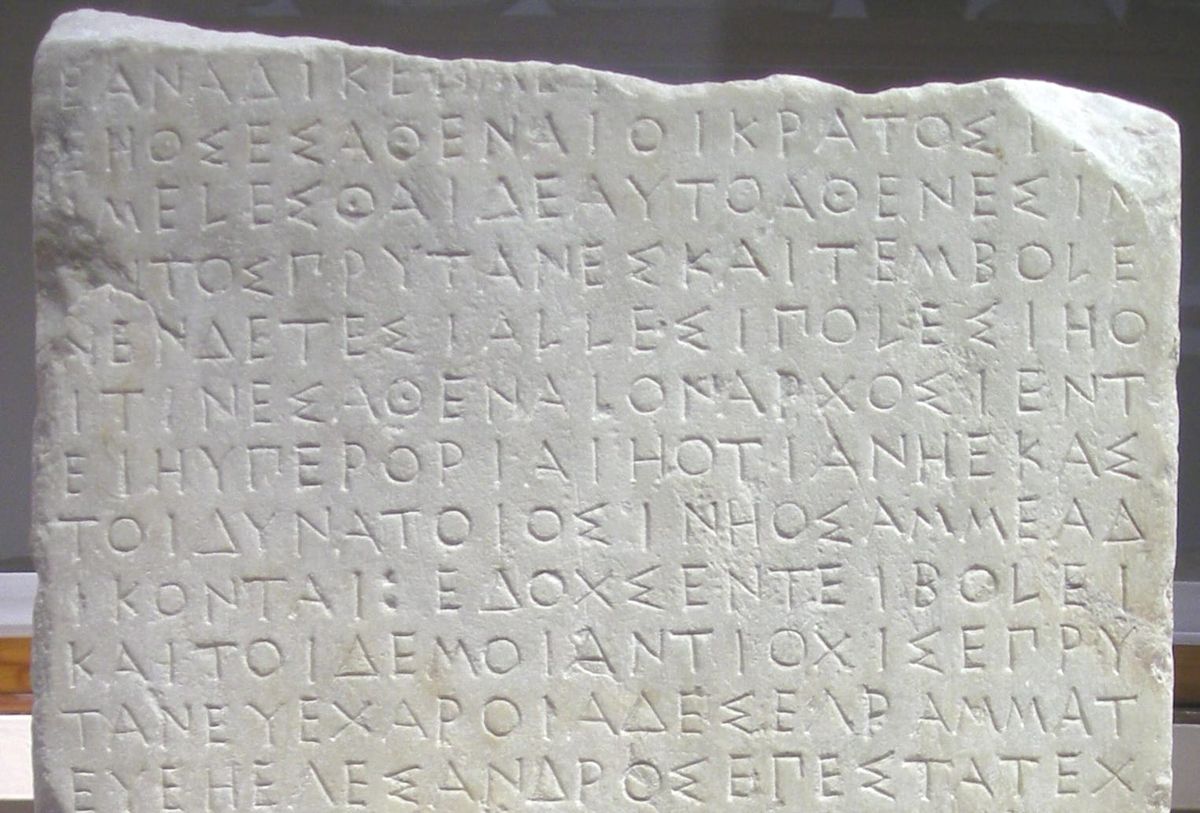
A new deep neural network may give historians a powerful way to restore ancient inscriptions, determine where they came from, and date them with striking accuracy. Called Ithaca and created by DeepMind, a British artificial intelligence (AI) research lab, alongside researchers at Ca’ Foscari University of Venice, Oxford University, and Athens University, the project shows how machine learning can work alongside historians to strengthen their research.
In a paper published earlier this month in the journal Nature, the team reported that Ithaca can reconstruct damaged texts with 62% accuracy, identify their place of origin with 71% accuracy, and date them within 30 years of their estimated ranges. When paired with a historian’s expertise, however, the accuracy of the combined approach rose substantially.
“Ancient history relies on disciplines such as epigraphy — the study of inscribed texts known as inscriptions — for evidence of the thought, language, society and history of past civilizations,” the paper’s authors wrote. “However, over the centuries, many inscriptions have been damaged to the point of illegibility, transported far from their original location and their date of writing is steeped in uncertainty.”
According to a press release, the algorithm was trained on “the largest digital dataset of Greek inscriptions” from the Packard Humanities Institute. That extensive archive helps Ithaca draw on decades of prior scholarship while reducing the effects of individual bias and earlier mistakes. The tool is designed to assist epigraphers in reconstructing fragmentary texts that have survived across centuries and millennia.
Dating an inscription, known as chronological attribution, and identifying its place of origin, or geographic attribution, are also central to epigraphers’ work. Since conventional methods are often highly detailed and time-consuming, Ithaca could help streamline the process. One major application is narrowing down texts that currently can only be assigned broad date ranges.
To demonstrate its value in scholarly debates, the researchers applied the neural network to a group of Ancient Greek decrees important to the history of classical Athenian politics. Historians disagree over whether those inscriptions were produced before or after 446/445 BCE. The team said its estimates matched “the most recent dating breakthroughs” and were more precise than competing methods.
A free interactive version of Ithaca has been released in partnership with Google Cloud and Google Arts & Culture, allowing users to enter Ancient Greek text with missing characters and ask the tool to date, locate, and restore it. The researchers also open sourced the code to encourage further study. “We believe machine learning could support historians to expand and deepen our understanding of ancient history, just as microscopes and telescopes have extended the realm of science,” Yannis Assael, staff research scientist at DeepMind, said in a statement. “Ancient Greece plays an instrumental role in our understanding of the Mediterranean world, but it’s still only one part of a vast global picture of civilisations that could be explored.”