The term “MacGuffin” will be familiar to anyone who has studied classic Hollywood. Hitchcock described it as “the thing the spies are after” — an object of mysterious origin and immense value that stays forever out of reach. Its actual purpose matters less than the chase it inspires, sending agents after it like dogs after cars in stories of domestic or international intrigue.
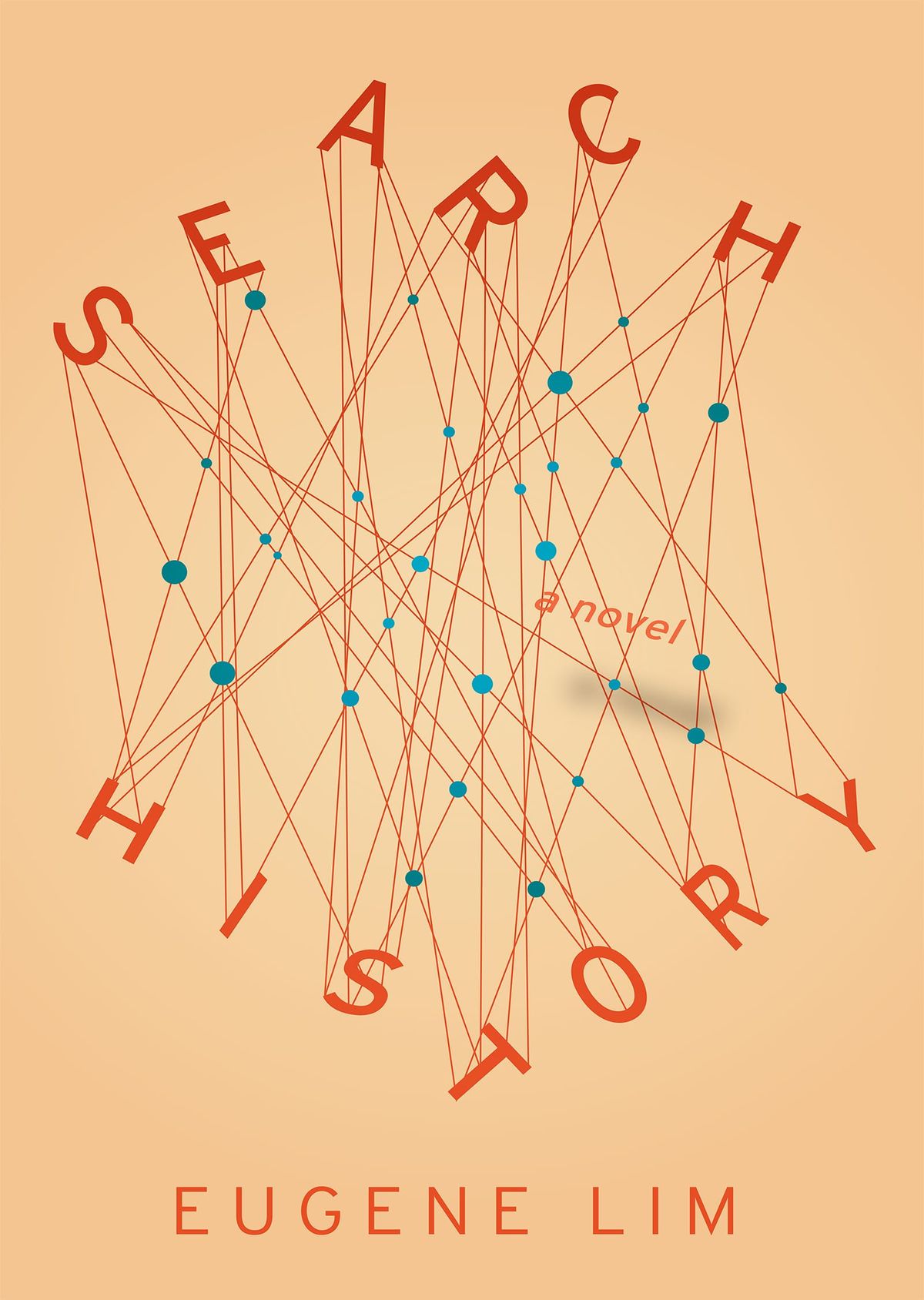
In Eugene Lim’s new novel, Search History, the chase runs in reverse: cars pursue dogs. More precisely, they pursue one dog — a cyborg engineered by a “dysthymic AI scientist” to “appear to the grieving as the embodiment of the deceased.” To one mourning man, it seems utterly convincing, sending him on a search that stretches across continents and into outer space. The presence of this MacGuffin signals that Lim is working in pulp genre territory, even as the novel’s use of words like “dysthymic” and “AI” suggests it is operating in several modes at once.
Chaotic in tone and arranged like a Möbius strip, Search History is Lim’s fourth book and his most ambitious effort yet to fuse digressive, intellectually dense ideas with the momentum of genre fiction. The risk is obvious: the story can feel like it is flying too close to the sun, with the wax holding it together still warm. That is especially clear in the novel’s two prologues, which read less like entrances for readers than as a kind of authorial warm-up. The narrative there is still molten, shifting from a dysthymic AI scientist to “a robot named César Aira,” then to two young women soldering cell phones in Dongguan, China, and then again to a plastic bag and the nubbin from a little-used toddler teething ring drifting in the Atlantic Ocean.
From there, those fragments keep talking, reflecting on “yellowface” and autotune while the book’s plot continues to slip in and out of focus. As journalist Charles Glass said of Salman Rushdie’s novels, trying to summarize the storyline feels “a futile exercise in a brief review […]. It’s like a Marx Brothers movie, easier to enjoy than to analyze.” In the main thread, an unnamed man — like Lim, a Korean-American living in Queens — pursues the cyborg dog, which may be the reincarnation of his dead friend Frank Exit or may simply have been made to seem that way through deep learning. That overlap between Buddhism and cybernetic mimicry is typical of Lim, who appears to treat both as routes around the same final void: death.
Elsewhere, chapters titled “Inauthentic Sushi” and “The Basement Food Court of Forking Paths” bring together a small group of friends, some of whom knew Frank, as they eat and argue about art, artificial intelligence, and the politics of representation and Asian identity in contemporary culture. Their conversations are “recorded” as if they were samples of reality, providing raw material for another AI scientist attempting to program an algorithm that can generate prize-winning literary fiction. “She’s aiming for a Pulitzer or an NBA shortlist but is willing to accept a PEN/Faulkner.” Yet even these exchanges never feel entirely natural, and that artificiality is part of the joke: Search History appears, on the surface, to be a book assembled from incompatible narrative forms shoved against one another. It is, fittingly, the sort of novel an AI might write.
Its interruptions, flashbacks, and extended speeches would derail the plot if they were not so clearly the point. Lim’s love of blockbuster spectacle is evident, but his fiction more closely recalls French New Wave films such as Breathless, where violence is blunt, efficient, and often offscreen. What remains are pauses, relationships, gestures, and the free-floating performativity of the characters, with the narrative repeatedly opening into essayistic reflections on politics and personal memory. The book even states this directly when Muriel observes that “That sense of discontinuity—a term cinema uses for an error in sequencing that results in the absurd—that comes from death arises from the non-coterminous nature of life’s various impermanences.”
The novel’s most gratifying surprise is that, beneath all its artifice, it is fundamentally about grief, and it treats that pain with unusual clarity. Genre machinery is everywhere, but it never prevents the characters from working through loss. In just 187 pages, Lim makes space for action, thought, and feeling alike, including two “Autobiographical Interludes” that serve as elegies for his mother and for an anonymous deceased friend who clearly models the mysterious Frank Exit. People slip away from us in death; by chasing them and preserving their memories, we keep them and ourselves moving within mortality’s long delay.
Lim’s real strength is his ability to stage that struggle as a dramatic pursuit while never losing sight of what lies beyond it. The far side of the moon, where the scientist and her dog ultimately head, is “terraformed […with] a small fortress […] away from the pestering calls of heads of state and immediate family.” It can look like a Bond villain’s hideout, but it also stands in for heaven, or simply a place beyond reach of the ones left behind. In Lim’s hands, the MacGuffin sheds its emptiness and becomes metaphysically charged. “Because after long enough you forget what you wanted, what you were going for, so that the search becomes where you live, its history your universe. Even if you bet your entire life on this MacGuffin. Especially if you did. […] History’s habit, landmarks, and tone are what make you. So, dog, I’ll throw the stick and you chase it. Yes Master. Okay dog.” Search History by Eugene Lim is published by Coffee House Press and available in stores and online.