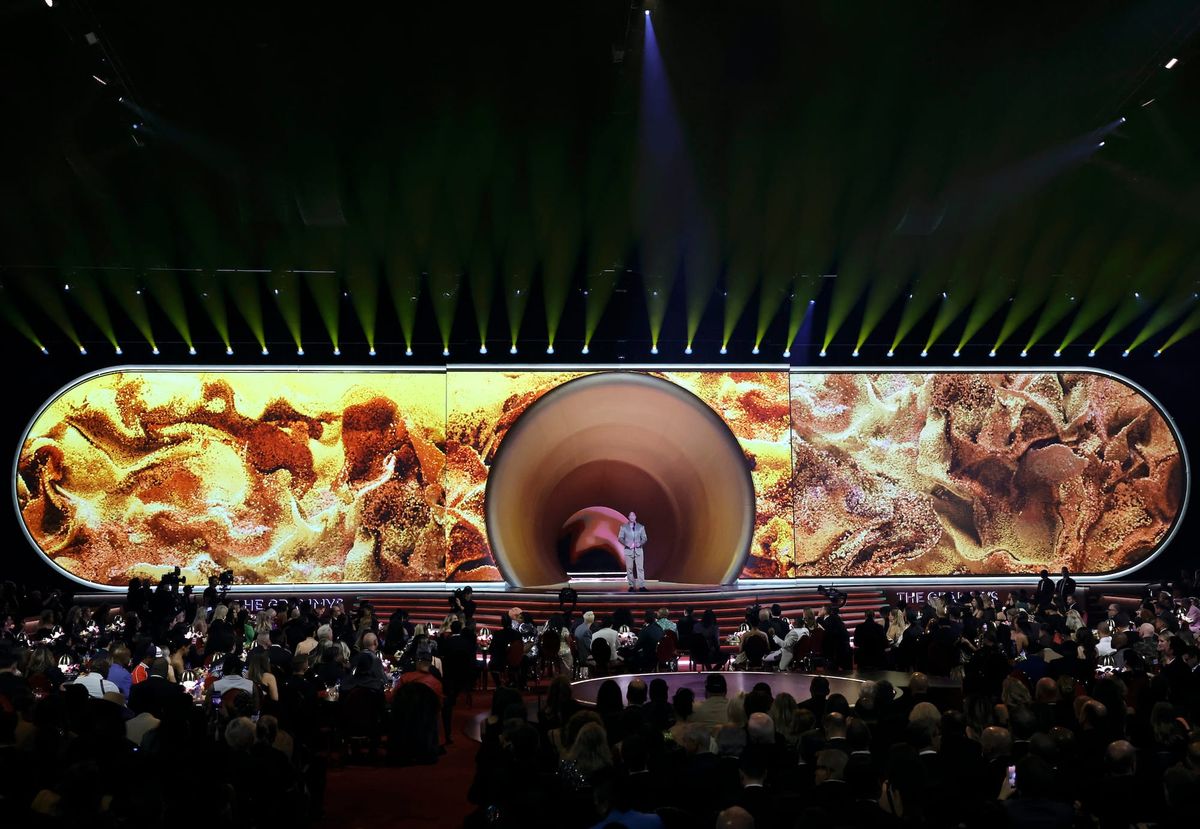
The 65th Annual Grammy Awards, held last night, February 5, unfolded as a largely routine ceremony, though it still managed to stir discussion around two predictable subjects: Beyoncé setting the record for the most career wins while once again missing out on a major prize, and Ben Affleck seeming to have a miserable time. Yet amid the otherwise quiet broadcast, attentive digital art followers may have spotted something new: an artificial intelligence artwork, generated in real time, playing on the screens behind the stage.
The hypnotic, constantly shifting abstract visuals were created by Turkish-American artist Refik Anadol, and a representative for his studio said the display was the first use of AI art in a Grammy broadcast. Anadol has also minted his AI works as NFTs and sold them at Sotheby’s. In a fitting coincidence, the Grammy debut of AI and NFT art took place at the Crypto.com Arena, the Los Angeles venue that was renamed from the former Staples Center in 2021.
“The collaboration started almost six months ago with an exciting call from the designers who are in charge of the stage design and the whole flow of the ceremony,” Anadol said in a statement shared with Hyperallergic. “Because this year they were going for an immersive stage design, they chose to license our artworks and turn them into a media experience on the giant screens on the stage.”
Among the works selected for the broadcast was “Galaxy (Infinite AI Data Painting)” (2021), a swirling generative piece trained on photographs from the Hubble Space Telescope. The work produces itself in real time and never repeats, creating what Anadol describes as “machine dreams” of the galaxies captured by the telescope. “This, to me, is very poetic because it’s technically photos of our past, and the memories of the universe,” the artist said.
The piece belongs to Anadol’s long-running Machine Hallucinations: Space Metaverse series, in which a machine learning algorithm was trained on deep space NASA photographs taken by satellites and spacecrafts. The resulting images are detailed and lifelike, though many of his digital works echo planetary surfaces and vivid galaxies while others look more organic, with pulsing and shifting forms on LED screens. “Unsupervised,” part of Machine Hallucinations, is currently on view at New York’s Museum of Modern Art.
Last night’s ceremony also included work from Machine Hallucinations: Nature Dreams, another generative series built from more than 300 million photographs of trees, mushrooms, flowers, landscapes, and other natural subjects. As with Space Metaverse, the algorithm produces an endless sequence of finished images, and the results are equally diverse: some resemble flower petals, others suggest mold under a microscope, and some evoke the interiors of fruit.