PARIS — Echo Delay Reverb: American Art, Francophone Thought at Palais de Tokyo presents a captivating examination of the impact of French critical theory, notably figures from Francophone Africa and the Caribbean such as Frantz Fanon and Aimé Césaire, on American art. While the concept might seem like a niche interest for fans of critical theory, the exhibition avoids the pitfalls of being overly dense or text-heavy. Instead, it offers concise theoretical insights, well-contextualized by informative wall labels, alongside a collection of compelling artworks.
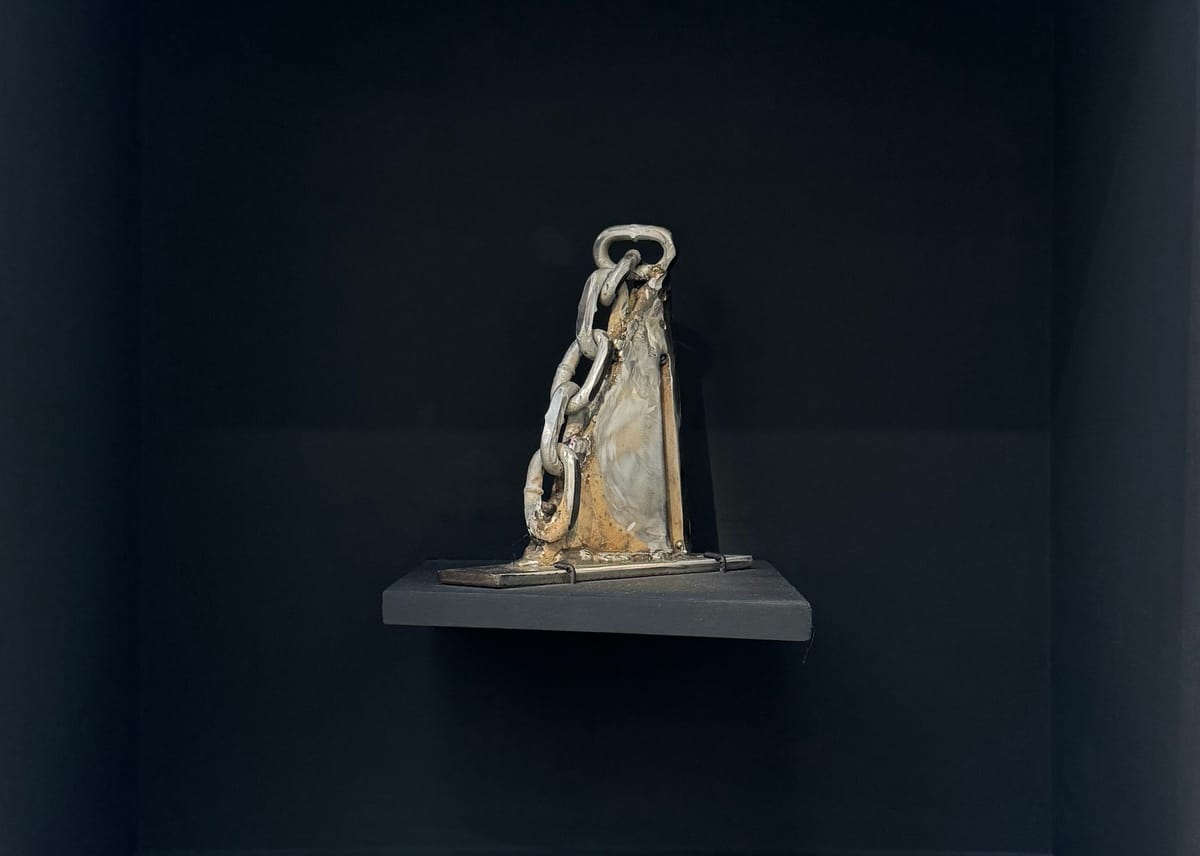
The exhibition nearly occupies the entire museum and commences with the influential work of abstract sculptor Melvin Edwards. His installation serves as an introduction to the main galleries, featuring pieces from his Lynch Fragments series and larger installations of barbed wire and industrial objects. The sculptures highlight the material realities of labor, incarceration, and death, presenting components that evoke strong associations even when isolated from their original contexts. Edwards’s art, intertwined with the ideas of poets and theorists like Léon Gontran Damas and Jayne Cortez, embodies much of the critical theory central to the exhibit.
Fred Wilson’s “Dear End” (2023) marks the start of the main show, featuring oversized glass droplets that defy photographic capture, emphasizing the artistic strategy of examining imperialism and the diasporic experience without being confined solely to those themes. While the exhibition includes renowned works and artists, its true discoveries lie with lesser-known talents whose art is given room to resonate across cultures and eras. Among these is a room with Theresa Hak Kyung Cha’s poststructuralist films, next to Cici Wu’s poignant homage, expanding on Cha’s exploration of race, gender, and age through light boxes and archival fragments.
Also noteworthy are photographs by Adler Guerrier, a Miami-based Haitian-American artist, presenting scenes from cityscapes to intimate plant portraits, accompanied by paint swatches symbolizing the diasporic connections between South Florida, Haiti, and the Caribbean. Echo Delay Reverb allows the relationship between artworks and theoretical scholarship to remain open-ended, yet underscores the significance of Caribbean thinkers in shaping French intellectual discourse. It importantly highlights the under-recognized contributions of these theorists compared to their more celebrated White, French peers.
The exhibition succeeds in making revolutionary diasporic thought accessible to a wider audience beyond academia. Whether or not viewers engage with this deeper layer, the show remains an enjoyable experience. This accessibility proves vital, as Echo Delay Reverb invites audiences into the abstract realm of critical theory with warmth and openness.