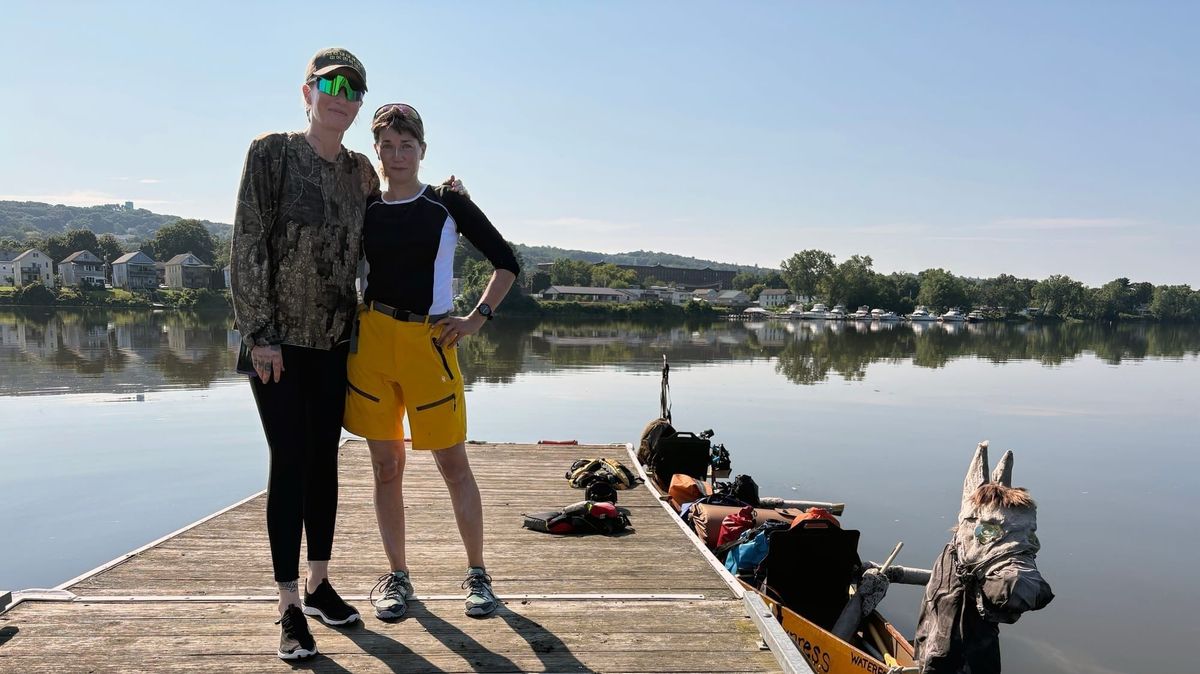
WATERFORD, NY — In early August, Waterford, Upstate New York, was filled with a striking scene: a group of cheerful elders sang loudly beneath faded American flags while enthusiastic supporters gathered around artist duo Z Behl and Kim Moloney — known together as “BALONEY STEEL” — as they prepared to begin their “Mule’s Passage,” a 350-mile (~563 km) paddle to Buffalo.
After a few brief remarks and an emotional spoken-word performance by playwright Judy Tate, founder of the American Slavery Project, Behl and Maloney stepped into their canoe at the end of the dock at the Eastern Gate corridor, the first of the locks that lifts vessels from the Hudson and Mohawk Rivers into the canal system. The singers moved to the bridge overhead and continued singing as the duo passed beneath them, launching their journey upstream in the intense summer heat.
Described as an artistic and anthropological inquiry into the Erie Canal, “Mule’s Passage” reimagines the woman’s body as both a force of industry and a witness to history. Their canoe, decorated to resemble a mule, pays tribute to the hidden labor that drove the early towpath canal that reshaped the United States and the world economy. The project calls for six hours of paddling each day and five weeks of camping, with the journey set to conclude this Friday, September 5, when the pair is scheduled to arrive in Buffalo after passing through every county along the waterway, which is also home to six territories of the Haudenosaunee Confederacy.
As the artists follow the old towpaths in a living study of labor and folklore, “Mule’s Passage” also draws attention to the Erie Canal as a tool of Indigenous displacement. Its construction cut through Native American lands, disrupted stewardship practices, and broke agreements with Indigenous communities. Along the route, the expedition is framed by interviews with ecologists, historians, activists, and residents in order to encourage dialogue about the ecological consequences of the manmade waterway.
The project is supported by the Erie Canal Museum Artist-in-Residence (AIR) program and the New York State Canal Corporation, along with additional sponsors including Bixpy, which provided the canoe’s electric outboard solar-charging motor, and Camp Chow, which donated homemade dehydrated meals. As the AIR program explains on its website, it gives artists a chance to engage creatively with the iconic waterway “by blending art with storytelling to illuminate its cultural, environmental, and historical significance.” Other partners include the Everson Museum of Art in Syracuse, which is set to present an exhibition of “Mule’s Passage” documentation in spring 2027.