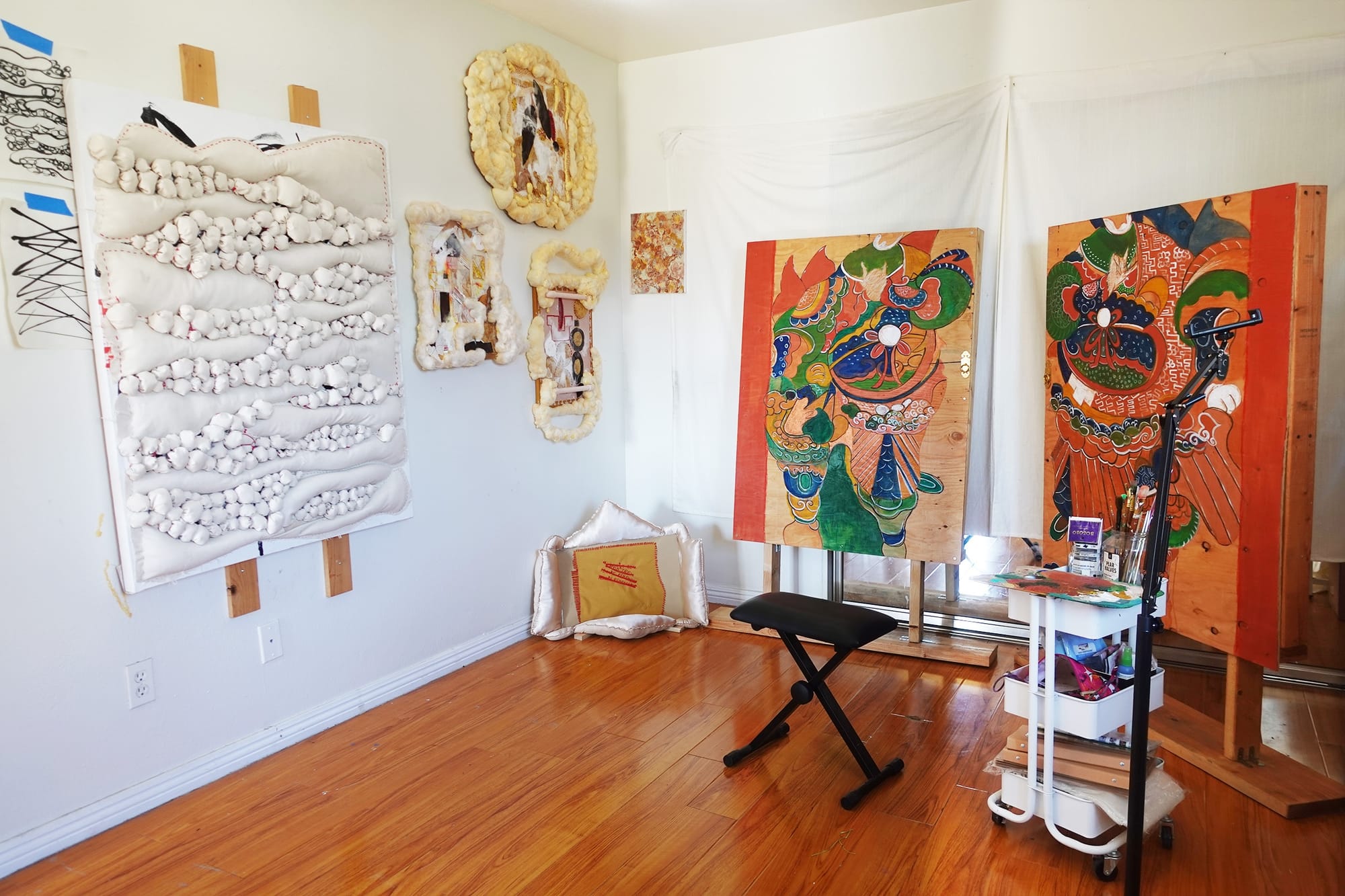
This marks the 319th edition of ‘A View From the Easel,’ a series dedicated to artists’ reflections on their workspaces. In this week’s edition, artists express a longing for loftier ceilings and draw inspiration from the solitude of their studios.
If you’re interested in contributing, please review our submission guidelines. We welcome entries about your studio setup, whether it’s a dedicated space or a corner at home.
XiaoXiao Wu, San Gabriel, California
How long have you been working in this space? Five years.
Describe an average day in your studio. My typical day begins between 8am and 9am, four to five days each week. I focus on my work without distractions like meals or entertainment. I often juggle two to three projects, involving activities like sewing, assembling, and filming. My weekends are reserved for attending openings and exhibitions. I usually wrap up by late afternoon, with history podcasts as my background soundtrack.
How does the space affect your work? My practice explores women’s spaces and their evolution from domestic settings to the body and daily labor. Thus, my home studio is integral to my work’s thematic reference. It mirrors my installations and soft pieces, with its modest scale prompting reflections on how ‘female space’ is constructed and adapted.
Desmond Beach, Brooklyn, New York
How long have you been working in this space? Three and a half years.
Describe an average day in your studio. My day begins slowly, allowing for a transition into a focused state. I organize materials and assess ongoing projects, guided by intuition rather than a strict schedule. My studio functions as an ecosystem housing fiber works, sound recordings, and other elements. Sound, especially spirituals and gospel, plays a crucial role. Sometimes, I work in silence, letting natural rhythms guide me.
How does the space affect your work? The lack of natural light creates a reflective environment where ideas can develop gradually. The studio acts as a container for memory and process. Its open floor plan supports the care and vulnerability needed for work rooted in personal and collective histories.