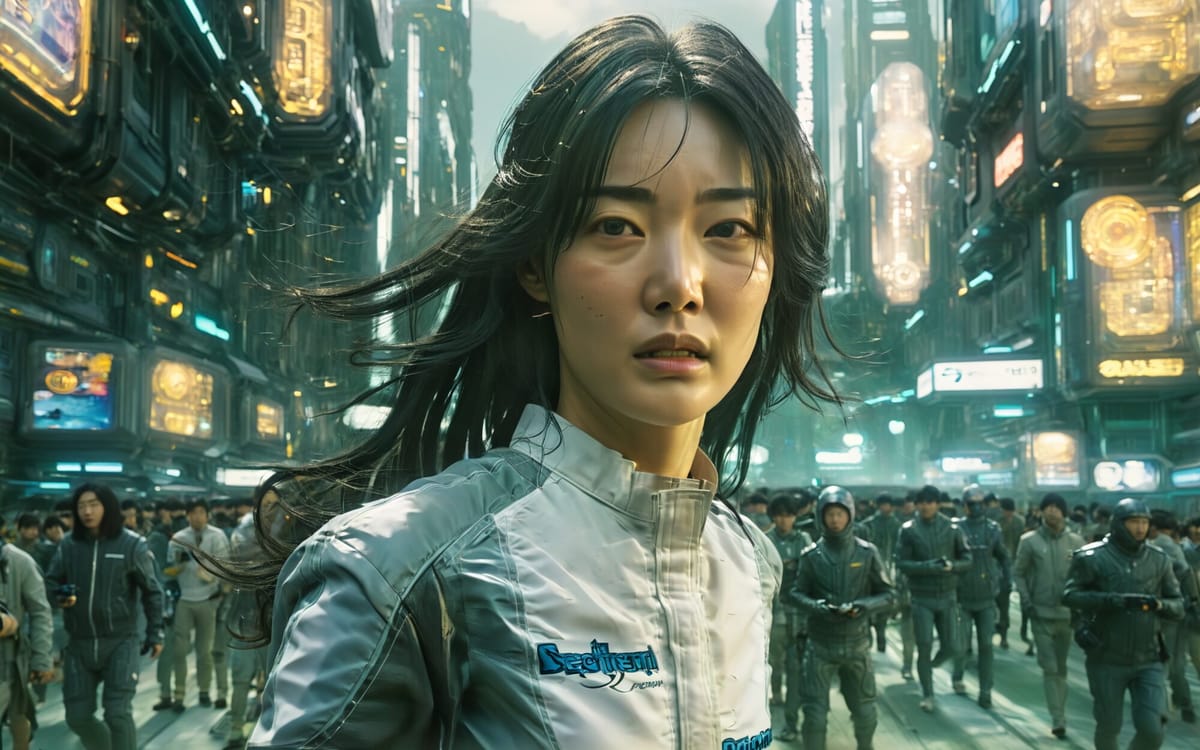
Unlike many well-known Korean artists who have set up studios overseas, Ayoung Kim remains in Seoul’s Nakwon Sangga, a site embodying both futuristic and historical traits. From this base, she interprets a city caught between capitalist pressures and its historical roots. Her exhibition, Ayoung Kim: Delivery Dancer Codex, showcased at MoMA PS1, utilizes video installations that blend live-action footage, video game technology, and generative AI. These works craft a series of speculative narratives featuring two female drivers, En Storm and Ernst Mo.
The first piece in the trilogy, “Delivery Dancer’s Sphere” (2022), imagines a gamified delivery network governed by a “Dancemaster.” As the drivers strive for optimization, they navigate space and time, eventually becoming “Ghost Dancers,” invisible at their highest level. Storm and Mo, portrayed by the same actress, symbolize the homogenizing effect of capitalism, where workers become indistinguishable. Their ambiguous connection—whether as lovers, adversaries, or figments of each other’s imagination—further complicates their individuality.
Continuing the theme of invisibility and fugitivity, the subsequent parts, “Delivery Dancer’s Arc: Inverse” and “Delivery Dancer’s Arc: 0º Receiver” (both premiering in 2024), expand on these concepts. In “0º Receiver,” Storm and Mo are depicted racing across a desert landscape, initially only visible as a dust trail. The narrative critiques the imposition of standardized time by the Timekeepers, suggesting alternative temporalities aligned with natural phenomena.
In “Inverse,” Kim introduces Novaria, a vertically structured world where deliveries progress from an underworld to an upperworld. The installation encourages viewers to gaze upwards at large screens, reminiscent of stargazing, challenging the modern tendency to look down at screens. Elements from 1990s animation to game-like settings are intertwined, presenting a vision where multiplicity thrives amidst virtual existence.
Throughout her work at MoMA PS1, Kim challenges the notion that virtual spaces are secondary to the physical world. The museum’s architecture, originally a public school, sometimes prioritizes virtual landscapes over physical installations, such as helmets and mirrors. By embracing fragmentation, Kim’s work questions standardization in time, labor, and identity, exploring technology’s role in enabling diverse desires. Ayoung Kim: Delivery Dancer Codex is on display at MoMA PS1 (22–25 Jackson Avenue, Long Island City, Queens) until March 16, curated by Ruba Katrib.