Since my initial review in 2011 of Bill Rice’s evocative nocturnal depictions of New York City’s Lower East Side, he has emerged in my mind as an unparalleled documentarian of urban loneliness from dusk to dawn. Utilizing layers of somber blacks, moody reds, grimy yellows, fiery oranges, and earthy browns, Rice portrays solitary figures in compressed, smoldering environments, where solitude is the sole companion of his subjects. The debut exhibition titled Bill Rice at the newly inaugurated Donald Ryan Gallery provides an opportunity to reevaluate this unique yet often overlooked artist. Of the 12 paintings featured in the exhibition, spanning 1973 to 1995, only “Purple Blow” (1995) includes more than one figure, depicting two men in a detached encounter.
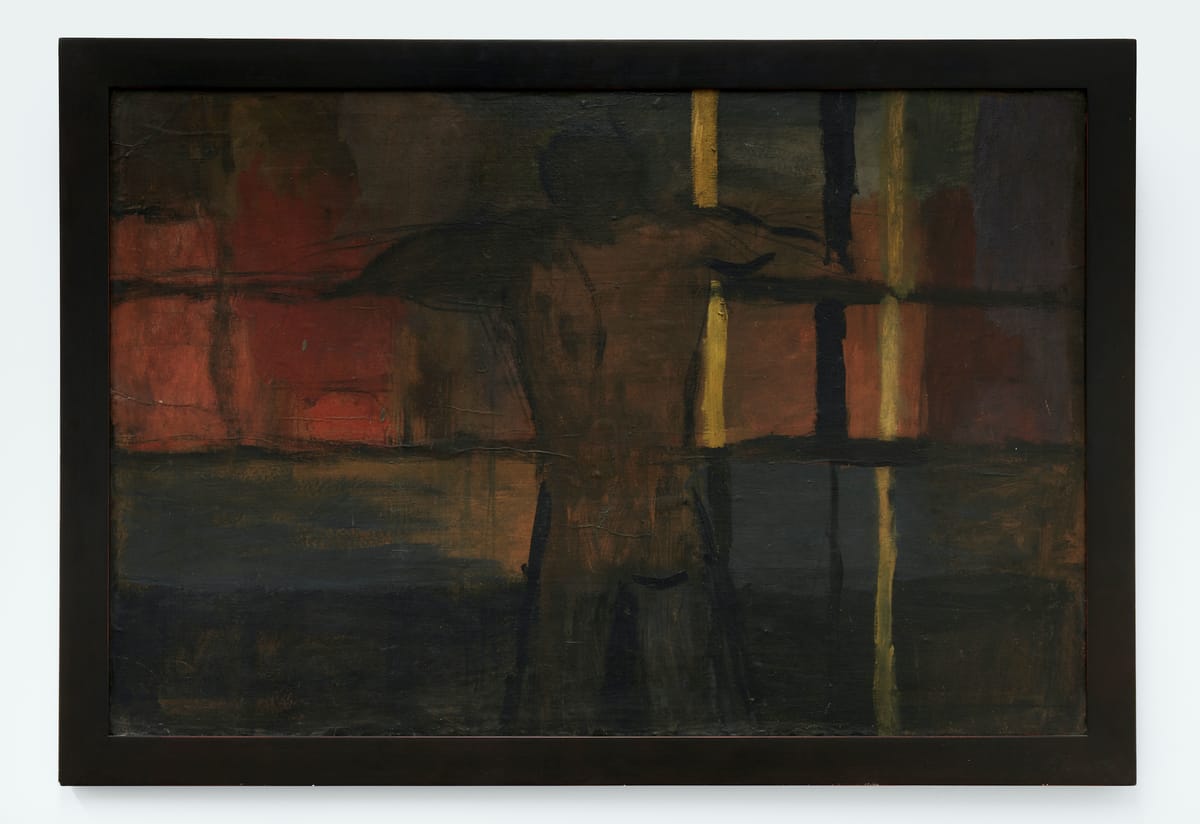
In “Man” (1979), the viewer is presented with the back view of a nude man gazing down at the streets, his forearms resting on a metal railing. Flanking him are dark orange and orange-red rectangles, painted thinly to imply something glowing below. This glow raises questions: is it a sign of intense passion or a distant destructive blaze? Rice’s paintings are permeated with a sense of detachment. His depictions of men with their backs turned evoke voyeurism, as if they are witnessing something unseen by the viewer, thereby enhancing the feeling of isolation. In “Window Gate” (1980), Rice overlays a diamond grid on subdued windows, compressing the space as if overwhelmed by the city’s anonymity.
Rice’s art integrates elements of abstraction and representation, foreshadowing a blending of these styles in later works. His preference for thinned-out dirty reds and gritty blacks is reminiscent of Mark Rothko’s abstracts, yet Rice’s work remains distinct. His artistic acumen is evident in his ability to reinterpret influences from other artists while maintaining his own aesthetic freshness. The painter’s use of blacks and grays masterfully captures the urban ambiance, resulting in works that are paradoxes of desolation and allure, melancholy and resilient spirit, embodying survival narratives.
In “Silks” (1984), the faint reflection of a yellow cab beside a man in a red hoodie and blue dungarees highlights a world of stark isolation and missed encounters. The red neon sign transforms the doorway into a metaphorical gateway to Dante’s inferno. Rice, alongside Martin Wong, is recognized for his keen sensitivity to the inhabitants of Manhattan’s once-ruined, spirited Lower East Side, prior to its gentrification. The New Museum, upon reopening in early 2026, should allocate a space to these perceptive observers of a cultural and artistic environment ravaged by AIDS and the U.S. government’s neglectful policies.
The exhibition of Bill Rice’s work continues at Donald Ryan Gallery (15 East 71st Street, 2A, Upper East Side, Manhattan) until January 10. This exhibition has been organized by the gallery.