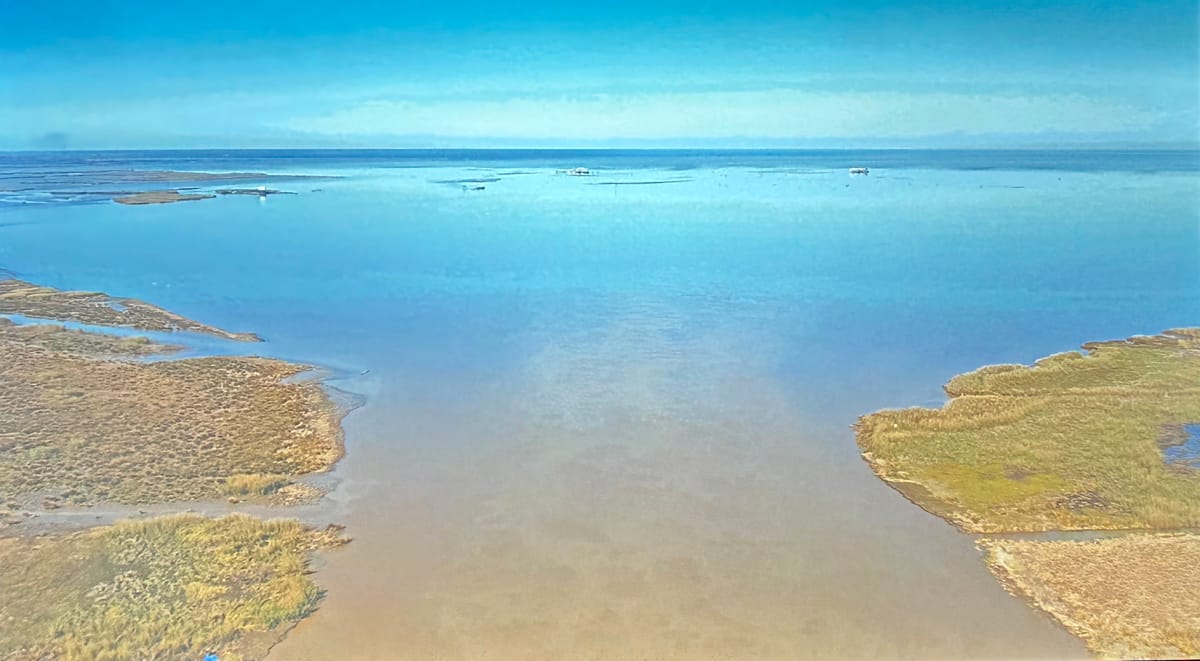
DENVER — Water embodies a dual nature in the climate discourse: it signifies both abundance and scarcity; it is essential yet feared. Artist Deborah Jack challenges viewers’ perceptions of the ocean’s allure by critiquing cartography, empire, and ecological adaptation. Her six-channel video creation, “a sea desalts, creeping in the collapse… in the expanse…a rhizome looks for reason… whispers an elegy instead” (2024), commissioned for Prospect.6 in New Orleans, is the centerpiece of her exhibition, the haunting of estuaries…an (after)math of confluence, at the Museum of Contemporary Art Denver.
Jack’s work examines water as a symbol of both climate crisis and colonial neglect. Estuaries, where freshwater meets the ocean’s saltwater, function as ecotones—spaces that fluctuate with weather patterns. The installation features two pairs of screens and two solitary screens in the room’s center. These depict coastal scenes from Maine, Brazil, St. Maarten, and Louisiana, prompting viewers to engage with the imagery while questioning it. The Diaphanous Ensemble’s score adds a haunting layer, with its minor chords and contrasting low and high notes.
Exploring regions like the Atlantic, Gulf of Mexico, and Mississippi River, Jack’s installation challenges viewers to focus selectively, acknowledging the impossibility of absorbing it all at once. Her visual narrative alternates between film and slide show, with black and white images overlaying the vibrant video content. Disorienting elements include contrasting colorful ocean footage with stark black and white scenes of mangroves, creating a dynamic tension.
In a 2021 interview, Jack reflected on St. Maarten’s salt industry, stating, “Salt was the main industry in St. Maarten for many years. It can corrode and can preserve at the same time. You have to be the salt and choose what role you want to play. Do you want to corrode or preserve?” This question resonates deeply, whether one lives by a water-abundant shore or in a landlocked area where water is scarce. Jack exposes the damage of climate change on coastal ecotones and preserves these truths through her elegiac visual storytelling.
As climate-induced disasters become more frequent, art like Jack’s may become a crucial indicator of their impacts. Currently, the National Science Foundation, under the Trump administration, is moving to dismantle the National Center for Atmospheric Research in Boulder, Colorado, which provides essential data to mitigate these risks. Without it, our awareness may only come from observing the natural world around us. Deborah Jack: the haunting of estuaries…an (after)math of confluence is on display at the Museum of Contemporary Art Denver (1485 Delgany Street, Denver, Colorado) until February 15. The exhibition is curated by Miranda Lash.