LOS ANGELES — The true power of art lies in its ability to remind us of our place within a world we trust and, perhaps, love. Sandra Vásquez de la Horra’s exhibition, The Awake Volcanoes, at the Institute of Contemporary Art, Los Angeles, captures this essence through her beeswax-dipped drawings. These works, featuring erupting women, mystical landscapes, and vivid flora, create a mysterious resonance, revealing universal truths within personal visions.
The piece “Volcánica (The Volcanic Woman)” (2023) exemplifies this connection. The taupe figure at its center, composed of smoke and bubbles from volcanic nipples, embodies a fury and vitality recognizable in one’s own physicality. Vásquez de la Horra’s Chilean roots, upbringing under Pinochet’s regime, and subsequent move to Germany to study art and practice Santería, suggest that this resonance transcends shared histories, delving into deeper, more intrinsic connections.
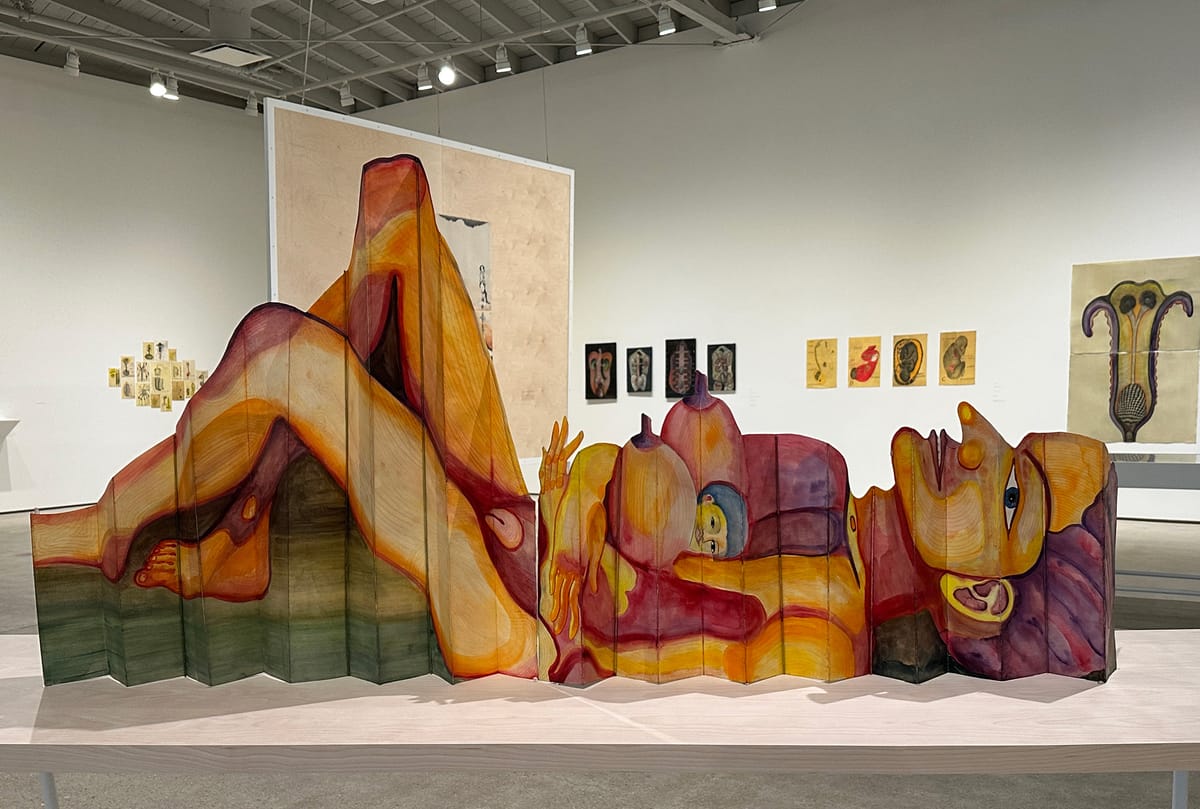
The exhibit’s opening image is flanked by two paper sculptures of reclining women, “Del sol naciente (From the Rising Sun)” (2023) and “Volver a ti (Coming Back to You)” (2023). These works explore themes of objectification and embodiment, juxtaposing vibrant colors with wooden textures to reflect the duality of female experiences. Vásquez de la Horra’s nearly 100 drawings depict women intertwined with natural elements — mountains, animals, and celestial bodies — underscoring their inseparability from the earth.
In pieces like “Anillo de fuego (Ring of Fire)” (2023) and “Deidad planetaria (Planetary Deity)” (2015), Vásquez de la Horra illustrates this connection further. Her work portrays women as integral to nature, with elements like volcanoes and serpents enhancing their forms. The botanical drawings echo this theme, presenting human and plant reproductive organs as interconnected through cycles of life, reinforcing the idea of an ecofeminist worldview rooted in the body’s relationship with nature.
Despite its mythic elements, Vásquez de la Horra’s art remains grounded in reality. The back wall’s rich salon-style display includes images with text, such as “el pueblo unido jamás será vencido” (the people united will never be defeated), highlighting the link between women’s physical struggles and broader social resistance. Her work draws a parallel between environmental exploitation and women’s subjugation, suggesting that freeing one body — biological, ecological, or political — liberates all.