LOS ANGELES — Renowned for his depictions of Henry VIII and his wives, Hans Holbein the Younger, a German-born artist who became a celebrated painter at the English court, has left a lasting impression on the representation of Tudor life. Notable works include the poignant portrait of Christina of Denmark, displayed near “The Ambassadors” (1533) at the National Gallery in London, and the seated portrait of Thomas Cromwell from the Frick Collection, featured in the Holbein exhibition at the Getty Center. Cromwell’s likeness may also be recognized by those familiar with the BBC series Wolf Hall.
The exhibition, Holbein: Capturing Character in the Renaissance, co-hosted by the Getty Museum and the Morgan Library & Museum, offers an intimate look at Holbein’s artistry, focusing on portraits and designs meant for close viewing. Curated by Anne T. Woollett, Austėja Mackelaitė, and John T. McQuillen, the display includes a diverse collection that bridges the art of painting and writing. While it touches upon familiar Renaissance themes, the exhibition’s selection creates unexpected connections across various media, featuring round formats like medals and rondels, and an abundance of circular imagery in portraits.
Holbein’s calligraphic flair imbues his portraits with vitality, drawing attention to noblewomen, officials, printers, artists, and humanist friends, including Desiderius Erasmus and Philipp Melanchthon. The exhibition highlights both the commonalities and distinctions among his subjects, evident in graphic elements such as the silhouette of a hat. Ink drawings, like those of William Parr and Henry Howard from the Queen’s Collection, showcase Holbein’s dynamic use of lines.
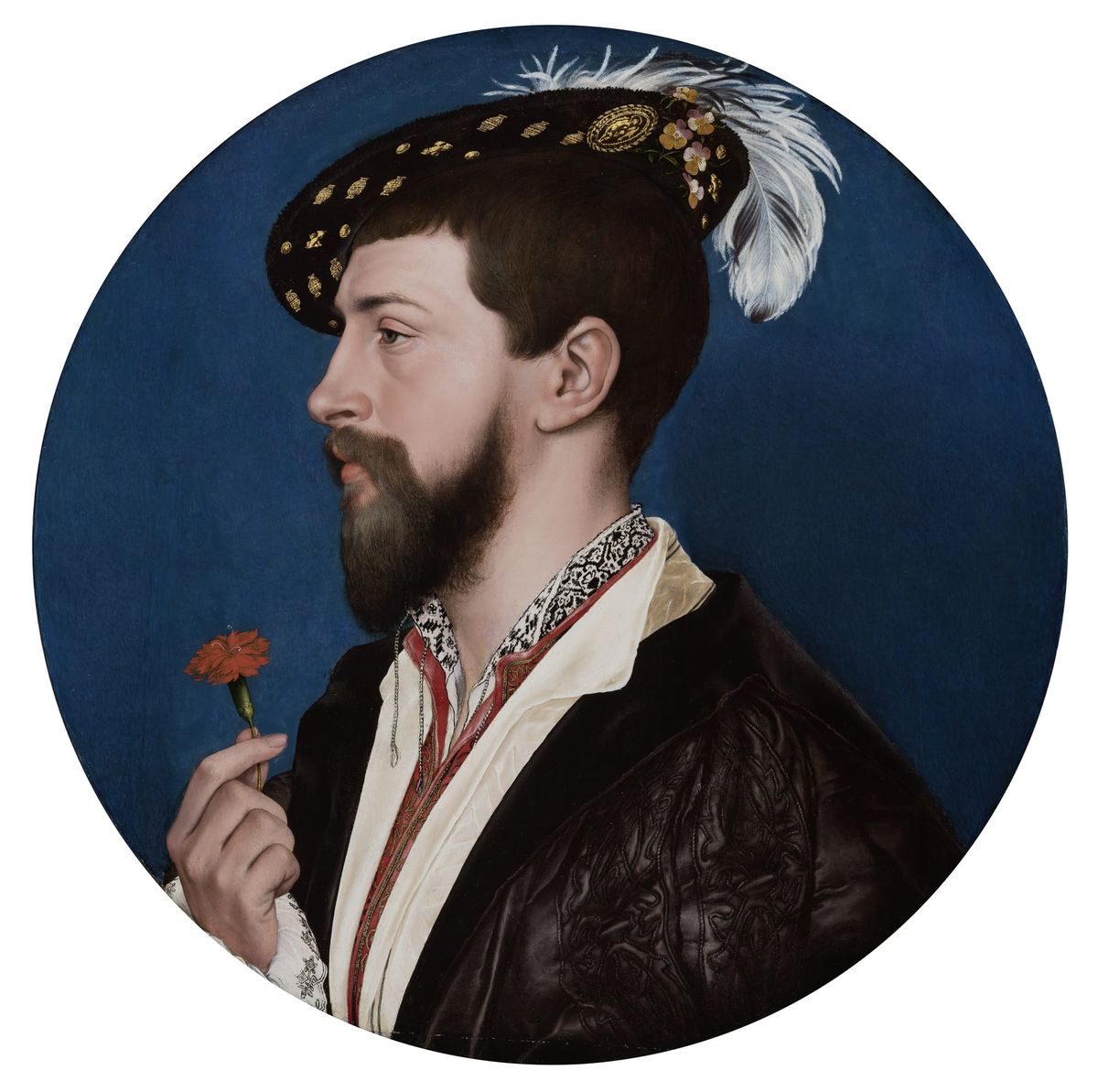
The exhibition emphasizes Holbein’s ornamental approach, illustrated by the round format of “Simon George of Cornwall” (1535–1540) from the Städel Museum. This portrait contains rich symbolism, with elements like a carnation, a glittering hat badge, and a swan, each contributing to its narrative complexity. Such attention to detail is mirrored in the jewels and textures found in the small objects display, highlighting historical allegories and myths.
Holbein’s work underscores how ornamentation can underscore social and political themes. Through his intricate designs, viewers are encouraged to explore painted panels and pages, guided by serpentine lines and geometric motifs. The exhibition, which captures identity through words and images, is a testament to Holbein’s calligraphic prowess.
Holbein: Capturing Character in the Renaissance is on view at the Getty Center (1200 Getty Center Drive, Brentwood, Los Angeles) until January 9. The exhibition, organized by the Getty Museum and the Morgan Library & Museum, will move to the Morgan Library & Museum (225 Madison Avenue, Midtown East, Manhattan) from February 11 to May 15.
Correction: An earlier version of this article misidentified Christina of Denmark as Catherine of Denmark, an error that has since been corrected.