MADRID — On April 25, 1974, Portugal’s Estado Novo regime, which had held sway for over 40 years, was peacefully overthrown by soldiers and civilians. Not long after, Spain’s dictatorial leader Francisco Franco passed away in 1975, ending 36 years of rule. Although their paths were different, both nations embarked on revolutions, transitioning to democratic governance and implementing fresh constitutions around the same era. Five decades later, however, there’s a noticeable rise in far-right political factions in Spain and Portugal, with some expressing nostalgia for the authoritarian past. This prompts reflection on what transpired during those pivotal times and how Iberian democracy is faring today. La Casa Encendida’s exhibition, ‘Inquietud. Libertad y democracia (Concern: Freedom and Democracy),’ curated by Paulo Mendes and Sandra Vieira Jürgens, delves into these questions with contributions from over 50 artists and nearly 80 diverse artworks.
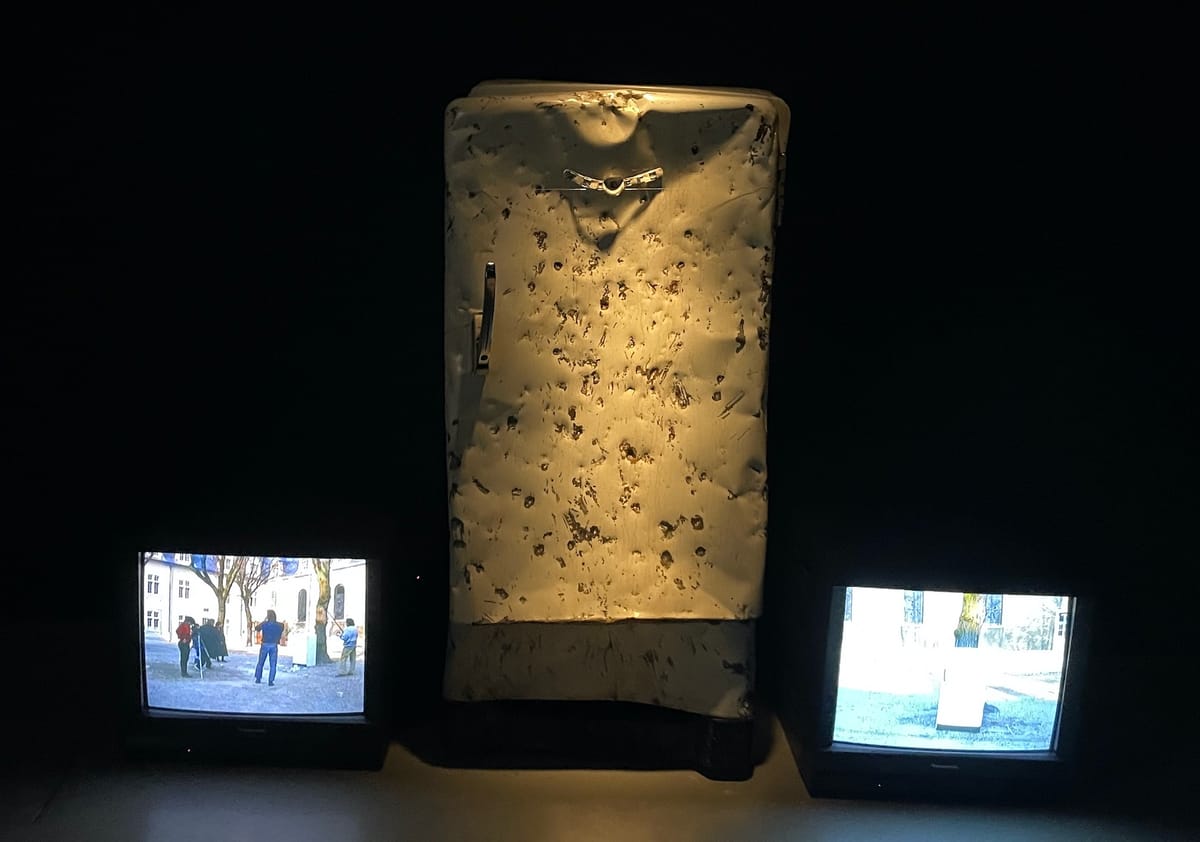
According to La Casa Encendida Director Pablo Berástegui, the exhibition offers a ‘visual and sonic account of the time,’ immersing visitors in a sensory exploration of the period. The exhibit’s title is inspired by José Mário Branco’s song ‘Inquietação’ (1982), reflecting the post-revolutionary unease and transition. Visitors encounter a rich tapestry of revolutionary-era artifacts, such as posters and songs, presented in a non-linear, unfinished manner that echoes the ongoing nature of democracy. The exhibit space, with its raw, unpainted walls, suggests a construction site, symbolizing democracy as an ever-evolving project.
The exhibit opens with a dimly lit room filled with large wooden crates, reminiscent of art shipping containers. A striking video by Santiago Sierra and Jorge Galindo, ‘Los Encargados’ (2012), features a dark procession of vehicles on Madrid’s Gran Vía, bearing inverted portraits of Spanish leaders post-dictatorship, hinting at the less than ideal transition to democracy. This piece was created prior to King Juan Carlos I’s abdication and subsequent exile, yet it already cast doubt on the integrity of Spanish democratic leadership.
In one corner, Eduardo Arroyo’s portraits of Victor Emmanuel III offer a scathing critique of authoritarian figures, reflecting a veiled criticism of Franco. Meanwhile, Anna Jermolaewa’s video installation, ‘The Doubles’ (2021), showcases impersonators of Soviet leaders, exploring society’s complex perspectives on its despots. Bárbara Fonte’s lenticular photos examine the contradictory roles of Portuguese women during dictatorship. The end of Portugal’s colonial era is depicted in Francisco Vidal’s ‘African Hair Cut 5’ (2018), which captures the legacy of conscription and immigration through vibrant artistry.
Overall, ‘Inquietud’ is an imaginative and insightful exhibition, particularly relevant as democracies worldwide face challenges. The provocative artworks serve as reminders of the ongoing effort needed to safeguard freedom and nurture democratic values. ‘All of us must take responsibility for what we do with democracy,’ Berástegui emphasized, noting that liberty is something to be earned, not simply granted.