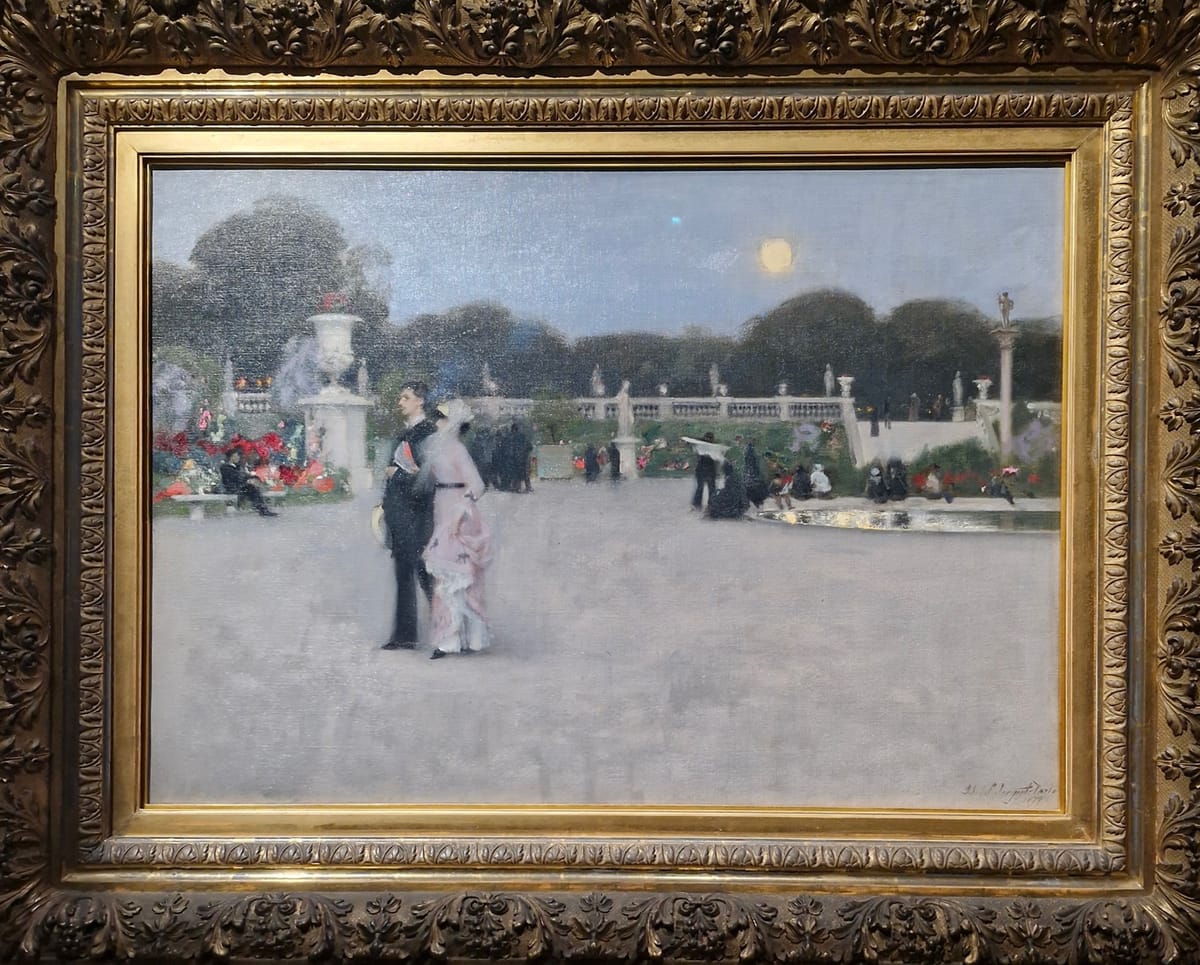
PARIS — Although John Singer Sargent spent approximately a decade living and working in Paris, his artistic ties to the city remain elusive. The itinerant artist’s portrait subjects are as diverse and widespread as his travels throughout Europe, where he grew up with American parents. The exhibition John Singer Sargent: Dazzling Paris at the Musée d’Orsay presents a unique challenge by assembling works connected to his Parisian period from 1874 to 1884 and beyond. The curators acknowledge in the exhibition text that “Parisian subjects feature surprisingly little in his work,” with a small study from 1879 of the Luxembourg Gardens standing out for its rarity.
Opening in September, Dazzling Paris follows two significant exhibitions: Sargent and Fashion at Boston’s Museum of Fine Arts and Tate Britain, and Sargent and Paris at the Metropolitan Museum of Art, which curator Stephanie Herdrich helped organize. Despite these efforts, Sargent is still relatively unknown in France, and the curators assert this is the first French museum to host a monographic exhibition dedicated to him.
The exhibition begins with intimate rooms that serve as a travelogue, showcasing en plein air sketches of scenes from his extensive journeys across France, Italy, Spain, and Morocco. Works like “Atlantic Sunset” (1876–8) and “Ramón Subercaseaux in a Gondola” (1880) in Venice are displayed, with the exhibition text linking these pieces back to Paris and their role in his studio work for the Salon. The next section features some of Sargent’s early Parisian works from his time under French painter Carolus-Duran’s tutelage, including academic drawings from his studies in Florence. These pieces highlight Sargent’s exceptional ability to transcend artistic styles and time periods.
Adjacent are works like “A Male Model Standing before a Stove” (1875–80), an oil study demonstrating Sargent’s mastery of three-dimensionality through layered construction. His studies from visits to Madrid’s Museo del Prado and the Netherlands, including copies of works by Diego Velázquez and Frans Hals, reveal his skill in capturing life with minimal brushwork. The exhibition showcases how Sargent, along with Velázquez and Hals, could achieve lifelike depictions with sparse strokes, as seen in pieces like “Rehearsal of the Pasdeloup Orchestra at the Cirque d’Hiver” (1879–80).
The highlight of the exhibition is Sargent’s 1883–84 portrait of Virginie Amélie Avegno Gautreau, known as “Madame X,” on loan from The Met and shown for the first time in Paris since its 1884 Salon scandal. The portrait, noted for its daring composition and tonal contrast, is complemented by an unfinished version from the Tate. The exhibition invites visitors to appreciate Sargent’s society portraits for their vibrant and expressive nature, despite the challenge of defining his connection to Paris. Ultimately, the exhibition title reflects the curators’ ambition to captivate today’s Paris with Sargent’s work.
Sargent: Dazzling Paris is on view at the Musée d’Orsay (1 Rue de la Légion d’Honneur, Paris, France) until January 11. The exhibition was curated by Caroline Corbeau-Parsons, Paul Perrin, and Stephanie Herdrich.