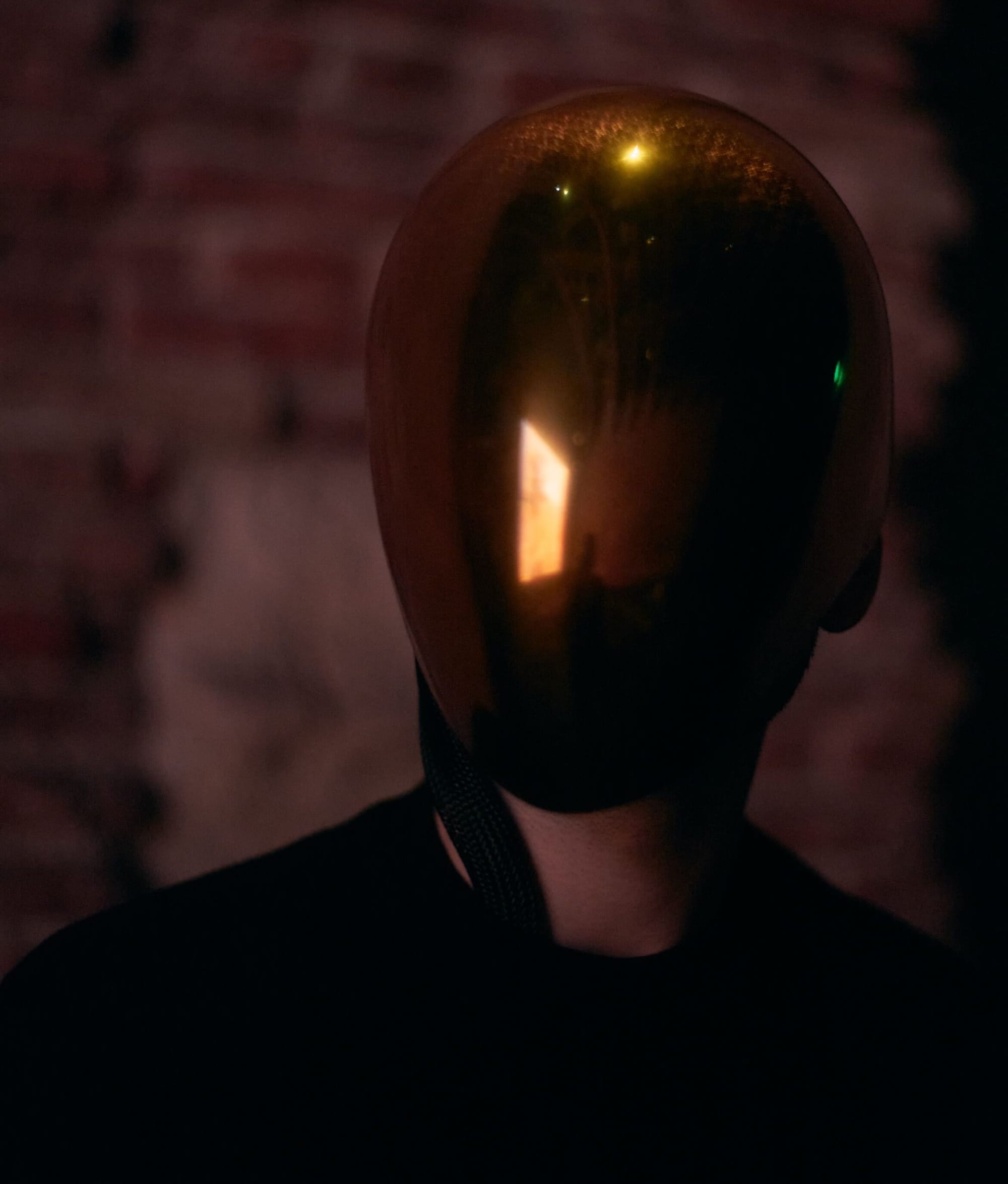
On a bright summer day in June, my daughter and I visited Pierre Huyghe’s exhibition ‘Liminal’ (2024) at the Pinault Collection in Venice, Italy. The space was shrouded in dim light, creating a truly liminal atmosphere. In the first gallery, we approached a life-sized statue of a man with a smooth, golden mask in place of a face. My daughter questioned if it was a real person, to which I laughed and moved closer to take pictures. A guard then surprised us by instructing us to step back from the performer, revealing that the ‘statue’ was actually a human, standing motionless as we intruded on their space.
Huyghe is among a number of contemporary artists investigating the boundaries between the human and nonhuman. His work is included in the New Museum’s spring exhibition, ‘New Humans: Memories of the Future.’ These artists often delve into the distinctions between art and personhood, a topic that gained traction after the US Supreme Court’s Citizens United decision in 2010, which granted free speech rights to corporations. This ruling sparked debates about extending similar rights to other entities like fetuses, dolphins, and AI.
Artists are pushing the limits of personhood by integrating humans, animals, and AI into their artwork. Huyghe’s other projects feature masked monkeys and a hermit crab with a Brancusi-inspired shell. Nina Katchadourian’s early bioart pieces involve caterpillars and spiders in unexpected collaborations. Ai-Da, a social robot created by Aidan Meller and Lucy Seal, is marketed as painting self-portraits, raising questions about the anthropomorphism in art.
In works like Marge Monko’s ‘I don’t know you so I can’t love you’ (2018), the use of personifying language challenges us to reconsider our assumptions about personhood. Art critic Michael Fried argues that such artworks can manipulate viewers into attributing human-like qualities to art objects, which might not require moral consideration.
My forthcoming book, ‘The Problem of Personhood: Giving Rights to Trees, Corporations, and Robots’ (2026), examines how extending legal personhood to nonhumans complicates moral and political issues. While such expansions might seem appealing, they ultimately create more challenges by increasing the number of entities requiring moral consideration without corresponding obligations.