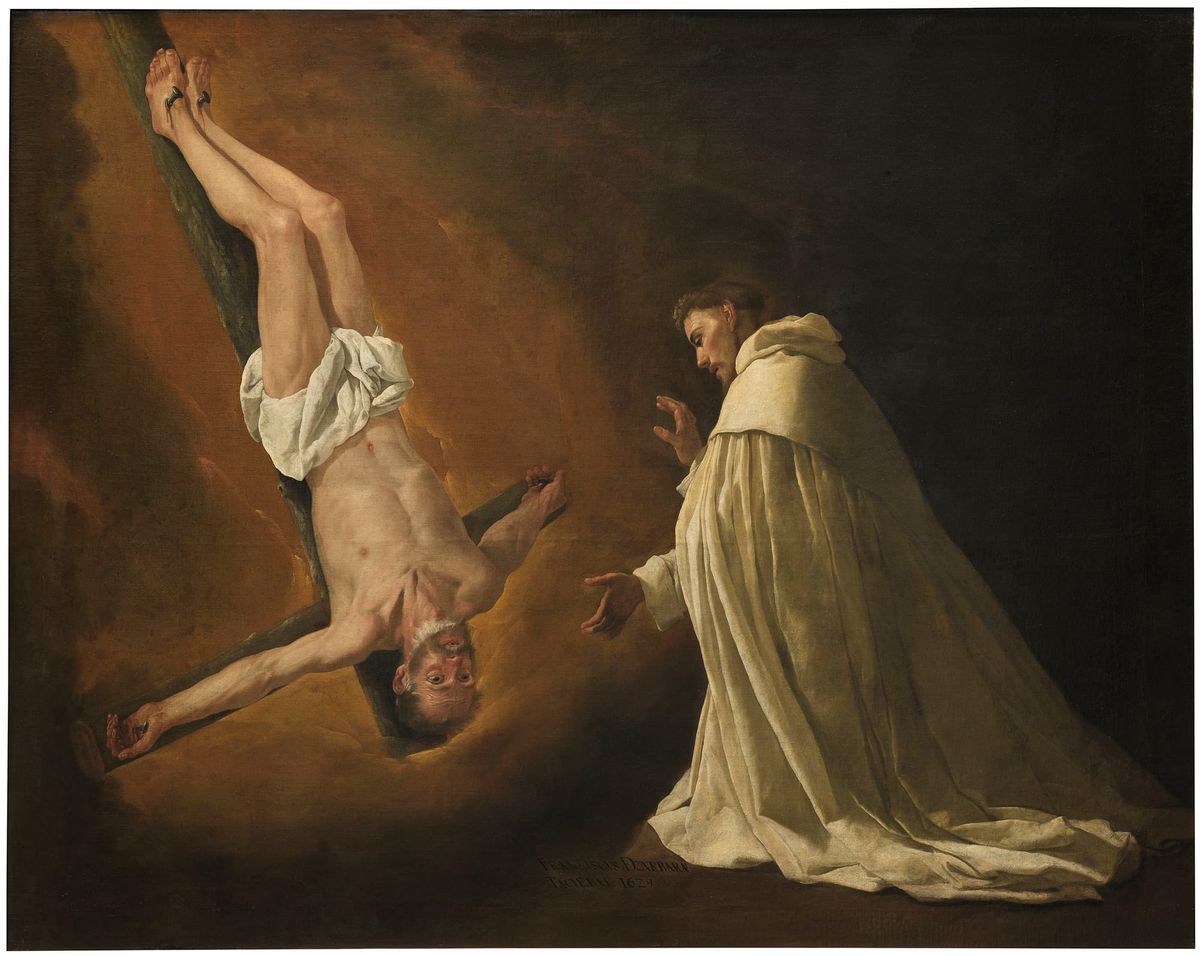
LONDON — Francisco de Zurbarán, the renowned 17th-century Spanish artist, is showcasing his potentially devout creations on an unprecedented scale at London’s National Gallery. Many of these grand works, once gracing the lofty altars of churches and monasteries around Seville in Southern Spain, are now displayed with stark simplicity against deep black walls. The exhibits include crucifixion scenes, solitary monks in worn brown robes, and female saints adorned in opulent fabrics reminiscent of courtly attire. The display evokes a sense of the sepulchral, awe-inspiring, and somewhat fear-inducing, as if urging viewers back to their faith. This is cultural Catholicism at its zenith, thriving within a prosperous empire. Notably, Zurbarán and his studio produced 120 pieces that ended up in the Spanish Americas.
However, a single word in my introduction lingers like an incessant ache: piety. Was Zurbarán himself a devout man? Were his religious depictions born from genuine belief? Does faith impact the quality of an artist’s work? I posed these questions to the curator, recalling Agnolo Bronzino, the esteemed Florentine painter known for both religious scenes and his cold portrayals of the Medici family. Despite his skilled depiction of fabric, Bronzino also penned bawdy verses in private.
Her response was intriguingly vague. No personal records survive to confirm Zurbarán’s beliefs—no letters, diaries, portraits, or drawings, only contracts. His legacy is largely financial, though he did father many children. She pointed to a small painting in the final gallery, created in Zurbarán’s later years. A modest crucifixion scene, it stands out amidst the larger works, positioned near the exit.
Beside the cross, an elderly, scraggly-bearded bald man holds brushes and a paint palette, featuring brown, white, and orange. Is this man Zurbarán, claiming his place in the crucifixion narrative? The curator deems it unique, suggesting it reflects Zurbarán’s piety—or lack thereof. Yet, the argument is not conclusive. Saint Luke, patron of painters, could also be the depicted figure. We lack a definitive likeness of Zurbarán, leaving room for interpretation. His relationship with the church, a major benefactor, could have prompted such an inclusion for ulterior motives.
The Zurbarán exhibition remains at London’s National Gallery until August 23 before moving to the Louvre Museum and the Art Institute of Chicago.