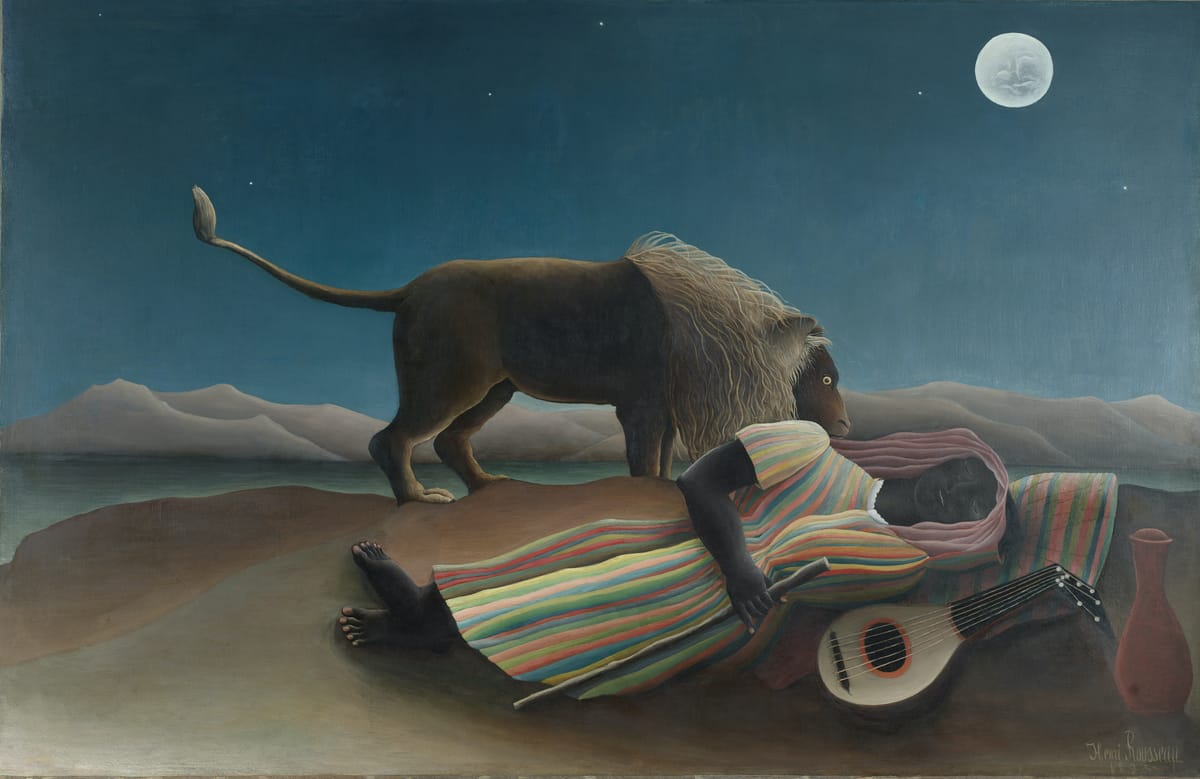
PHILADELPHIA — Those who have attempted to decipher the enigmatic scene in Henri Rousseau’s “Sleeping Gypsy” (1897) at the Museum of Modern Art are well acquainted with his skill in captivating audiences. This intriguing piece, featuring a lion and a sleeping woman, is part of the exhibition Henri Rousseau: A Painter’s Secrets at the Barnes Foundation, which showcases nearly 60 spellbinding works. Rousseau, who taught himself to paint, started his artistic journey after retiring as a toll collector in Paris in 1893, becoming a professional albeit impoverished artist. The title, A Painter’s Secrets, aptly describes the exhibition where curators Christopher Green and Nancy Ireson present many works in the context of Rousseau’s life, supported by technical studies revealing long-hidden details.
The catalog enlarges the image of a grumpy-faced baby in “The Family” (c. 1892–1900) to highlight Rousseau’s keen observational prowess. Visitors with a keen eye will find surprises, such as the distant view of the Eiffel Tower in “Sawmill, Outskirts of Paris” (1893–95). Some discoveries are eerie, like the disembodied head observing revelers in “Carnival Evening” (1886). The exhibition includes several of the Barnes Foundation’s 18 Rousseau paintings, temporarily displayed alongside related loans. Visitors can contrast their “Scouts Attacked by a Tiger” (1904) with the dramatic animal battles in the Fondation Beyeler’s “The Hungry Lion Throws Itself Upon the Antelope” (1898–1905) and the Cleveland Museum of Art’s “Fight Between a Tiger and a Buffalo” (1908).
Christopher Green notes that Rousseau is more of a “story-giver” than a storyteller, leaving narratives unresolved, a trait that endeared him to the Surrealists. Although Rousseau sought official recognition, it was his fellow artists who first appreciated his genius. Picasso discovered Rousseau’s work in 1908 when he found “Portrait of a Woman” (1895) in a second-hand shop. This piece, featuring a model on a balcony amidst potted flowers, was kept by Picasso until his death and is now part of A Painter’s Secrets, on loan from the Musée national Picasso-Paris.
For those whose interest is piqued by A Painter’s Secrets, the exhibition’s comprehensive catalog offers further insights. Alternatively, Roger Shattuck’s The Banquet Years (1961) provides context on Rousseau’s place in the avant-garde movement in pre-World War I France. While at the Barnes, visitors can explore other Rousseau works from the permanent collection, unchanged since 1951, alongside pieces by Picasso, Cézanne, Matisse, and Renoir. A Painter’s Secrets provides a rare chance to appreciate Rousseau’s innovative use of space and color, and his vivid imagination.
Henri Rousseau: A Painter’s Secrets is on display at the Barnes Foundation (2025 Benjamin Franklin Parkway, Philadelphia, Pennsylvania) until February 22, 2026. The exhibition, curated by Christopher Green and Nancy Ireson, with support from Juliette Degennes, will later travel to the Musée de l’Orangerie in Paris.