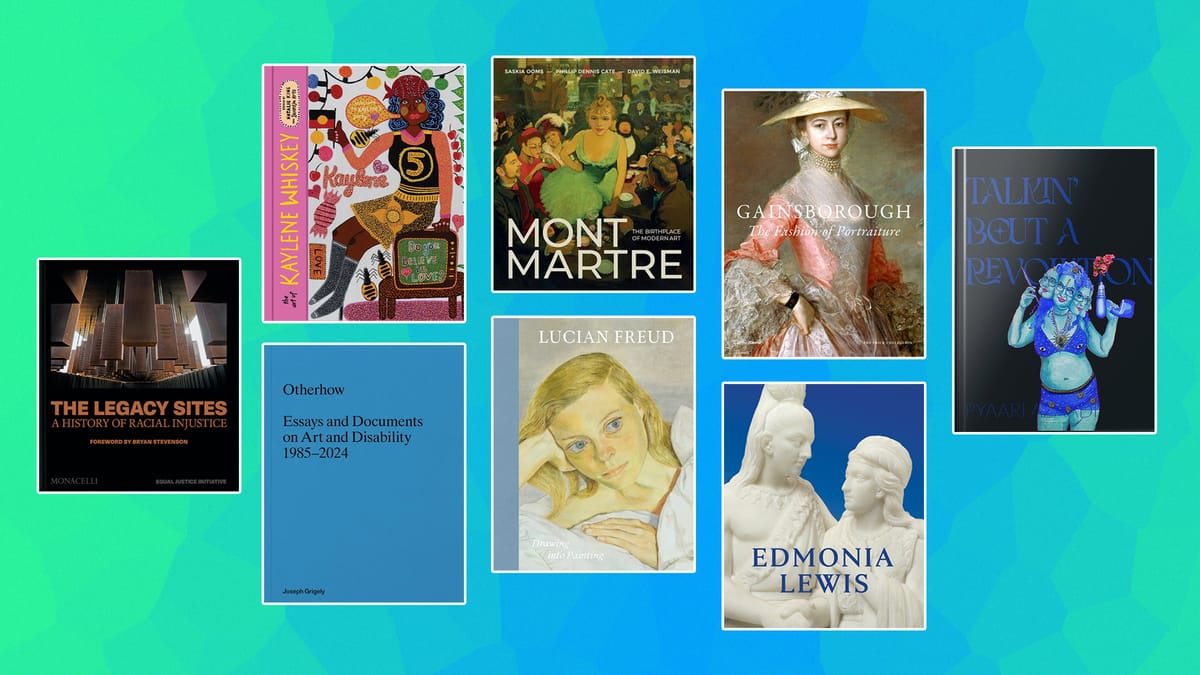
Books have the power to remind us of the vast scope of art. This month, eight books transport us across time, geography, and subjects—from 19th-century Montmartre’s modernism to the internet’s evolution from marginalized voices, and the inclusive art of Pyaari Azaadi. Each book is a testament to creative expression’s ability to enhance our world and offer varied perspectives. Works from the Equal Justice Initiative and artist Joseph Grigley challenge racism and ableism, while artists Kaylene Whiskey and Edmonia Lewis, both pioneering women of color, enrich our lives with their beauty. —Natalie Haddad, reviews editor
Talkin’ Bout a Revolution: Pyaari Azaadi | Pen + Brush, January The opening of Talkin’ Bout a Revolution at Pen + Brush, featuring a performance by LaWhore Vagistan, marked a homecoming for Pyaari Azaadi. The exhibition reflects decades of activism and artistic creation in New York City. As global fascism rises, the accompanying catalog offers hope and resilience. Contributions include Hyperallergic Editor at Large Hrag Vartanian’s insights, critic Anuradha Vikram’s homage to Azaadi’s studio, and journalist Yashica Dutt’s exploration of her community-focused, anti-caste artwork. —Lakshmi Rivera Amin
Montmartre: The Birthplace of Modern Art by Phillip Dennis Cate, Saskia Ooms, and David E. Weisman | Giles This book delves into Montmartre, once the artistic pulse of Paris, hosting the Moulin Rouge and Lapin Agile. From the late 19th to early 20th centuries, it was a hub for artists like Suzanne Valadon and Picasso. The authors describe it as a cradle of modernism, and the richly illustrated volume offers a captivating journey for fans of modern art, French culture, and remarkable personalities. —Natalie Haddad
The Art of Kaylene Whiskey: Do You Believe in Love?, edited by Natalie King and Iwantja Arts | Thames & Hudson Yankunytjatjara artist Kaylene Whiskey’s vibrant works blend traditional dot painting with her unique graphic style. Her first monograph includes paintings and essays that explore her integration of Anangu music, feminist imagery, and ecological themes, creating a vivid narrative. —Lakshmi Rivera Amin
The Legacy Sites: A History of Racial Injustice by Equal Justice Initiative | Monacelli Press Bryan Stevenson’s Just Mercy illuminated the racial injustices of the death penalty. Now, this book provides an essential record of the Legacy Sites project in Montgomery, Alabama, showcasing how art and public spaces commemorate slavery’s history and resist its ongoing effects. —Lakshmi Rivera Amin