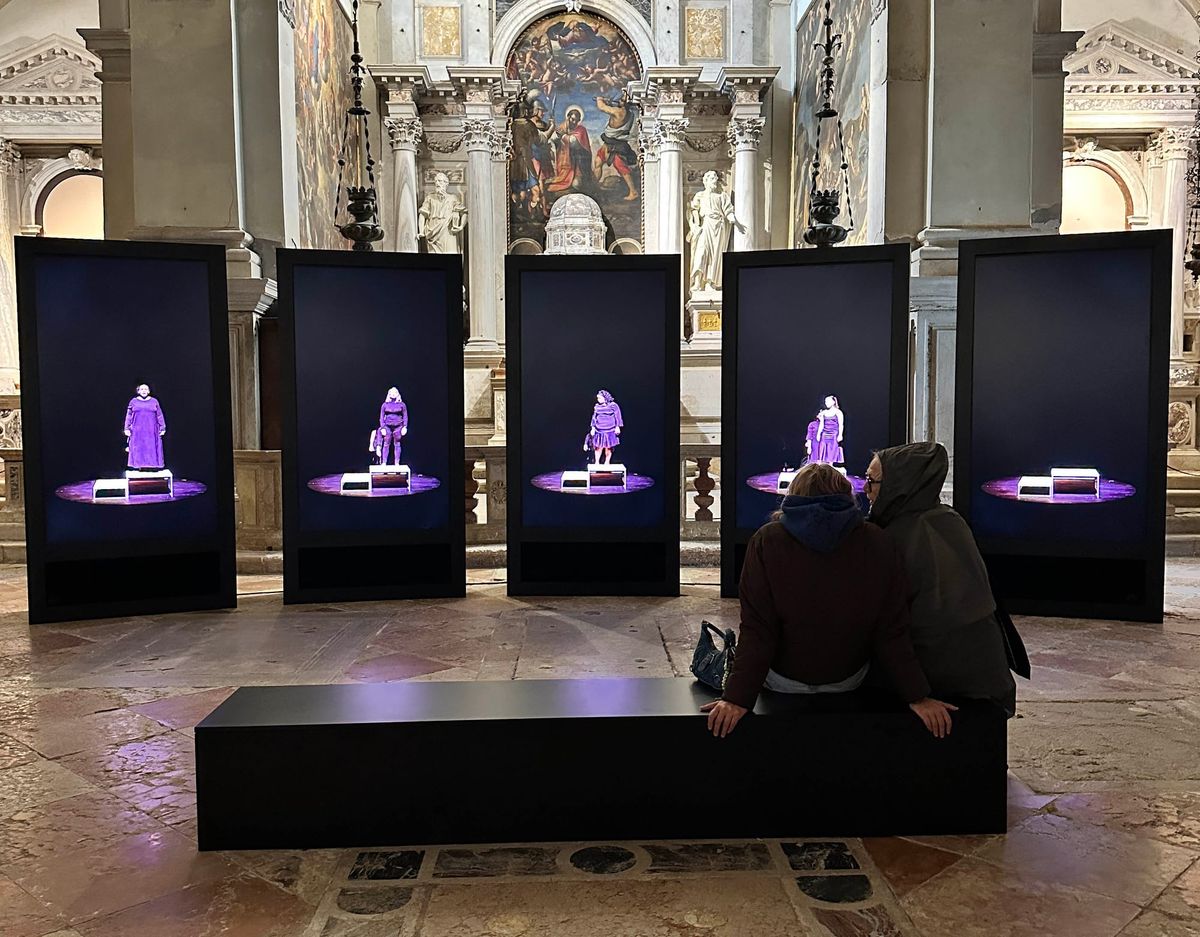
VENICE — Within the ornate confines of Chiesa di Sant’Antonin, Gabrielle Goliath presents Elegy, which serves as South Africa’s unofficial pavilion for the 61st Biennale Arte. This unofficial status is due to South Africa’s Culture Minister Gayton McKenzie’s decision that overturned the independent committee’s choice of the nation’s representative. McKenzie, leading the Patriot Alliance, a pro-Israel far-right party, claimed the platform was used to advance a geopolitical message related to Israel’s actions in Gaza. This decision contrasts with South Africa’s prior legal actions at The Hague, supported by over 30 countries, challenging the legality of Israel’s conduct.
Goliath, along with curator Ingrid Masondo, legally contested McKenzie’s decision, but the South African courts dismissed their case. The exclusion of Goliath’s work from the Biennale is particularly striking when one experiences the installation itself, which is both haunting and tender. Her three works in the Elegy series honor victims of violence: Elegy—Ipeleng Christine Moholane (2015) commemorates a South African student victim of femicide; Elegy—for two ancestors (2024) remembers women killed during the Ovaherero and Nama genocide by German colonial forces; Elegy—for a poet (2026) pays tribute to Palestinian poet Heba Abunada, killed in an Israeli airstrike in Khan Yunis in October 2023.
Each piece features individuals on freestanding LED screens, singing a sustained note until they falter, at which point another takes over. The number of screens varies, with the final screen in the Gaza piece left empty, symbolizing an invitation to participate or a placeholder for future victims. In the church’s acoustics, the voices blend into a chorus, linking these acts of violence through sound and geopolitics. Goliath’s work doesn’t objectify the victims but keeps their memory present without turning them into spectacles.
These mournful pieces serve as calls to action. Goliath emphasizes the necessity of collective mourning as a means of building solidarity, a collective act that can lead to change. The situation in Gaza highlights the importance of naming atrocities to confront them collectively, reflecting on our sadness, anger, and complicity. Venice currently hosts numerous works addressing global violence, but Goliath’s Elegy stands out by encouraging active engagement beyond passive witnessing.
Other notable works include Lawrence Abu-Hamdan’s forensic sound analysis of a sonic weapon used against Serbian protesters, Roman Khimei and Yarema Malashchuk’s future reckoning for Russian soldiers, Amar Kanwar’s focus on Myanmar’s democracy struggle, Zhanna Kadyrova’s plant rescue project in Ukraine, and Dana Awantani’s reconstruction of endangered religious sites. These artworks, including Goliath’s, compel us to transform empathy into action, fostering a collective responsibility to preserve life.