On a grand mantelpiece in a mansion at 1 East 70th Street, Manhattan, lies a vivid portrayal of the English Renaissance’s intricacies. Hans Holbein the Younger’s circa 1527 ‘Portrait of Sir Thomas More’ and his 1532 ‘Portrait of Thomas Cromwell’ (a contemporary copy of the lost original) are displayed at opposite ends of Henry Clay Frick’s New York estate, now known as the Frick Collection.
Sir Thomas More, a renowned humanist and Lord Chancellor of England, is depicted with a stern expression, sharp features, and a distant gaze in his portrait. Dressed in luxurious red and black velvet, the Tudor rose chain adorns his neck. As Elizabeth Goldring explains in her book ‘Holbein: Renaissance Master,’ this portrait aimed to present More as the ideal Tudor statesman, a concept Stephen Greenblatt describes as ‘Renaissance self-fashioning.’ This publication, by Yale University Press and the Paul Mellon Centre for Studies in British Art, provides insight into Holbein’s genius through detailed analysis and reproductions.
Nearby, on the opposite side of the Frick’s mantle, is the portrait of More’s political adversary, Thomas Cromwell. Unlike the Catholic More, Cromwell dons a simple, black Protestant robe, with fur lining to keep warm. His eyes, sharp and penetrating, seem to challenge More across the fireplace. Both men, despite their differences, ultimately met the same fate—beheading on the orders of the king they served.
In the five-year gap between Holbein’s creation of these portraits, the portrayal of 16th-century England unfolds. More is seen as an advocate of Renaissance learning and a martyr for the Church, marked by his hair-shirt. Cromwell, meanwhile, represents the shrewd operator who paved the way for reform under King Henry VIII, yet fell from favor. Holbein’s portraits present them as complex, believable characters, united by intelligence, ambition, and humanity.
Elizabeth Goldring’s study emphasizes Holbein’s status as a cosmopolitan painter, equally comfortable in Augsburg, Basel, and London. He excelled in various artistic disciplines, particularly portraiture. Holbein’s works, such as the series of portraits of Erasmus, reveal his exceptional skill in capturing the essence of his subjects. His mastery of depicting hands is evident in his studies of Erasmus’s hands, a metaphor for the unity of mind and matter.
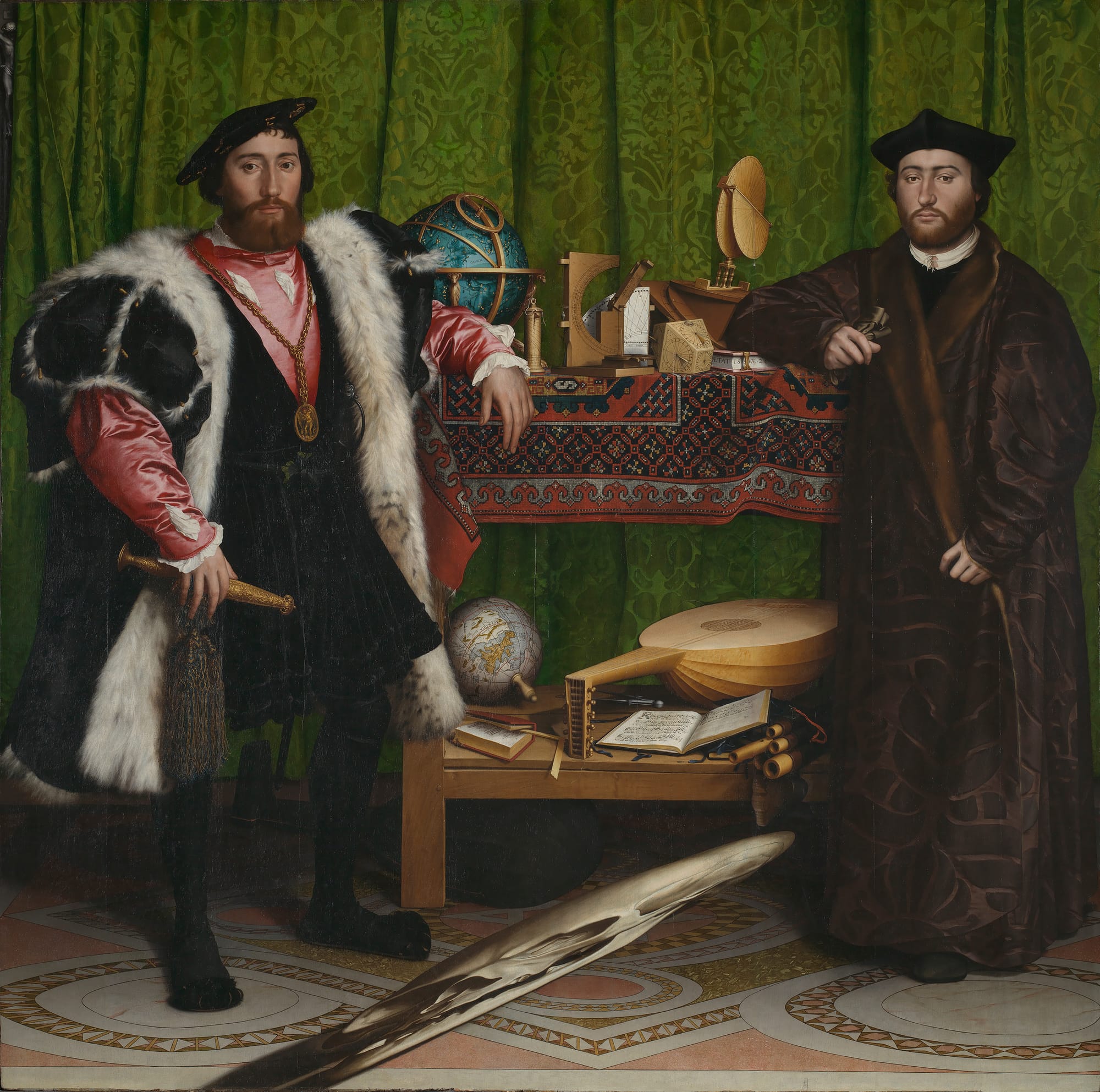
Holbein’s career pinnacle is the 1533 dual portrait ‘The Ambassadors,’ showcasing French diplomats Jean de Dinteville and Georges de Selve. This masterpiece, displayed at the National Gallery of London, combines Renaissance humanism with its subjects’ reality. Featuring dials, globes, and an anamorphic skull, the painting conveys the proximity of life and death. Holbein’s remarkable talent, however, was not without peril. His 1539 portrait of Anne of Cleves, arranged by Cromwell, led to political turmoil when King Henry VIII was disappointed by Anne’s appearance upon her arrival at court.
While many of Holbein’s subjects faced execution, the artist himself avoided such a fate. Goldring’s book delves into Holbein’s extraordinary talent, which captivated even a tyrant like Henry VIII. As the king famously remarked, ‘I could make seven earls from seven peasants if it pleased me, but I could not make one Hans Holbein out of seven earls.’