The Metropolitan Museum of Art’s exhibition, Seeing Silence: The Paintings of Helene Schjerfbeck, offers Americans a rare chance to appreciate the extraordinary work of an artist who remains largely unfamiliar in the United States. Although Schjerfbeck is not a newly uncovered talent, her acclaim is well-established in Nordic countries, especially in Finland, where she holds cultural significance similar to Edvard Munch’s in Norway. Her relative obscurity in America can be attributed to the fact that most of her artworks are housed in Finnish and Swedish collections, with The Met’s recent acquisition of her piece, “The Lace Shawl” (1920), marking the only major collection presence in the U.S.
The exhibition has the potential to elevate Schjerfbeck to international prominence, akin to the impact of the 2018 Guggenheim exhibition of Hilma af Klint. Schjerfbeck’s work, characterized by its exceptional quality, is prominently represented by her numerous self-portraits. Born in Helsinki in 1862, when Finland was under Russian rule, she grew up in a Swedish-speaking family, which facilitated her interactions with other Nordic artists during her time in Paris starting in 1880. Although her talents were evident from a young age, as shown by her enrollment at the Drawing School of the Finnish Art Society at 11, she studied at the Académie Colarossi since the École des Beaux-Arts did not admit women.
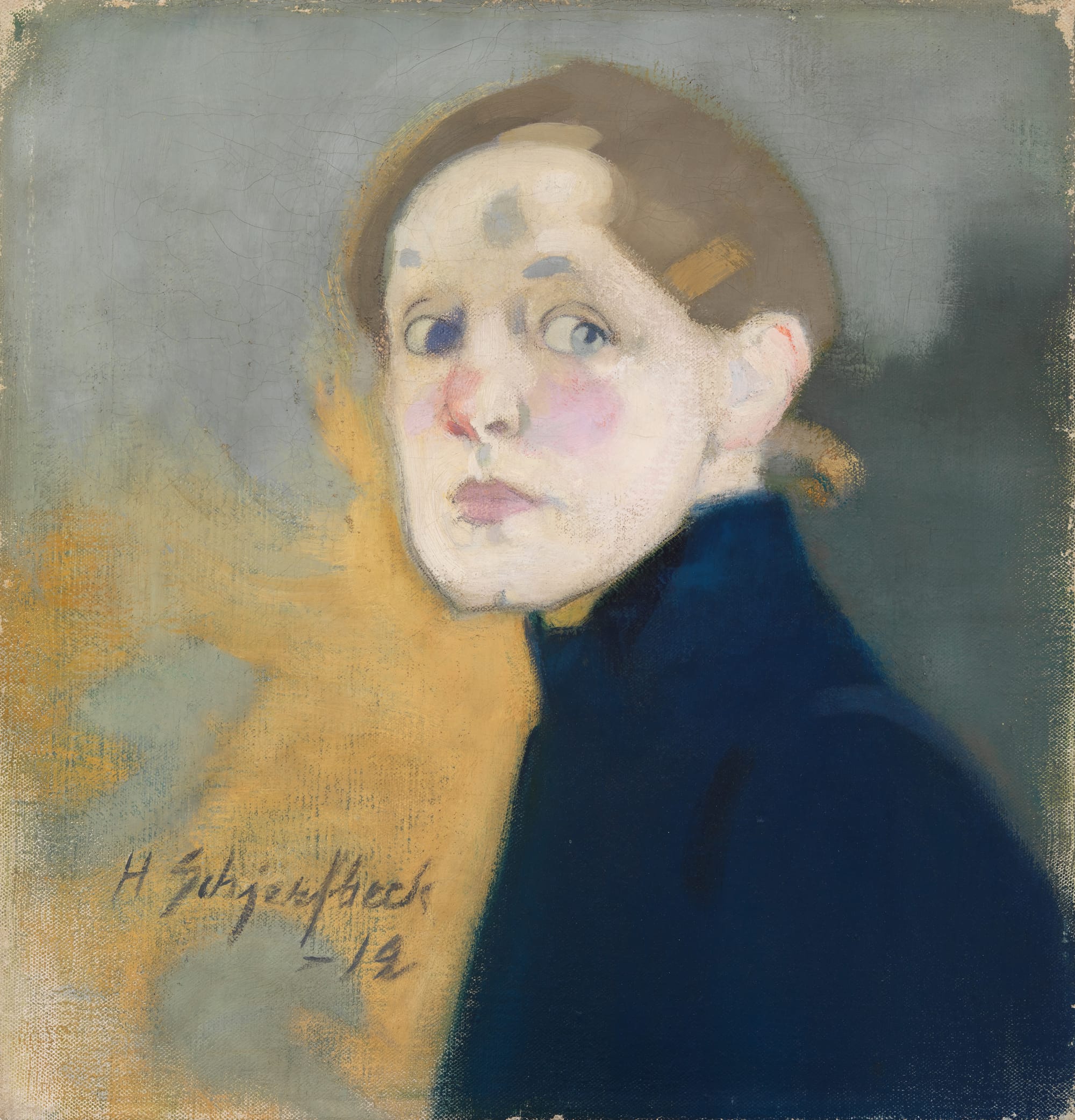
A notable piece in the exhibition is “Portrait of Helena Westermarck” (1884), capturing her lifelong friend and fellow artist. Schjerfbeck’s recollections of their time in Paris reflect her passion for painting without grand future plans. Her artistic journey is documented through her self-portraits, beginning with a confident “Self-Portrait” (1884–85) created during her Paris studies. These portraits, numbering 40, span from her early 20s to her final years, offering poignant insights into her development as an artist and the inevitable toll of aging.
Schjerfbeck’s return to Finland in 1890 marked a new phase, where she transitioned from naturalism to a distinct style characterized by simplified forms and symbolic colors. While the exhibition highlights influences from French artists and older European traditions, it omits references to her Nordic contemporaries like Vilhelm Hammershøi and Edvard Munch, whose work resonates with hers. Schjerfbeck’s piece “The Tapestry” (1914–16) evokes a similarity to Munch’s “Two Human Beings. The Lonely Ones,” and her “Fragment” (1904) recalls the texture of Munch’s “The Sick Child.”
The exhibition concludes with a dramatic display of her later self-portraits, which reflect her unyielding exploration of self and mortality. Works such as “Self-Portrait with Red Spot” (1944) and “Self-Portrait in Black and Pink” (1945) confront aging and death with a fearless intensity. Schjerfbeck’s reflections on her life, as shared with a former love interest, underscore a life marked by both sorrow and joy. Seeing Silence: The Paintings of Helene Schjerfbeck is on view at the Metropolitan Museum of Art through April 5, curated by Dita Amory and Anna-Maria von Bonsdorff in collaboration with the Finnish National Gallery / Ateneum Art Museum.