MADRID — A striking image of Maruja Mallo, captured by poet Pablo Neruda in 1945, shows her enveloped in seaweed on a Chilean beach, exuding the aura of a marine deity. This carefully crafted photograph reflects Mallo’s self-view as an integral part of her art, where female energy harnesses natural and cosmic powers.
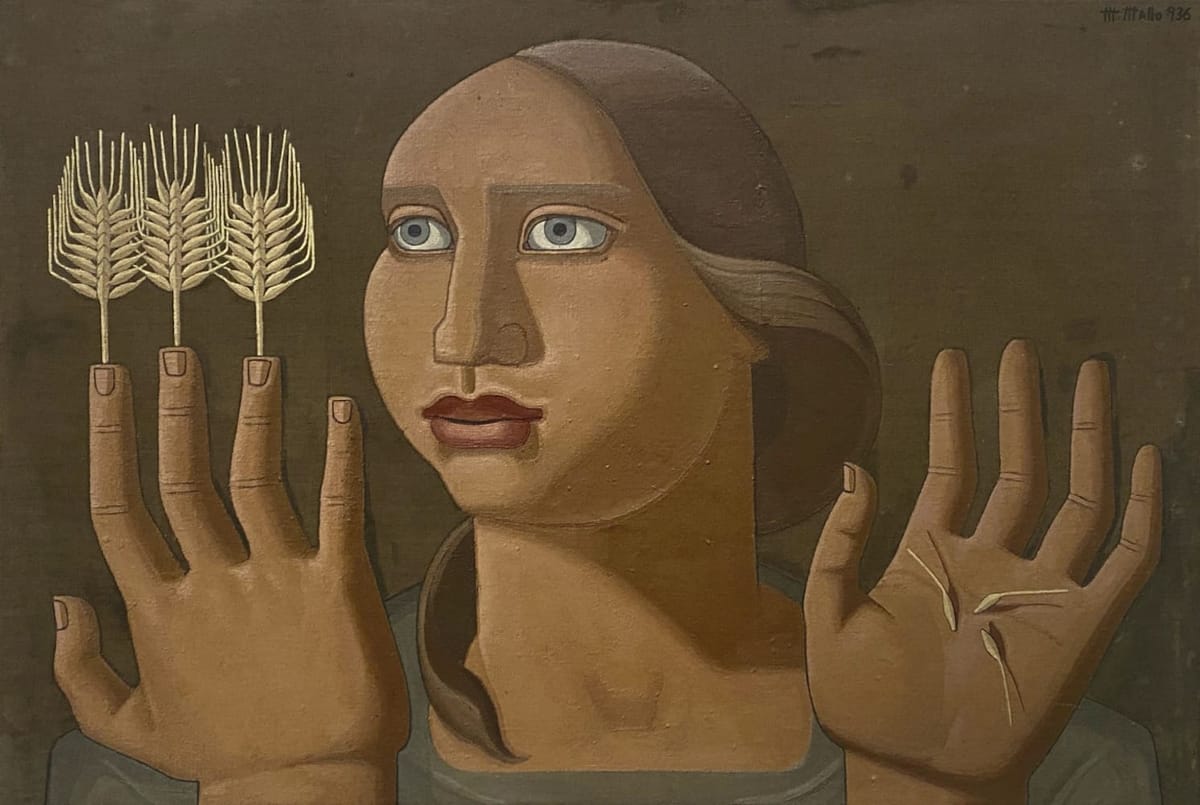
The Museo Nacional Centro de Arte Reina Sofía hosts the largest-ever retrospective of Mallo’s work, titled ‘Maruja Mallo: Mask and Compass’. Curated by Patricia Molins, the exhibit showcases 100 paintings, 70 drawings, and 100 archival items, including writings, self-portraits, and notebooks, offering a comprehensive view of Mallo’s diverse achievements.
Born Ana María Gómez González in Viveiro, Galicia, in 1902, Mallo trained at the Real Academia de Bellas Artes de San Fernando in Madrid. She mingled with icons like Luis Buñuel, Salvador Dalí, and Federico García Lorca, becoming part of the avant-garde Generación del ‘27. Though linked with various art movements, her distinct style eventually set her apart, limiting her recognition beyond Spain.
Three decades posthumously, this exhibition cements Mallo’s status as a major 20th-century artist. Her early works featuring athletic women challenged societal norms, while her vibrant ‘Verbenas’ series celebrated urban life. Her later works, influenced by the Spanish Civil War and life in South America, continued to explore themes of universality and natural order.
Mallo’s later period is marked by paintings of floating masks and ethereal figures, reflecting her experiences of exile and nonconformity. By the 1970s, she turned her gaze to cosmic themes, creating mystical artworks that reinforce her legacy in modern art. The exhibition is on view at the Museo Nacional Centro de Arte Reina Sofía in Madrid until March 16.