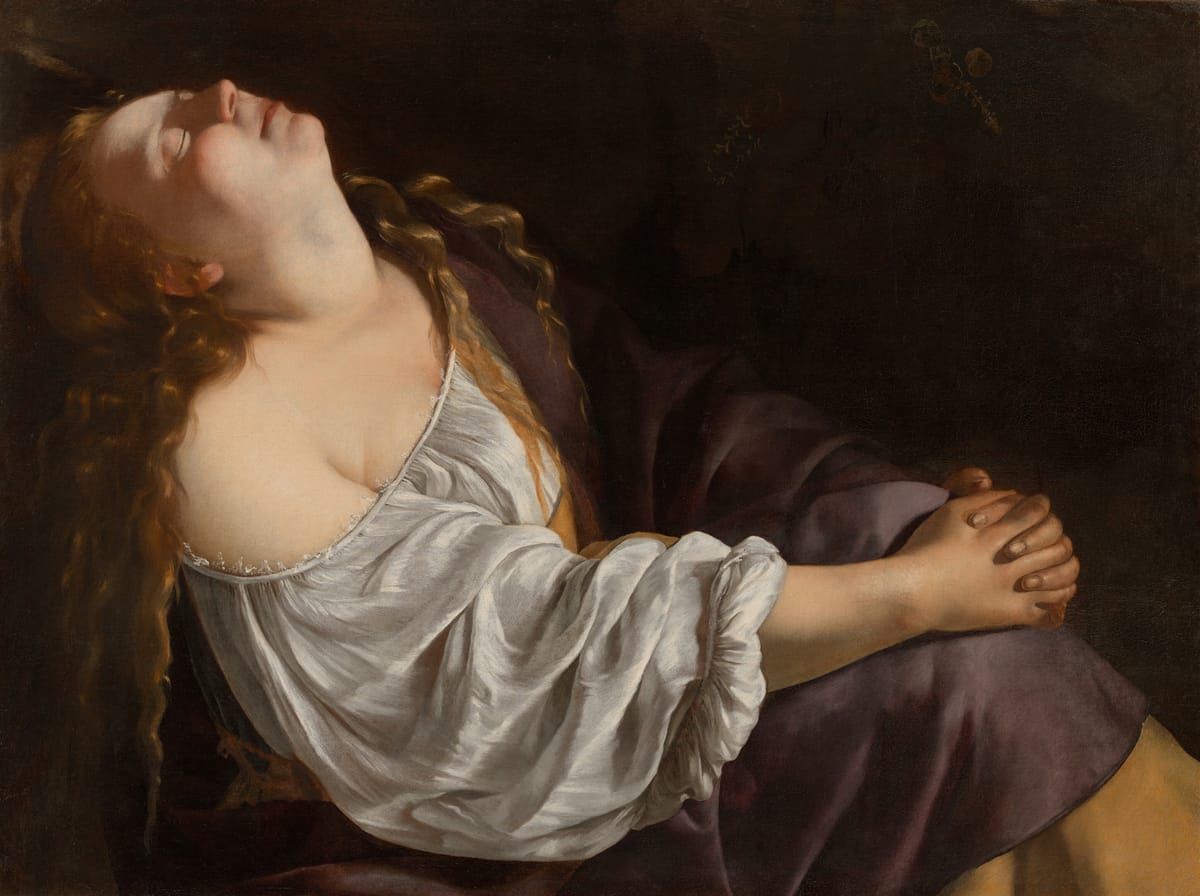
The National Gallery of Art in Washington, DC, has made a significant addition to its collection by acquiring a painting by renowned Italian Baroque artist Artemisia Gentileschi. The work, titled “Mary Magdalene in Ecstasy” (c. 1625), marks a historic first for the gallery. Believed lost for many years, the painting resurfaced in 2011 from a private collection in France and was sold at Sotheby’s in 2014. It made its U.S. debut in the 2021–22 exhibition By Her Hand: Artemisia Gentileschi and Women Artists in Italy, 1500-1800, showcased at both the Wadsworth Museum of Art in Connecticut and the Detroit Institute of Art.
The exhibition was co-curated by Eve Straussman-Pflanzer, now the curator and head of Italian and Spanish Paintings at the NGA. She noted in an email to Hyperallergic that Gentileschi’s most compelling works were produced in the early 1620s, during the peak of her career. “In this period, Artemisia Gentileschi offers the viewer her most confident pictures, including our newly acquired ‘Mary Magdalene,’ where the figures, male or female, are fully realized, sentient human beings,” Straussman-Pflanzer explained.
The painting draws inspiration from Caravaggio’s earlier depiction but omits traditional elements like the skull, cross, and ointment jar, instead focusing on Mary Magdalene’s solitary life in a cave following Christ’s ascension. In the painting, she reclines with closed eyes and a tilted head, exuding a spiritual yet sensual aura through her unbound hair and exposed shoulder. Despite the intimate framing, the figure appears oblivious to the viewer, a testament to Gentileschi’s skill in engaging audiences through her subjects and self-portraits.
Renowned for her ability to blend feminine strength and vulnerability, Gentileschi is celebrated for works such as “Judith Beheading Holofernes” and “Susanna and the Elders.” In this newly acquired work, Mary Magdalene’s spiritual fervor is shared with the viewer. “We feel and experience this conversion/change along with her,” Straussman-Pflanzer remarked.
The acquisition highlights the prowess of 17th-century women artists, underscoring their ability to convey profound human emotions and experiences. “They were able to capture the power of human emotion and human experience — in this case religious conversion — and transmit it in a vivid and powerfully evocative picture that captures the complexity of human experience, especially that of a woman undergoing a profound emotional and mental change,” Straussman-Pflanzer emphasized, recognizing this as Artemisia Gentileschi’s unique contribution.