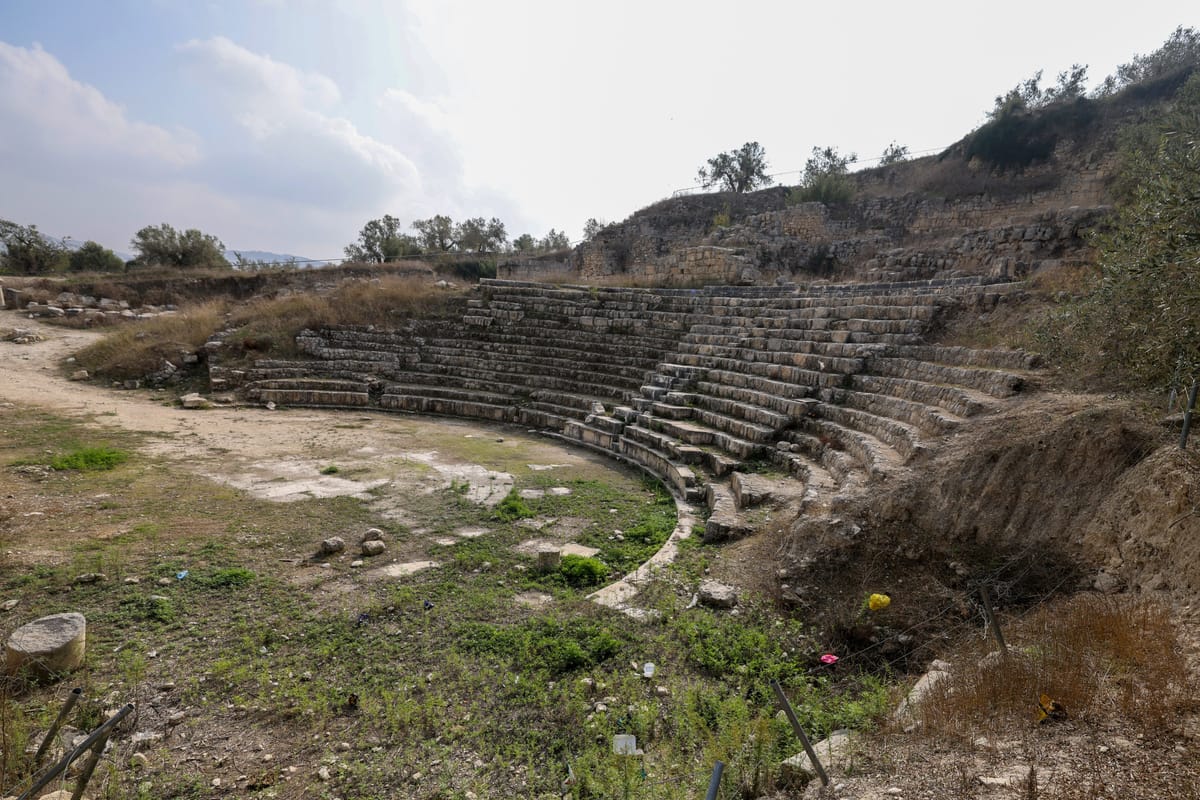
The inhabitants of Sebastia, a village in the Occupied West Bank, are expressing deep concern and anger over Israel’s official announcement last November to seize control of their town and its adjacent archaeological site. The Guardian reports that locals fear Israel’s intention to develop the area into a tourist attraction for Jewish settlers will devastate their community.
Located a few miles northwest of Nablus, Sebastia, historically known as Samaria (or Shomron in Hebrew), served as the capital of the northern Kingdom of Israel during the Iron Age until the Assyrian conquest in 722 BCE. With a history of approximately 3,000 years of continuous habitation, the area is rich in archaeological and architectural remnants from various religious and imperial periods. The ruins, which are situated on a hilltop within the boundaries of the Occupied West Bank, are close to the village where 3,500 Palestinians reside.
The archaeological site features walls encircling a neglected acropolis, a Roman amphitheater, fragments of a temple honoring Emperor Augustus, and a Hellenistic tower. Israel’s contentious plans include constructing a visitor center, parking facilities, and a perimeter fence, which would restrict villagers’ access to the ruins and their olive groves, severely affecting their livelihoods from tourism and olive products. Additionally, an access road is proposed to connect directly to Israel, bypassing the West Bank town.
Alon Arad, head of Emek Shaveh, a Jerusalem-based archaeological NGO, highlighted in a December piece for +972 Magazine that the expropriation of around 450 acres of private land represents the largest seizure of Palestinian land so far. Arad stated, “[…] Sebastia’s archaeological significance only sharpens the political contradiction at hand: While the site merits careful study, the gulf between the ethical commitments claimed by Israeli archaeologists and the state violence carried out in archaeology’s name to justify steps toward annexing the West Bank has never been more stark.” Hyperallergic has reached out to Arad and Emek Shaveh for further remarks.
Israel frequently underscores the archaeological value and Jewish heritage ties of the land to justify its control, supported by extensive state funding, sponsored digs, and settlement expansions. Critics argue that Sebastia has a complex history shaped by successive Assyrian, Roman, Byzantine, Islamic, Crusader, Ottoman, and British influences, accusing Israel of “archaeological cleansing” to mask its territorial ambitions. “It is not right just to focus on one or other period,” stated Wa’ala Ghazal, a local curator at a museum within a 13th-century mosque, which has served various religious roles over centuries, including as a Crusader cathedral and a Byzantine church where John the Baptist was supposedly buried.