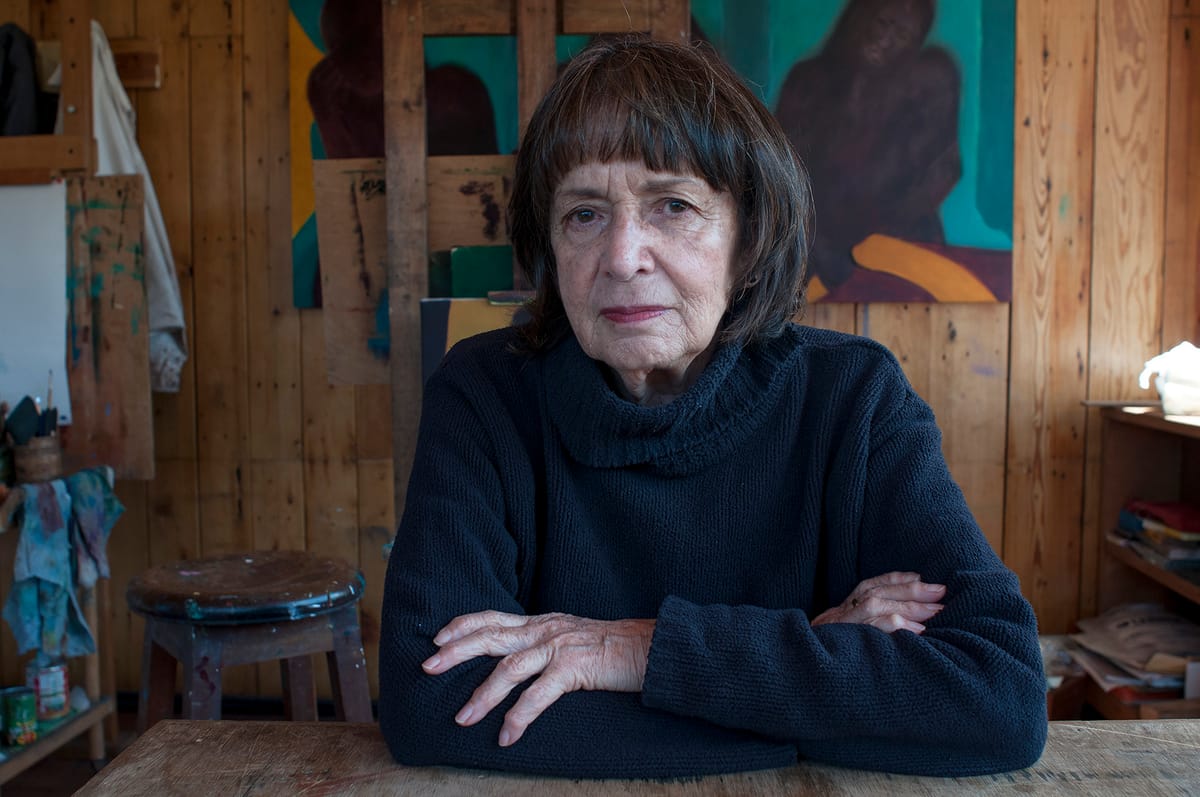
Beatriz González, an influential figure in contemporary Latin American art, passed away at her home on January 9, aged 93. Known for her bold color choices and innovative use of furniture as canvases, González’s work focused on capturing the collective memory of Colombia, often portraying political upheavals, violence, and loss. Her gallery, Casas Riegner in Bogotá, confirmed her passing.
While often linked to Pop Art due to her use of popular culture and mass media images, González insisted this was a misinterpretation. Her art was deeply rooted in Colombian visual culture, distinct from the American and European scenes. Unlike contemporaries such as Andy Warhol and Richard Hamilton, who mirrored consumer culture, González critically examined the relationships between taste and social class.
Beginning in 1962, she adapted classical artworks by Diego Velázquez and Johannes Vermeer onto industrial furniture, later drawing on newspaper images and mass-produced chromolithographs from Gráficas Molinari. This choice was an exploration of how these images influenced individual perceptions. “I discovered pleasure in gaudy objects,” González said in a 2020 interview. “Bad taste can coexist with good taste.”
Violence and trauma were pivotal in her art, exemplified by her work “Auras anónimas” (2007–09) at Bogotá’s Central Cemetery. She and artist Doris Salcedo fought to save columbaria for anonymous victims, creating 8,956 headstones to honor Colombia’s disappeared. “It relies on repetition to preserve memory,” she explained, aiming to keep the memory of the missing alive.
Born in Bucaramanga on November 16, 1932, González moved to Bogotá in 1956 to study architecture. Her career included roles at the Museo de Arte Moderno de Bogotá and the Museo Nacional de Colombia. Influenced by mentors like Juan Antonio Roda and Marta Traba, she began exhibiting in the early 1960s and married architect Urbano Ripoll Rodríguez in 1964. Despite calling herself a “provincial artist,” her work resonated globally, participating in events like the São Paulo Biennial and Documenta 14.
Her legacy includes major exhibitions, such as a 2019 retrospective at the Pérez Art Museum Miami and the Museum of Fine Arts, Houston. PAMM Director Franklin Sirmans noted her focus on global cultural dynamics. Lotte Johnson of the Barbican Art Gallery praised her critique of Western art history and her tributes to grief and violence. Catalina Casas Riegner, her gallerist, expressed a commitment to promoting González’s extensive body of work.