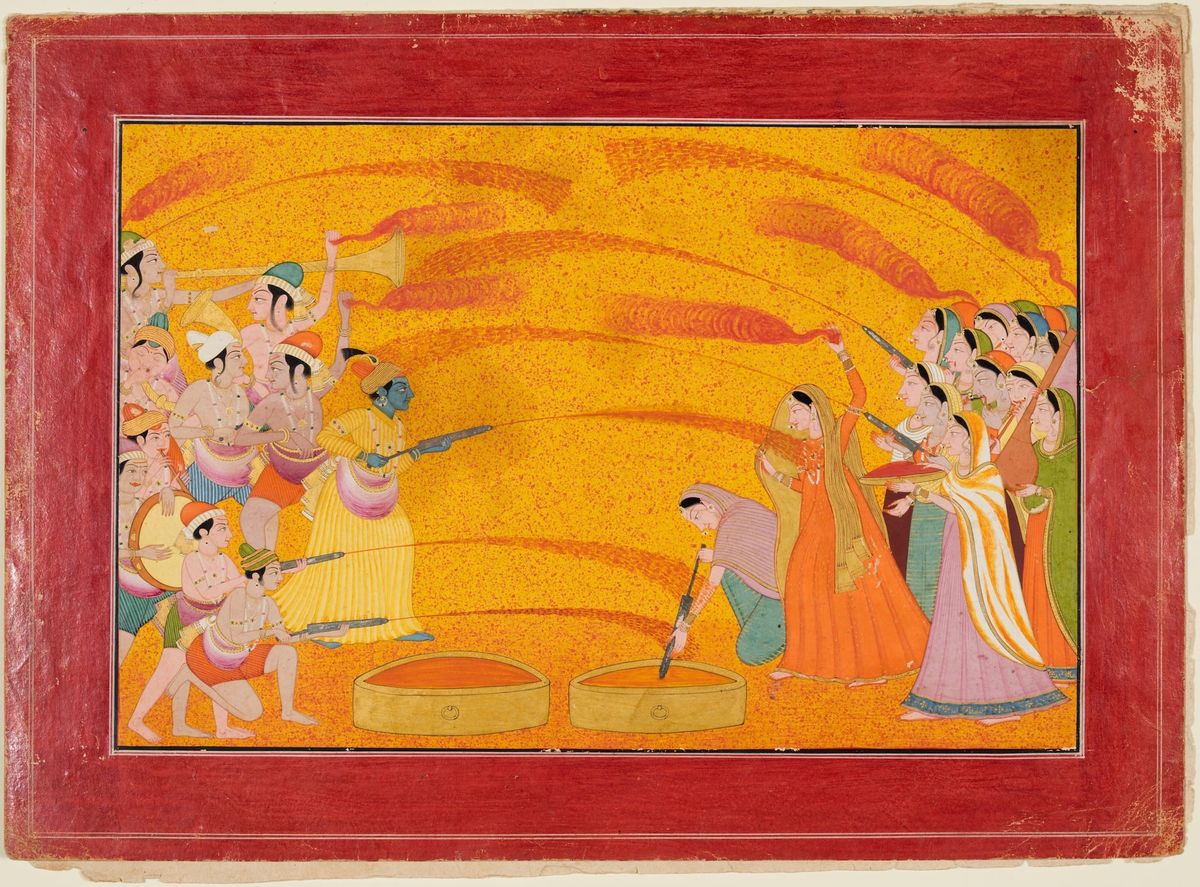
In the luminous 1760 painting “Taking of the toll (Dana-Lila),” Radha, the Hindu goddess of devotion, catches a startled Krishna after he steals toll money from her maiden companions, the gopis. Scholars say the work resembles two other paintings derived from a workshop drawing model, though its place of origin remains uncertain. Formal analysis suggests that “Dana-Lila” most likely came from the 18th-century kingdom of Chamba, which was then home to at least 16 established artist families. Chamba, along with Kangra, Nurpur, and other areas in India, sits where the Himalayas meet the plains of Punjab in what is now Himachal Pradesh, forming the Pahari region.
The expansive new catalog Pahari Paintings: Art and Stories (2026) draws on works once assembled by scholar Catherine Glynn Benkaim, whose collection has since been acquired by the Cleveland Museum of Art, the Cincinnati Art Museum, and the National Museum of Asian Art. The hardcover volume offers striking reproductions, a sharp introductory essay by curator Sonya Rhie Mace and art historian Sarang Sharma, and detailed analytical entries. Building on the foundational scholarship of B. N. Goswamy on Indian painting, the book focuses closely on the prolific lineages of artists and workshop systems in the Pahari region.
Unlike the better-known traditions of Rajput painting from the independent Hindu courts of Rajasthan or Mughal (Indo-Persian) manuscript illumination, Pahari painting most often centered the intimate devotion of Radha and Krishna. Artists including court painter Sajnu were highly mobile across the established kingdoms of the Western Himalayas. Art historian Debra Diamond writes that in the folio The goddess Sumukhi, from a Mahavidya (circa 1800), Sajnu and other workshop artists blended Kangra and Mandi styles, producing deities with stronger features and more animated expressions.
In the rare instances when artists crossed state borders, the record includes Purkhu, who left his family workshop in Kangra to work for Maharaja Ranjit Singh in present-day Lahore. These movements underscore the regional and interconnected nature of Pahari art, even as it developed distinct visual and devotional traditions. The new catalog places that history at the center of a broader reassessment of the field.