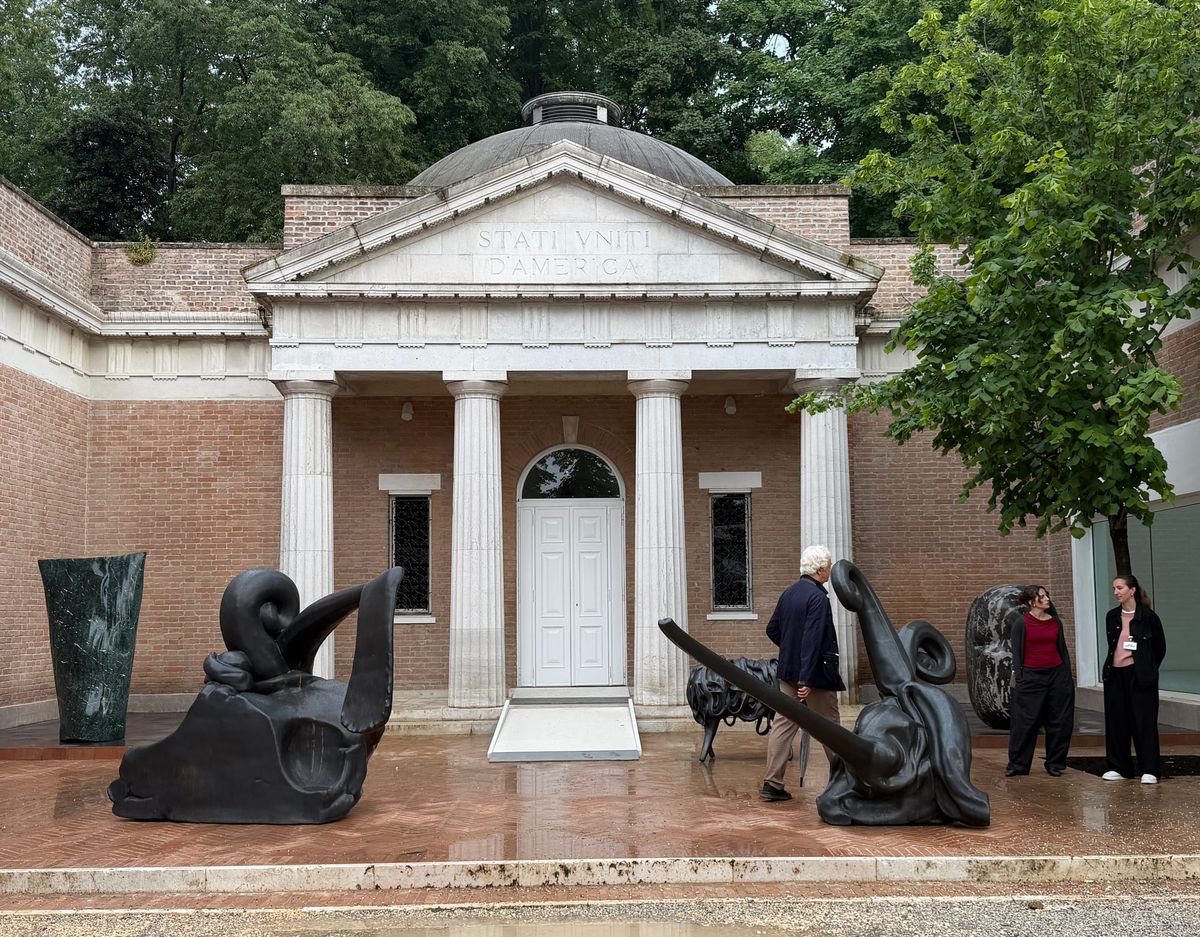
VENICE — At the Venice Biennale, Alma Allen’s US pavilion presents an exhibition that feels devoid of message or impact, curated by Jeffrey Uslip, who stepped down from a previous role in 2016 amid allegations of “racial insensitivity.” Titled Call Me the Breeze, sharing its name with a 1974 Lynyrd Skynyrd track, the show features sculptures that are amorphous and inspired by nature, crafted from materials like bronze, wood, and stone. Despite the evocative potential of a refreshing breeze, the pavilion leaves one feeling unchanged.
The essence of Allen’s work lies in his choice of materials, such as the Colorado Yule marble, known for its use in the Lincoln Memorial in Washington, DC. The sculptures are challenging to decipher; some resemble organic forms like worms, while a large gold piece suggests a cactus. Outside, a sculpture could be either a lamb or a pile of spaghetti. A gallery attendant explained Allen’s method: shaping materials with his fingers without looking, and if he likes the result, he magnifies it into a larger piece. This style of art, appealing to high-end collectors, is both non-threatening and visually impressive, fitting comfortably alongside collections of African masks.
Following impactful installations by Jeffrey Gibson and Simone Leigh in previous biennales, Allen’s exhibit feels lackluster. The selection process, disrupted during the Trump administration, became a chaotic spectacle. The exclusion of National Endowment for the Arts experts led to the selection of curator John Ravenal and artist Robert Lazzarini, whose proposal fell through due to financial and political issues. The lesser-known American Arts Conservancy, headed by Jenni Parido, ultimately chose the artist. Uslip was tasked with finding an artist and after rejections from Barbara Chase-Riboud and William Eggleston, selected Allen, a Utah-born sculptor residing in Mexico.
Sponsors of Allen’s pavilion remained unknown until the Venice preview, where a plaque listed donors like businessman John Phelan and fashion designer Tommy Hilfiger. Uslip describes Allen’s sculptures as reflecting contemporary life’s realities and human fragility. While I can’t fully agree, he correctly notes the work avoids definitive stances. The highlight for me was the piece in white Colorado Yule marble, shaped like a portal, hinting at an escape to a more engaging US pavilion in another universe.
Alma Allen: Call me the Breeze is on display at the United States pavilion during the 2026 Venice Biennale (Giardini della Biennale, Calle Giazzo, Venice, Italy) until November 22. The exhibition is curated by Jeffrey Uslip.