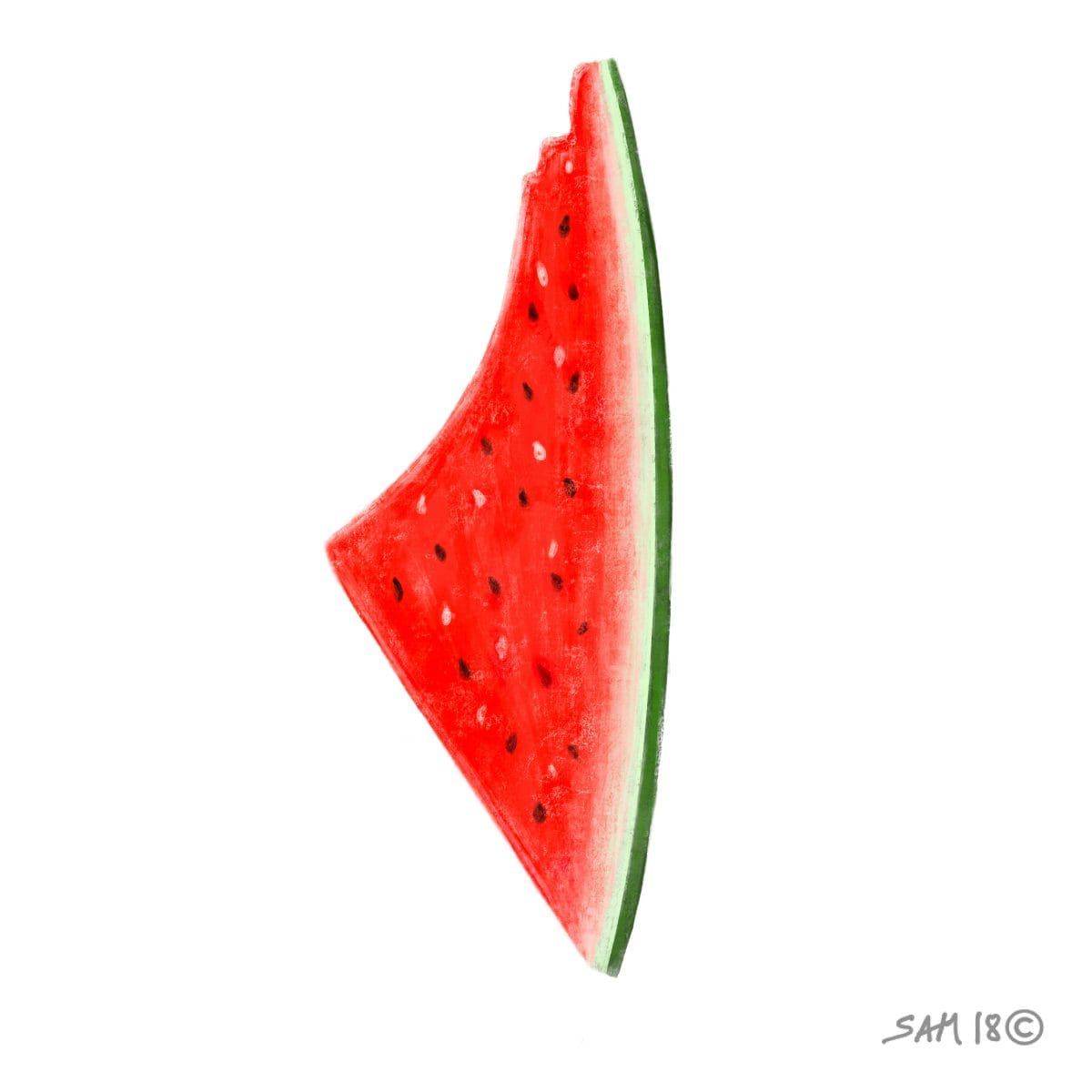
In the context of occupied Palestine, the watermelon has emerged as a potent emblem of resistance. Its hues, echoing those of the Palestinian flag, can be spotted from Gaza’s stone walls to the art spaces of Ramallah, reflecting the political significance of this beloved summer fruit. Over time, it has become a public expression of cultural identity, prominently featured in artworks that symbolize the Palestinian struggle against Israeli apartheid.
Today, a new wave of artistic expression is taking root online, connecting Palestinians globally and drawing inspiration from historical movements for free expression. Since the uprisings in Sheikh Jarrah, a minimalist silkscreen watermelon has gained renewed attention thanks to younger artists. This resurgence highlights the ongoing narrative of resistance, particularly since the Israeli government’s 1967 ban on public displays of the Palestinian flag and its colors.
In the 1980s, three artists—Nabil Anani, Sliman Mansour, and Isam Bader—faced arrest for incorporating the flag’s colors into their works. Mansour recounted in an AJ+ interview how an Israeli police officer attempted to dissuade them from creating political art. The act of even depicting a watermelon could lead to confiscation, as the officer warned. Thus, the watermelon grew into a symbol of defiance, inspired ironically by the very forces trying to suppress it.
Historically, before the 1948 Nakba, Palestinian watermelons from regions like Jenin and the Jordan Valley were renowned worldwide. The introduction of Israeli seed companies post-occupation displaced Palestinian growers. Despite these challenges, Palestinian watermelons are celebrated for their size and quality, with locals distinguishing them from those grown in Israeli greenhouses, which were sometimes used in protests against IDF tanks.
In recent times, Palestinian artists have embraced the watermelon as a symbol of protest art. Khaled Hourani’s series, The Story of the Watermelon, has found new relevance. His work, depicting a simple yet powerful pixelated watermelon, resonates as a statement of identity and resistance. From paintings to graphic designs, this symbol permeates artistic mediums, embodying the enduring Palestinian struggle for recognition and justice.