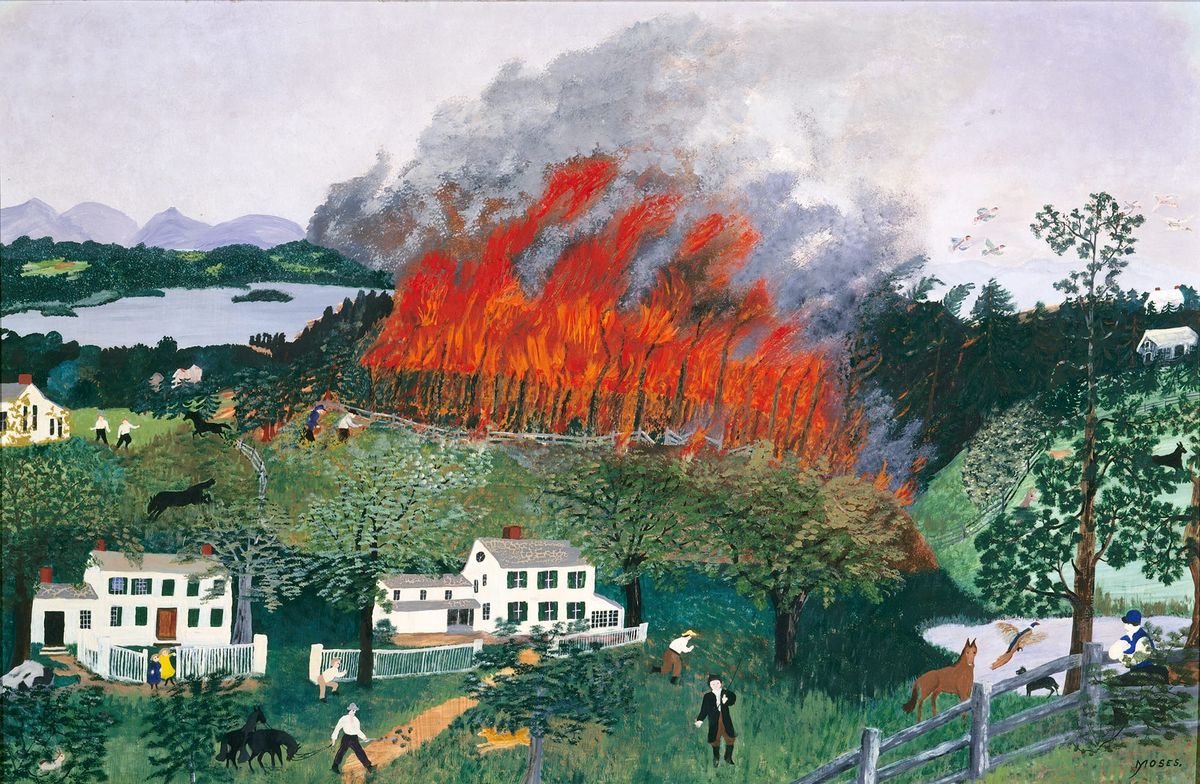
WASHINGTON, DC — The Smithsonian American Art Museum’s exhibition, Grandma Moses: A Good Day’s Work, faced a month-long postponement due to the 2025 government shutdown. Although the curatorial team isn’t to blame, this delay highlighted the powers at play in the U.S. The exhibition opens with unexpected scenes of landscapes ablaze or under stormy skies, contrasting with the artist’s typical serene rural depictions. While these dramatic scenes initially intrigued me, the exhibition’s conservative approach to Moses’s work quickly quelled this excitement. The exhibit’s scale is impressive, showcasing a large portion of her work but lacks fresh interpretations or justifications for its evocative title, instead offering a didactic biography.
This lack of interpretive depth is disappointing, especially given the exhibition catalog’s insightful essays that challenge existing scholarship on Moses. Blaming Trump’s executive order “Restoring Truth and Sanity to American History” for this cautious stance is easy, yet it points to a broader issue: maintaining myths central to U.S. exceptionalism. While Moses’s rise as a renowned U.S. artist is remarkable, her diverse body of work deserves more thorough critique. The exhibition’s simplistic narrative inadvertently perpetuates problematic values inherent in American history.
Anna Mary Robertson Moses, born in 1860 in Washington County, New York, learned domestic skills on a farm before moving to Virginia with her husband, Thomas Salmon Moses. After 18 years and the birth of 10 children, they returned to upstate New York, where Moses eventually turned to painting due to arthritis. Discovered by art collector Louis Caldor in 1938, she became a beloved figure, her art widely reproduced. Despite the show noting her age, it doesn’t explore how it influenced her artistry. Erika Doss, in her essay, argues that as life expectancy rose, older Americans were marginalized, yet Moses embodied resilience. Her paintings, such as “Early Springtime on the Farm” and “White Birches,” reflect her aging process, a nuance the exhibition overlooks.
The exclusive display of White figures in Moses’s works presents another oversight. This racial bias is apparent in her Virginia depictions, where she employed Black workers yet only White figures appear in paintings like “Calhoun” (1955). Despite the catalog engaging with racial dynamics, the exhibitions fail to address these complexities. Race is linked to another weak aspect of Moses’s practice: figure painting, often detracting from her otherwise serene landscapes. The debate over Moses’s artistic merit—whether her work is fluffy or extraordinary—remains unresolved as some paintings are visually stunning while others contain aesthetic flaws.
Grandma Moses: A Good Day’s Work feels static, offering little new for audiences familiar or unfamiliar with her story. By avoiding complex discussions, the exhibition diminishes Moses’s legacy. However, deeper insights into her work could challenge harmful myths while celebrating her as a beloved American artist. The exhibition runs at the Smithsonian American Art Museum until July 12 and will travel to the Crystal Bridges Museum of American Art from September 12, 2026, to March 29, 2027. Organized by Leslie Umberger, Randall R. Griffey, and Maria R. Eipert, the exhibition aims to present a comprehensive view of Moses’s significant contributions.