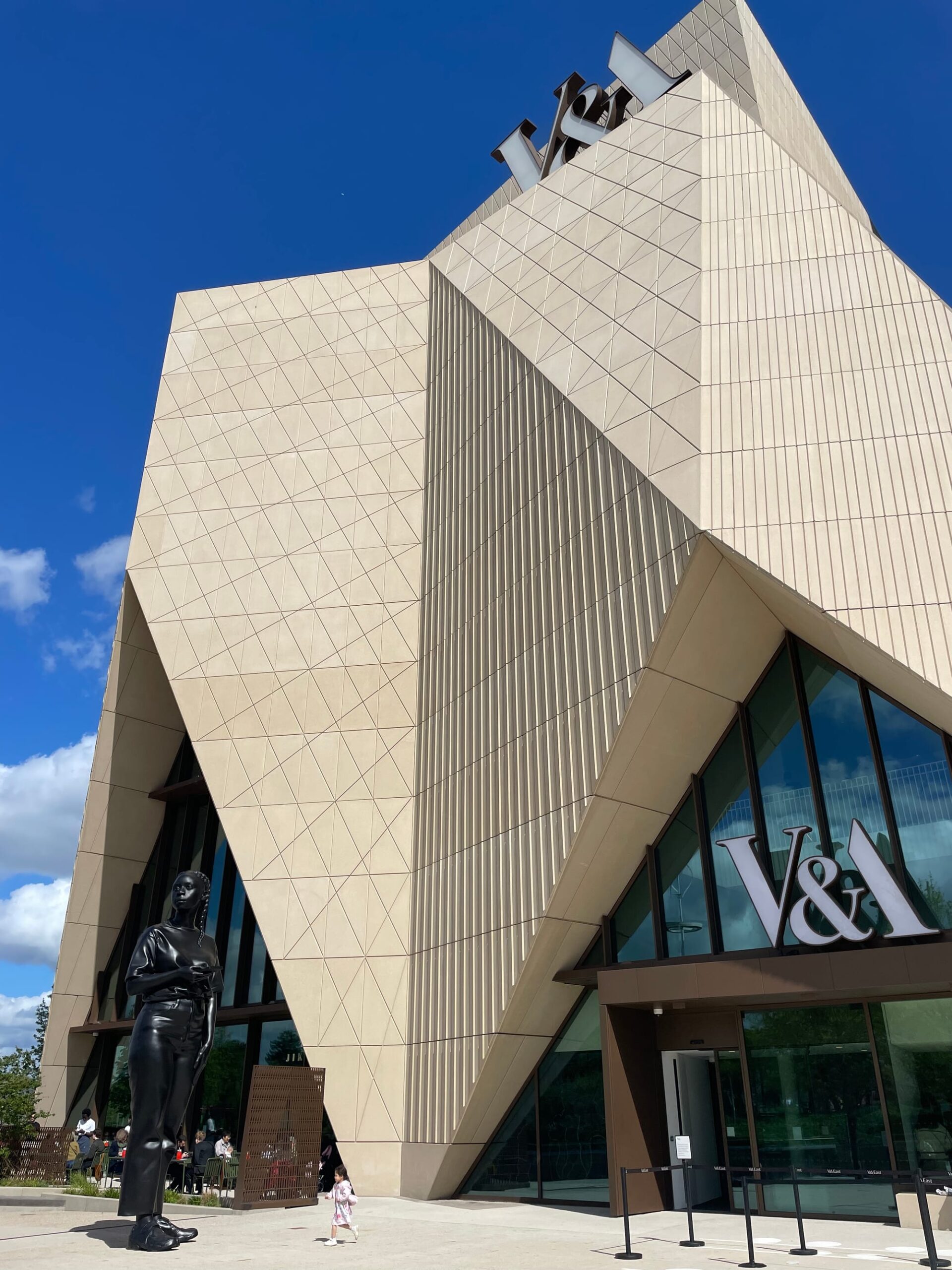
LONDON — The eagerly anticipated East London branch of the Victoria and Albert Museum (V&A) has officially launched. Situated across the city from its South Kensington location, the new V&A East and its counterpart, the V&A East Storehouse, aim to present the renowned British art and design collection in a fresh and groundbreaking manner. Historically, the V&A has prided itself on being a public institution. Originally stemming from the 1851 ‘Great Exhibition’, which reportedly attracted a third of Britain’s population, the museum remains one of the UK’s most frequented cultural venues, famous for major exhibitions on figures like Marie Antoinette, Christian Dior, and David Bowie.
In recent years, the V&A has expanded significantly. Besides its main museum, a new site opened in Dundee, Scotland, in 2018. The following year, the V&A Wedgwood Collection was introduced in Stoke-on-Trent. The Young V&A reopened in 2023 after substantial renovations, and the V&A East Storehouse debuted last year. Part of a £660 million (~$893 million) redevelopment initiative, the V&A East, located in Stratford, has been over a decade in the making. The area, heavily invested in during the London Olympics, feels almost like a digital model rather than a tangible city. Within this unusual setting, the V&A East strives to foster a sense of community.
Galleries in the new museum were co-designed with the Youth Collective, a group of East Londoners aged 16 to 25, who also collaborated with Cuban artist Tania Bruguera on the stained-glass piece ‘Towards A Civic Museum.’ Director Gus Casely-Hayford noted in the Guardian how a survey of 30,000 young people shaped the galleries’ object selections, focusing on identity, social justice, and environmental themes. Displays, spread over two stories, feature 500 objects from the V&A’s collection, including a 2020 Kehinde Wiley portrait paired with a self-portrait by an ‘unrecorded painter’ from circa 1530-1620.
The museum emphasizes East London artists, such as sculptor Thomas J Price, fashion designer Molly Goddard, and photographer Tom Hunter. The floor above the galleries houses a temporary exhibition space, currently featuring ‘The Music is Black: A British Story,’ while the top floor offers a compact gallery and rooftop terrace. A visitor remarked on the museum’s manageable size, suggesting it prioritizes the visitor experience. A wall text advises guests not to feel obligated to see everything in one visit, contrasting with the imposing architecture of the South Kensington V&A, which can overwhelm visitors with its scale.
Additional thoughtful features include welcoming staff, efficient elevators, and well-designed facilities for young families, enhancing accessibility. A creative activity table invites children to ’embrace the DIY spirit’ by crafting furniture from miniature parts. Just a 15-minute walk away, the V&A East Storehouse offers an innovative look into over half a million objects stored in open stacks, challenging traditional museum models. While the original V&A remains tied to its historical roots, the V&A East and Storehouse represent a new, potentially more inclusive type of museum. Despite the bittersweet context of East London’s rapid gentrification, these museums provide hope for sustaining creativity and community in the face of cultural transformation.