WALTHAM, Massachusetts — As visitors approach the main gallery of the Rose Art Museum to view Fred Wilson’s Reflections, they are greeted by a striking black and white canvas featuring a trident, stars, a swan, and a half-circle gear pierced by a machete. Titled “The People” (2010), this piece, prominently displayed in the museum’s entrance, sets the tone for the exhibit. The artwork showcases a deep, shiny black that absorbs light so effectively that it renders the surrounding white walls almost lackluster. While decoding the symbolic imagery is optional, the piece, along with others in the collection, probes the interplay between black and white: one representing the absence of color, the other encompassing all colors, each reinforcing the other’s narratives.
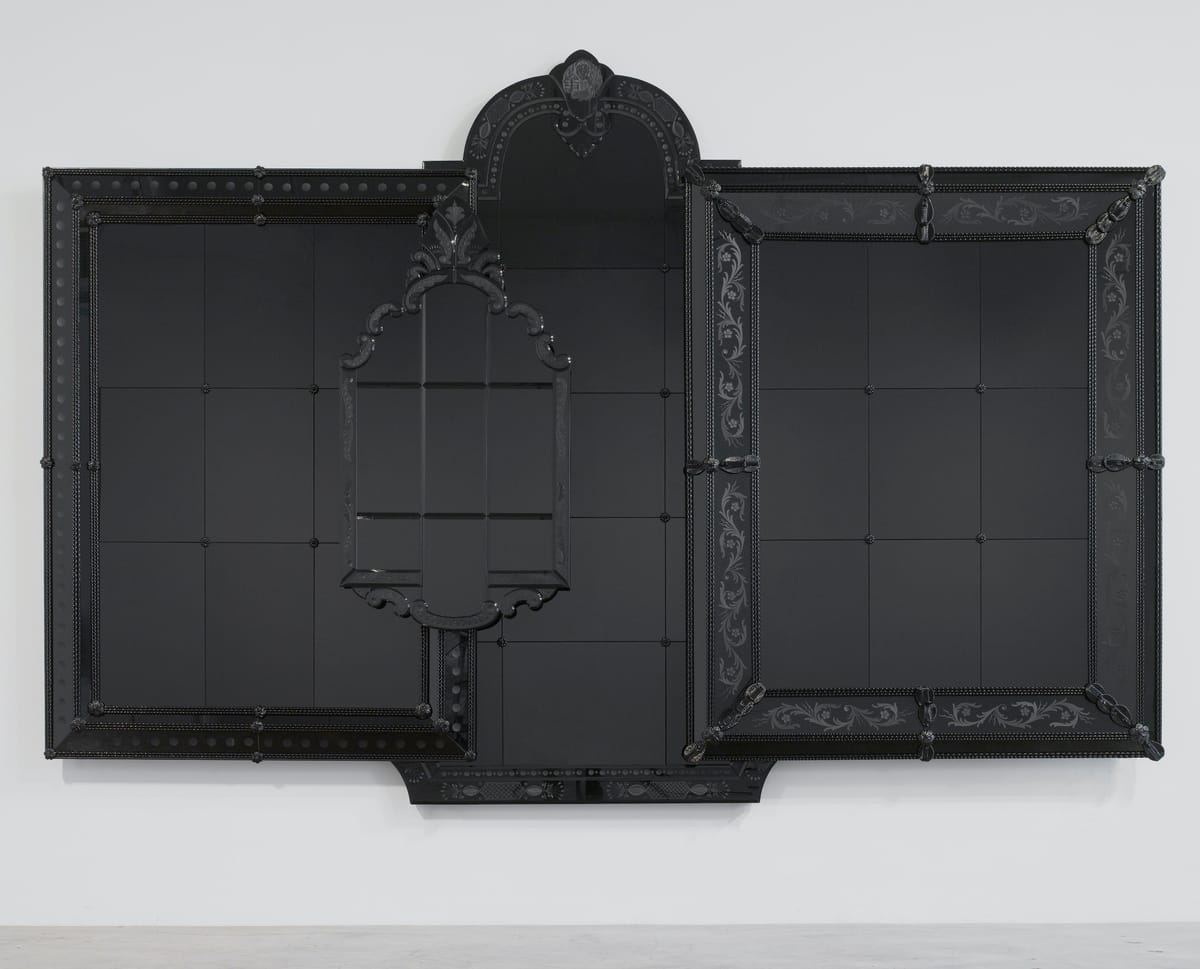
Throughout his career, Wilson has delved into these themes using mediums like Murano glass, European decorative arts, and caryatids. The exhibition features three glass chandeliers—“Dramatis Personae” (2022), “Eclipse” (2017), and “No Way But This” (2013)—and two Rococo-style mirrors, all adorned with black glass droplets. Known for their ornamental allure, Rococo arts in Wilson’s hands become a commentary on the interracial union of Desdemona and Othello from Shakespeare’s play. Set in Venice, a diverse port city, the play highlights societal tensions surrounding such unions. While the chandeliers’ connection to Othello may not be immediately apparent without context, they critique the racial biases inherent in Euro-American art through their color choices.
Wilson’s critique of Western art institutions extends to “North Africa, Europe, the Near East, and the Americas” (2003), a series of four pieces featuring black figures with white eyes and teeth, seemingly sharing a collective sorrow. The exhibition’s focal point, Black Now!, displays 2,500 items Wilson has amassed since 2005, prompting viewers to confront their preconceptions. This array juxtaposes positive images, like Black Santas and a cookie box with Meghan Markle and Prince Harry, against negative portrayals such as minstrel figures and Obama masks. During my visit, I observed many White attendees engaging with the exhibition’s decorative elements while quickly passing through the more challenging Black Now! section, which includes altar-like displays that evoke minstrel imagery, raising questions about the intent behind these presentations.
The exhibit concludes with a series of monochrome flags representing African nations ascending a staircase, with the Pan-African flag (red, black, and green) positioned above the back door, reminiscent of its historical significance for Black Americans during segregation. This arrangement invites reflection on the colonial shadows that shape our contemporary world. Until we confront the consequences of our shared prejudices, the mirror of our culture will remain distorted.