Jeff Koons is an artist whose sculptures consistently provoke discussion, in contrast to his paintings, which lack memorability due to their unremarkable nature. This discrepancy doesn’t suggest that the art of painting is obsolete, merely that Koons’s contributions to it are.
Debates surrounding Koons’s sculptures often become overly charged, with critics—frequently White—debating whether his work critiques capitalism or glorifies consumerism. This discussion seems moot considering that the production cost of a ‘Balloon Dog’ far exceeds the annual earnings of most Americans. Alongside these debates are humorous narratives, such as Arthur Jafa’s tongue-in-cheek claim in a 2020 New Yorker article that Koons is ‘a very light-skinned Black guy passing for white,’ and that his Equilibrium series’ floating basketballs symbolize castration and Black sexual prowess. The separation between Koons’s art and the analysis it spurs is evident.
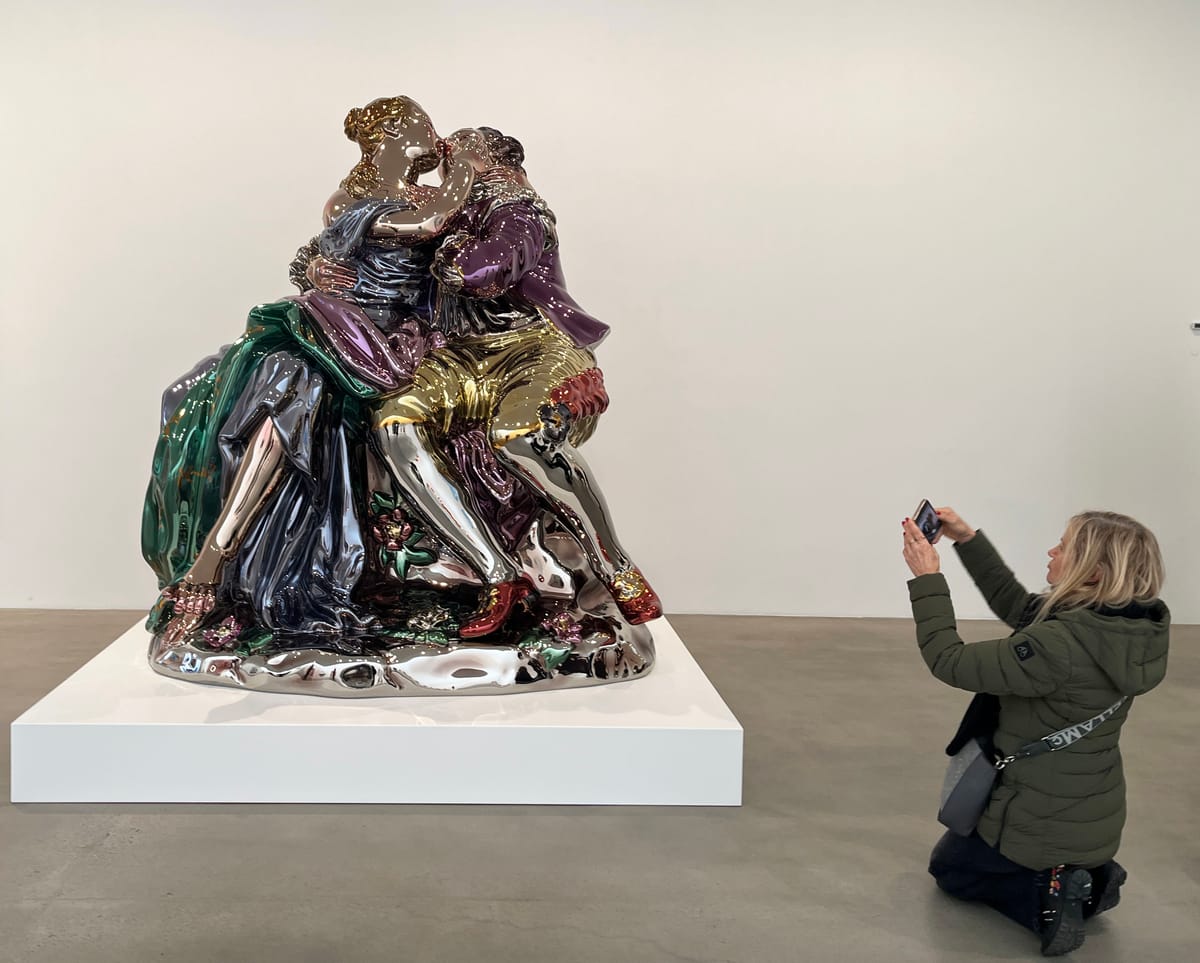
With this dichotomy in mind, I attended Koons’s latest show, Jeff Koons: Porcelain Series at Gagosian Gallery. The gallery’s press release promised an experience where viewers see themselves both reflected and distorted in the sculptures’ mirror-polished surfaces. The pieces, including ‘Aphrodite’ (2016–2021), ‘Three Graces’ (2016–2022), and ‘Kissing Lovers’ (2016–2025), invite viewers to engage with their sensorial allure and symbolic potential, blending past, present, and future stylistically and conceptually.
The experience of seeing oneself reflected in these works is akin to viewing one’s image in a funhouse mirror or Anish Kapoor’s ‘Cloud Gate’ in Chicago. While initially intriguing, the novelty of such distorted reflections quickly fades. This fleeting impact is mirrored by Koons’s anecdote about playing with his grandparents’ porcelain figures, which inspired many of his sculptures. In an interview with Joachim Pissaro for The Brooklyn Rail, Koons recalls the excitement of those interactions, equating it with the experience of viewing a Michelangelo, illustrating his lack of self-awareness and universalist thinking.
Koons often discusses his balloon works as models of the self, emphasizing the interface between the internal and external world. His sculptures’ reflective surfaces do not just mirror the viewers but resonate more with those who identify with Koons’s aesthetic and regard his work as significant in art history. Imagining the context and audience for Koons’s sculptures brings to mind President Trump’s extravagant ballroom plan, funded by donations from art collectors like Warren Stephens and Ken Griffin. Koons’s works would fit seamlessly into such opulent settings, perhaps even gracing the foyer of a new luxury hotel.
Jeff Koons: Porcelain Series continues at Gagosian (541 West 24th Street, Chelsea, Manhattan) through February 28. The exhibition is organized by the gallery.