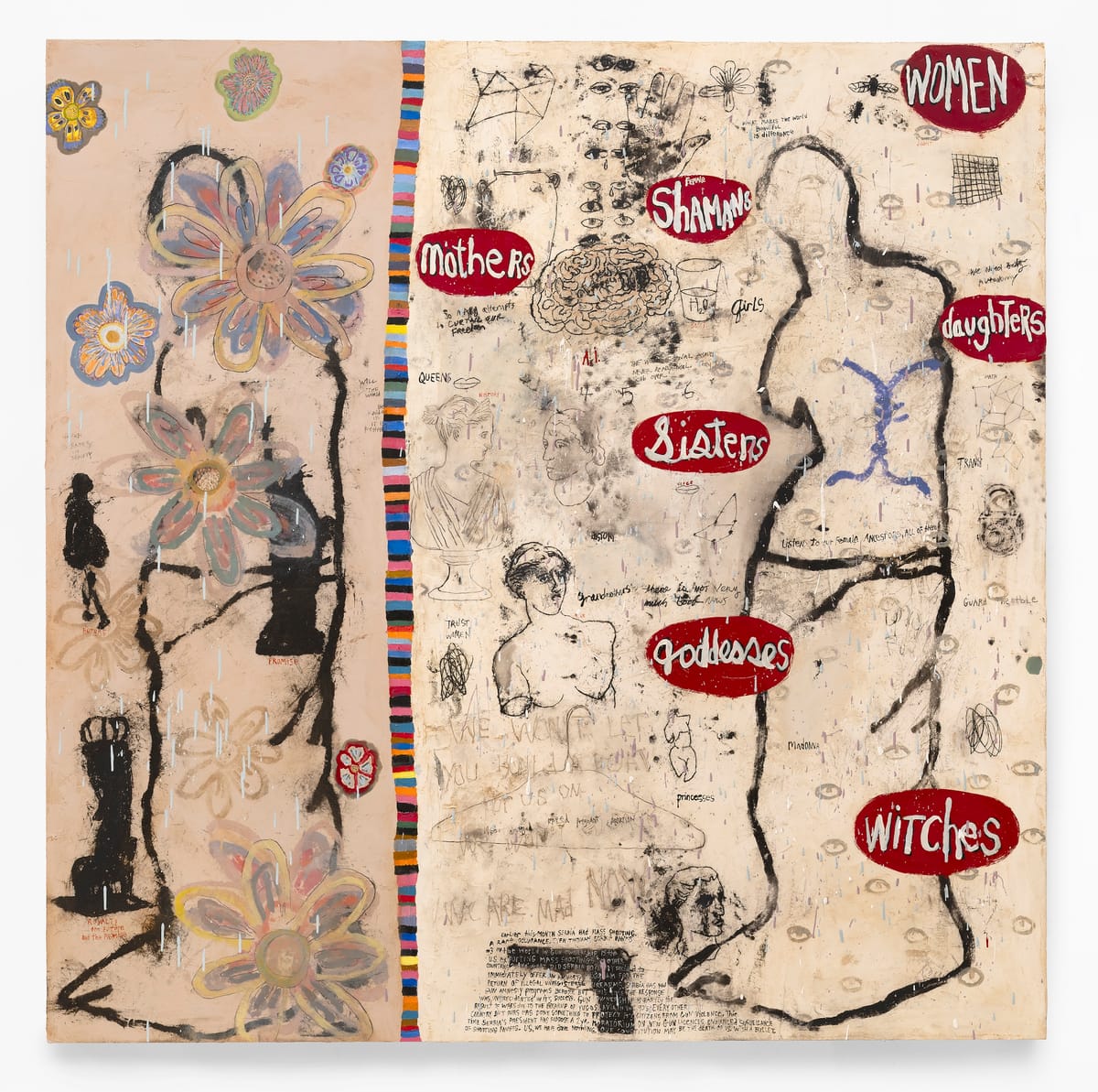
In a 2006 conversation with Squeak Carnwath, she expressed her belief that painting “can take on any form,” a conviction that has resonated with me over the years. Her pursuit of creating “something expansive” within painting’s traditional framework challenges the idea that the medium’s potential is finite. This is what drew me to her latest show, Goddess of All, at Jane Lombard. Carnwath’s work, previously explored in the 2009 Oakland Museum of California exhibit Painting Is No Ordinary Object, remains underappreciated in New York City. Notably, neither the Whitney Museum of American Art nor the Museum of Modern Art includes her work in their collections, despite her substantial impact.
At the heart of this oversight could be Carnwath’s dedication to the historical lineage of oil painting, tracing back to the Renaissance. Her independence from the Bay Area figurative painting or the Funk movement, despite her long-standing presence there, might also contribute to her lack of recognition. Artists like Carnwath and New York-based painter Joanne Greenbaum, both fiercely independent, often go unnoticed unless aligning with a curator’s thematic interests. Such independence is evident in the 11 square paintings showcased in Goddess of All, varying from 36 by 36 inches to 77 by 77 inches, crafted entirely from oil and alkyd on canvas mounted on panels.
Carnwath’s work is characterized by recurring motifs, such as an LP record, a sinking ship, and the Venus de Milo’s outline, alongside phrases like “guilt free zone.” These elements, along with three black silhouettes depicting Degas’s “The Little Fourteen-Year-Old Dancer,” the Statue of Liberty, and a crowned figure, explore idealized views of women. In “Ancestors and Future Ghosts” (2023), a vertical band of colored rectangles divides the canvas, featuring silhouettes and floral motifs that emphasize the surface’s role as a canvas for imagery and text.
Through her paintings, Carnwath reflects on contemporary issues while engaging with historical and future narratives. “Ancient Fragments” (2025) includes Roman busts, insects, flowers, and kissing faces, all underscored by introspective words like “insight.” Her pieces, like “Our Own” (2022), juxtapose statements on bodily autonomy against a backdrop of symbolic imagery. Despite the tumultuous world she inhabits, Carnwath’s commitment to painting remains unwavering, finding moments of order amid chaos.
The exhibition Goddess of All is on view at Jane Lombard Gallery in Tribeca, Manhattan, until February 28. The gallery organized this compelling showcase of Carnwath’s work.