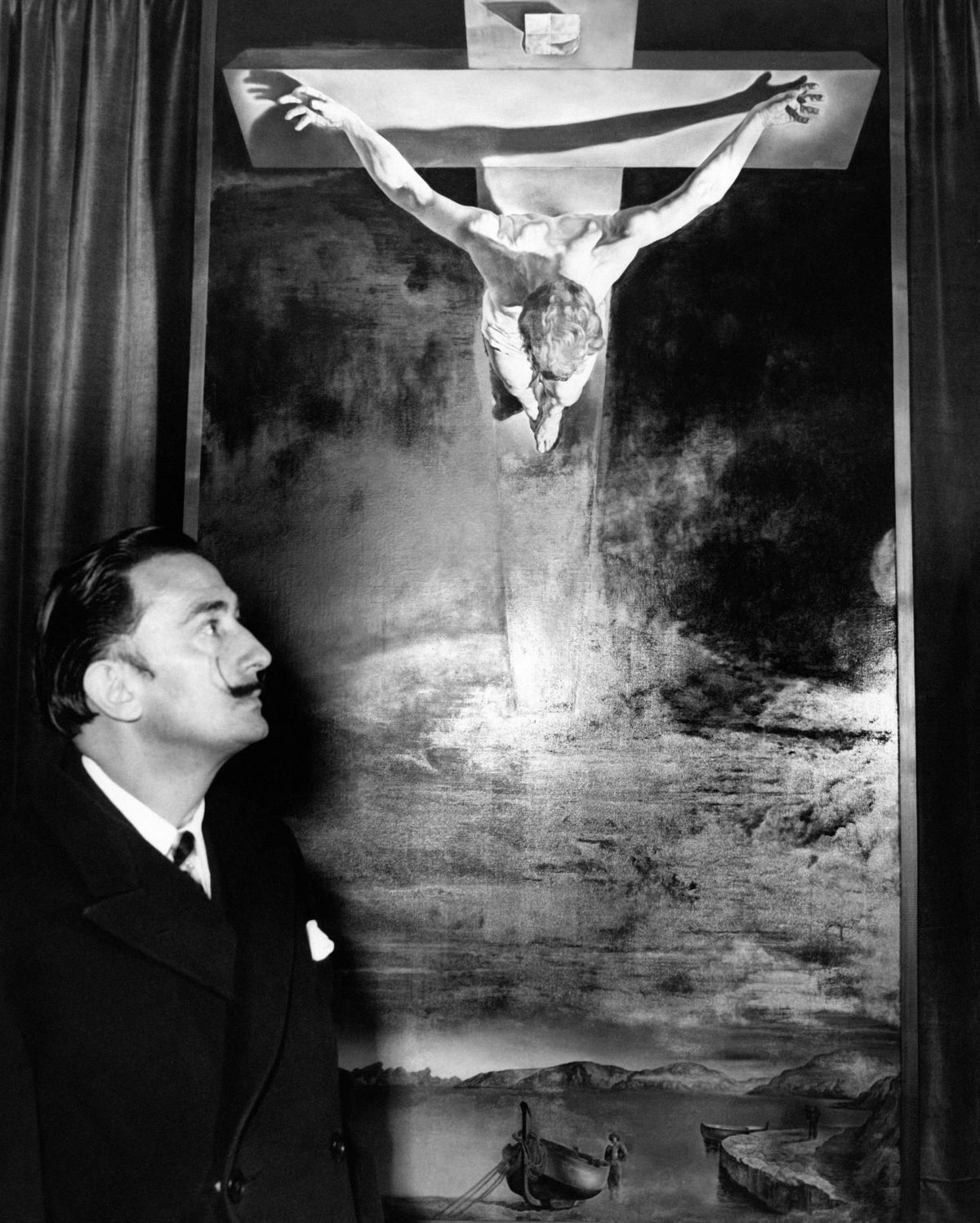
In 1961, shortly after Easter, a 22-year-old man vandalized Salvador Dalí’s 1951 painting, “Christ of Saint John of the Cross,” at Kelvingrove Art Gallery and Museum in Glasgow. Driven by fervent religious beliefs, the man slashed an eight-foot tear through the depiction of Christ. This wasn’t the only attack on the painting; nearly two decades later, another vandal attempted to shoot the canvas with an air rifle. Fortunately, by then, the artwork was protected by a thick acrylic layer. In a 2022 essay for the Los Angeles Review of Books, Kasra Lang shares how he resisted the impulse to damage the painting himself upon first seeing it, suggesting that Dalí’s intent was far from heretical.
The painting is part of Dalí’s mid-career phase, embracing Roman Catholicism and his interest in the Falangists, who executed his friend Federico García Lorca. Dalí called this phase “Nuclear Mysticism.” Although the crucifixion is a well-explored theme, Dalí presents it innovatively. From a top-down perspective, Christ is shown without traditional wounds, floating above an unblemished cross. This vision stemmed from a “cosmic dream” where Dalí likened Christ to the “nucleus of the atom,” representing the universe’s unity.
To accurately depict the human anatomy in suspension, Dalí hired Russel Saunders, Gene Kelley’s stunt double, to pose on a cross in his studio. Below the ethereal, gray-blue clouds in the painting, a fisherman’s boat floats not on the Sea of Galilee but outside Dalí’s studio in Port Lligat. Despite the religious subject, the painting sparked controversy, leading to multiple acts of vandalism. Lang notes that while Dalí’s religious works haven’t received extensive critical attention, the fervor they provoke is undeniable.
Compared to other Surrealists like Man Ray and Max Ernst, Dalí is a household name, famous for his flamboyant persona and surreal iconography. However, this has also led to his work being dismissed as kitsch. Known for his theatrical presentations and eccentric behavior, Dalí’s later works, such as the Nuclear Mysticism series, often face critique. Despite this, his innovative approach to blending science and religion, as seen in “Crucifixion (Corpus Hypercubus),” reflects a genuine and complex exploration of faith.
Dalí’s Nuclear Mysticism sought to unite theological and scientific themes, inspired by the new physics and the atomic age. His exploration of higher dimensions in art, exemplified by the hypercube in “Crucifixion (Corpus Hypercubus),” challenges viewers to consider a transcendent reality. Although criticized for its metaphysical implications, the painting captures an innovative and profound representation of the divine, separating the human from the divine in a manner that is both beautiful and unsettling.