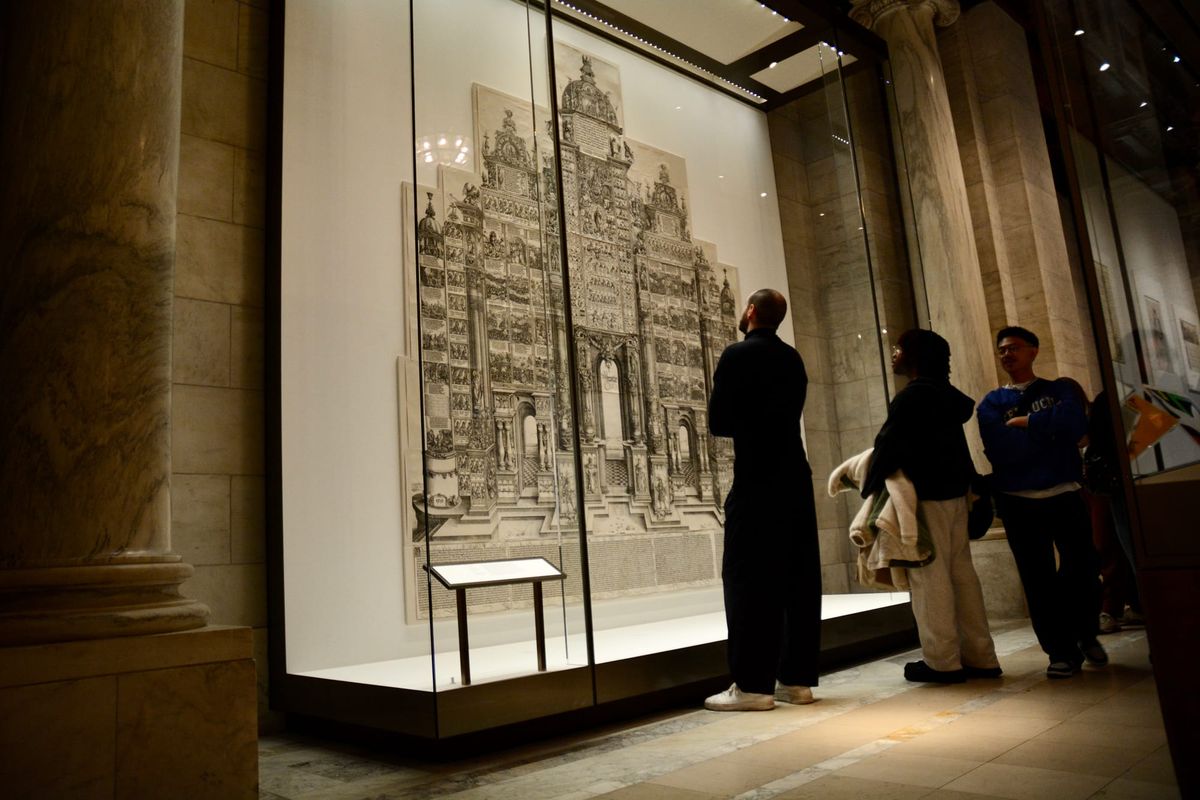
In 1512, German printmaker Albrecht Dürer was tasked by Holy Roman Emperor Maximilian I to produce an impressive piece of imperial propaganda for palace and city hall display. Originally named the ‘Arch of Honor’ and now known as the ‘Triumphal Arch,’ this extensive woodcut print, standing roughly 13 feet (four meters) tall, ranks among the largest of its kind ever created. Dürer, with the aid of a dedicated team of assistants, students, carvers, and advisors, completed this project over more than two years. The New York Public Library (NYPL) holds almost 50 impressions from the original 1515 run, as well as a complete set from the 1799 third edition, which has been showcased since the Polonsky Treasures exhibition began in 2021. However, due to the print’s delicate nature, the NYPL plans to store it away this fall, making this potentially the last chance to view it in full for an extended period.
The ‘Arch’ was donated to the library in 1903 by Atheron Curtis, according to Madeleine Viljoen, NYPL’s curator of Prints. Funds were raised to frame the piece, and it adorned the Great Hall for almost 50 years, a decision Viljoen described as ‘sort of insane’ given its fragility. Around 1984, the library staff concluded that it required conservation, leading to its storage. The print reemerged in 2009 for the Philadelphia Museum of Art’s Grand Scale exhibition, undergoing a meticulous restoration that included replacing its old linen backing with more durable materials. After a brief display, it was returned to storage until recent years.
Why does the ‘Arch’ capture the fascination of both the public and experts? The answer may lie within its intricate symbols, which narrate tales of power, mythology, and dynasty. ‘The imagery is quite complicated,’ Viljoen commented on the piece. It traces Maximilian’s lineage back to Troy, a somewhat fictional ancestry, according to Viljoen, and showcases verifiable family members like his father, Frederick III, and his wife, Mary of Burgundy. The depiction of his ancestry, including the golden fleece, the imperial family’s emblem, suggests a sense of destiny. ‘This is a person who was meant to be in this role,’ Viljoen observed.
Beyond lineage, the print details Maximilian’s military accomplishments. Viljoen noted that the arch’s design held military significance in Ancient Rome, where triumphal arches were erected by emperors returning from victorious campaigns. Unlike these enduring monuments, Dürer’s print was intended to be transient. ‘It wasn’t something that was permanent in the way that a marble sculpture would be,’ Viljoen remarked. The choice of print over stone could also reflect financial considerations, as Maximilian was ambitious but not affluent. ‘As a print, its cost was obviously inexpensive in comparison with an actual stone monument,’ said Jeffrey Smith, professor emeritus of Art History at the University of Texas at Austin.
The ‘Arch’ was printed in hundreds of copies, allowing for wide dissemination, a capability revolutionized by Gutenberg’s printing press around 1450. This development was pivotal in spreading ideas and is credited with sparking the Protestant Reformation. ‘A copy could be placed on the wall of a city hall, a palace, or other locations,’ Smith explained. Visitors are often ‘amazed’ by the print’s scale, Viljoen noted, emphasizing the collaborative effort behind its creation. ‘He’s such a refined printmaker,’ Viljoen said of Dürer, highlighting whimsical elements like monkeys and dragons in the print. ‘It’s imaginative and beautiful at the same time,’ she added. The print will be put back into storage on October 18, with future viewing possible by appointment, though only one piece can be viewed at a time due to its size.