In 1802, William Wordsworth wrote in his poem “My Heart Leaps Up”: “My heart leaps up when I behold/ A rainbow in the sky … The Child is father of the Man.” His poetry focused on the subjective “I,” contrasting with John Keats’ self-effacing perspective. Over time, Wordsworth’s “I,” defined as “the spontaneous overflow of powerful feelings … recollected in tranquility,” evolved into the existential angst of Abstract Expressionism, where spontaneous gestures took precedence over calm reflections.
Jasper Johns diverged from the emotionally charged “I” of Abstract Expressionism, ironically critiquing the heroism and spontaneity linked to figures like Jackson Pollock and Willem de Kooning. Using encaustic, a medium that hardens quickly, Johns created works featuring the American flag, targets, maps, and numerals that appeared deliberate rather than impulsive. He transformed familiar objects into art, expanding his visual language and exploring neglected subjects, as showcased in his exhibition at Gagosian, Between the Clock and the Bed.
The American flag was the first subject Johns chose to transform, or rather, it chose him, appearing to him in a dream. In “Flag” (1954–55), now in MoMA’s collection, he used newsprint and cloth dipped in hot wax to create the piece on a bedsheet. Years later, when I remarked that “Flag” could be a “conservator’s nightmare,” Johns replied, “Yes, it is falling apart, just like me,” linking the painting’s fragility to his own aging body, underscoring its vulnerability as a temporal entity.
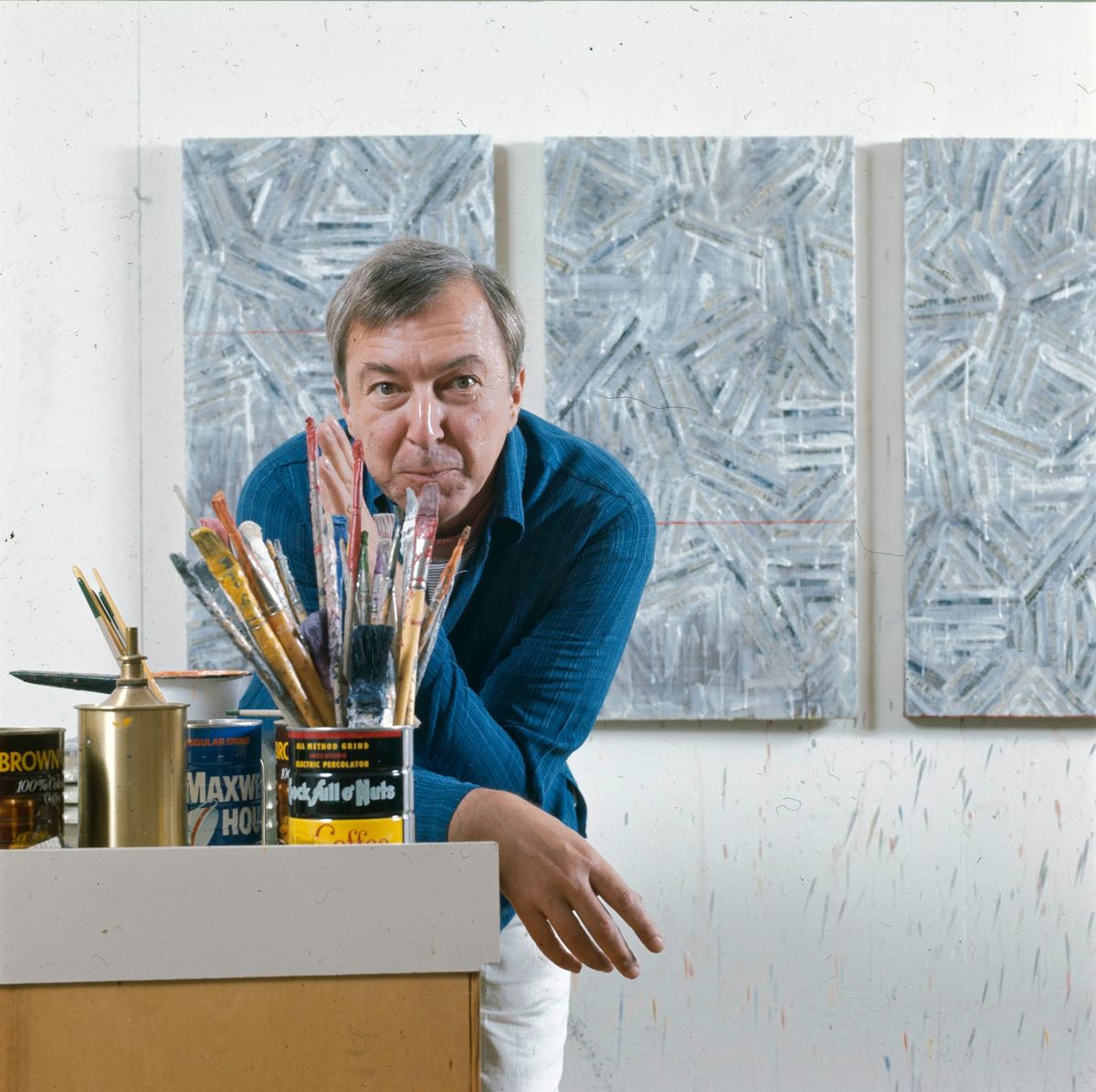
Johns, a meticulous and analytical artist, gained insights into how dreams reflect our existence as he transformed the stars and stripes into art. While creating “Flag,” he pondered the connection between dreaming and reality. This exploration marked the beginning of his use of preexisting items and his implicit rejection of the necessity for originality. His crosshatch technique, first seen in “Untitled” (1972), became a central theme from 1972 to 1982, as he explored mechanical repetition and human obsession, a focus of Between the Clock and the Bed.
The exhibition includes works like “Corpse and Mirror” (1974) and “Weeping Women” (1975). These pieces use crosshatch patterns to explore themes of mortality, beauty’s impermanence, and isolation. In his dialogue with Picasso and Munch, Johns maintains an abstract vocabulary while engaging with their themes, reflecting on mortality and the fleeting nature of existence. Through his work, Johns has consistently chronicled the interplay of his mind and body with the world, celebrating art’s enduring beauty.