Jule Korneffel, initially influenced by Mary Heilmann’s seemingly informal take on abstraction, has delved deeper into her unique artistic path. In her debut exhibition at Spencer Brownstone in March 2019, Korneffel expressed to Jamie Martinez from Arte Fuse that she sought a ‘calm joy’ in her work. Her paintings featured thin layers of matte backgrounds with circular gestures, sometimes as quick, loaded lines or irregular shapes. These artworks revealed earlier shapes and layers beneath the surface, encouraging viewers to explore the interplay of colors and layers. Unlike Heilmann, whose color inspirations are often pop culture-based, Korneffel’s sources are less identifiable.
In her second exhibition at Spencer Brownstone, titled Jule Korneffel: Here Comes the Night (February 26–April 16, 2022), the artist’s palette shifted to a darker, more somber tone. Moving away from the joyful hues of her previous show, the new pieces are dominated by blacks, grays, dark greens, and rust reds. The change is not only in palette; where her earlier works exhibited clarity and stability, these paintings suggest fleeting glimpses and ghostly presences. At times, viewing her nine-foot-tall piece, ‘Another Tragic Moment in History (Detail of a Flower Still Life)’ (2021), evokes memories of Ad Reinhardt’s Black Paintings, yet Korneffel’s work affirms rather than denies the hand’s role in painting.
The subtle presence of a green-tinted orb in ‘Another Tragic Moment in History (Detail of a Flower Still Life)’ challenges the viewer to pause and engage deeply with the canvas. The indeterminate forms urge slow observation, a notion that would be complemented by the addition of a gallery bench for contemplation. The dark red shape may symbolize the ‘Another Tragic Moment in History’ referenced in the title, highlighting the contemporary world’s conflicts while maintaining faith in abstract painting.
Korneffel continues a dialogue with other artists, evidenced by titles and notes on her paintings’ backs, such as in ‘Ppl Leaving (Fantin-Latour Blues)’ (2021). This piece showcases a floating blue circle against a layered backdrop of mixed hues, with subtle red accents peeking through. Her work balances color abstraction with material and immaterial interplay, focusing on the relationships between the tangible and the ephemeral.
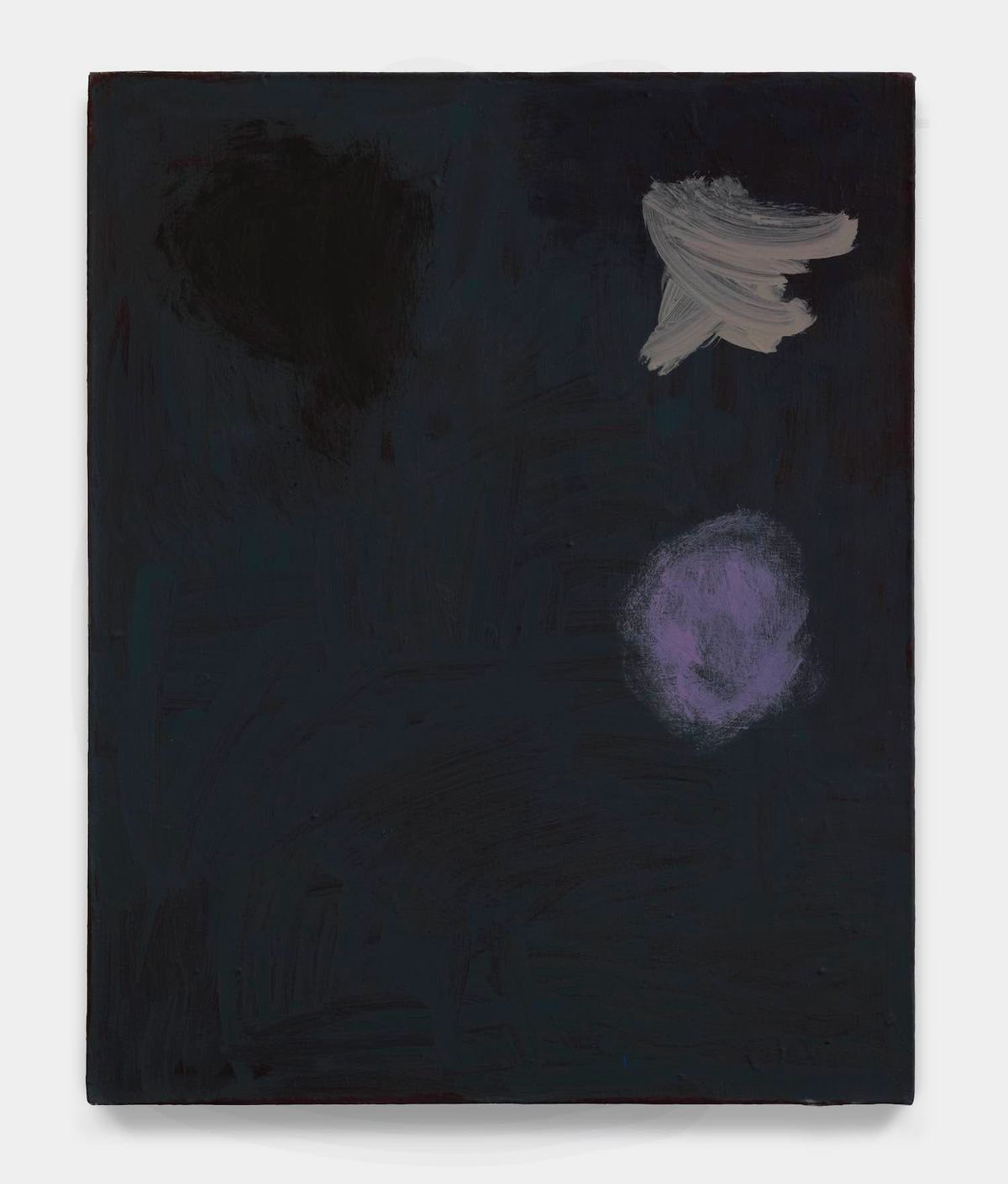
In ‘Monet’s Shadow’ (2021), the distinctness of shapes marks a significant evolution from her debut exhibition. Set against a streaked ground of dark green and black, the painting features a tan brushstroke, a violet circle, and an irregular black shape that suggests portals or absences. Each brushstroke and paint density commands attention through its subtle identity, offering a fresh and tender experience. This balance of restraint and audacity invites viewers to engage in slow looking, standing apart from the art world’s current trend of entertainment and distraction. Korneffel’s dedication to paint and its visual-physical blend reflects her resistance to prevailing abstract narratives, pursuing the thoughtful pleasures that only painting can offer.