The English-born Trevor Winkfield has followed a singular route that has not yet been fully appreciated for how unlikely, deep, and wide-ranging it is. After studying art in Leeds and earning his master’s degree from the Royal College of Art in 1967, he relocated to New York in 1969, where he continued publishing the poetry magazine Juillard (1968–72) and gained recognition among the writers and artists associated with the New York School. He also worked for Arthur Cohen, who sold books and ephemera related to 20th-century Modern Art movements including Dada and Surrealism, and contributed entries to Cohen’s expansive catalogues. Those entries were informative, concise, and witty. Winkfield was a polymath with unparalleled knowledge of lesser-known artists and writers such as Gerald Murphy and Ronald Firbank.
In 1976, Winkfield returned to painting, began making book covers, and collaborated with poets including John Ashbery, Charles North, Ron Padgett, and Harry Matthews. He made his New York debut exhibition in 1977 and published his translation of Raymond Roussel’s How I Wrote Certain of My Books. Roussel, widely regarded as the most eccentric writer of the 20th century, composed works according to linguistic rules based on homophones, words that sound alike but have different meanings. Predictably, critics have tried ever since to link Winkfield’s collage-like paintings of fabricated worlds to Roussel’s improbably imagined novels, yet no key has ever been found — and, in my view, there never was one. Literary as Winkfield is, he is also deeply visual, and that duality is what makes him unique.
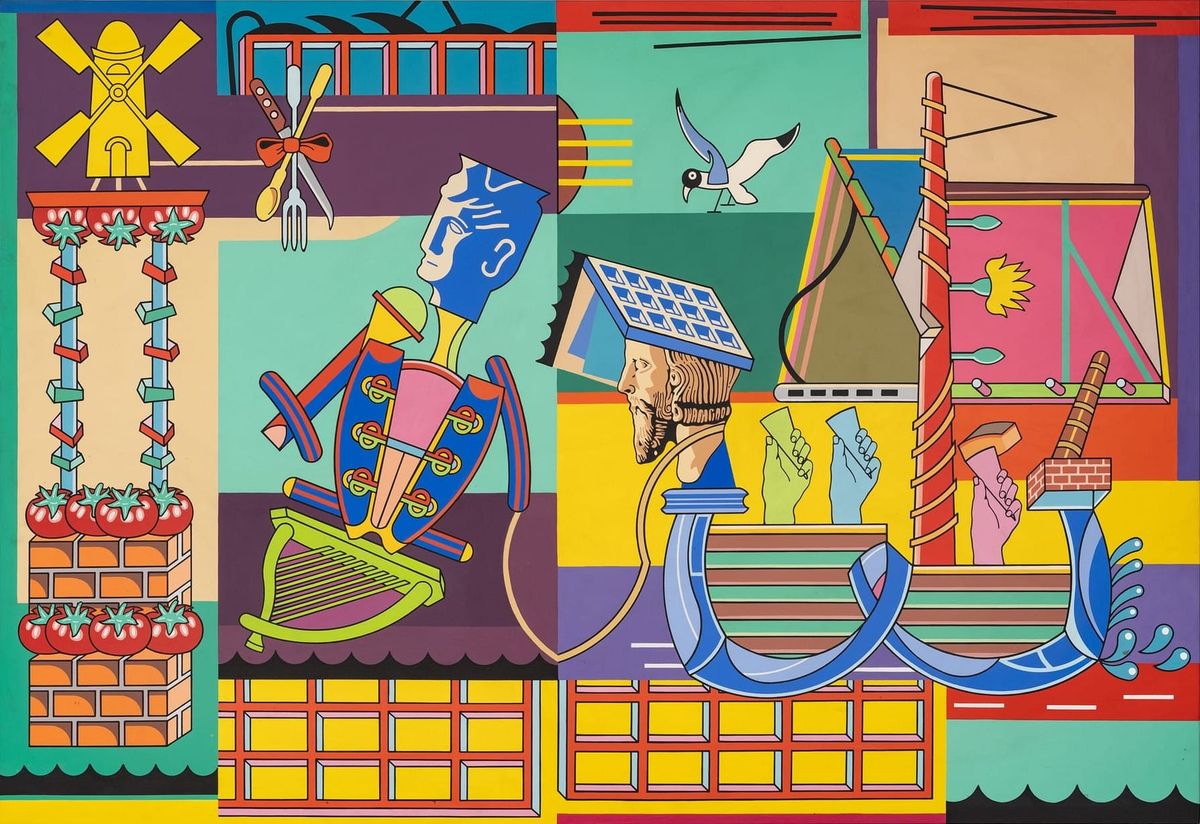
Winkfield paints at a table, and the eight works in The Mermaid’s Revenge – Paintings 1991-2001 at Tibor de Nagy gallery come from a decade when he had access to an apartment large enough for the surfaces he wanted to work on. Executed in acrylic on linen, the paintings range from 35 1/2 x 19 1/2 inches (~90.1 x 49.5 cm) to 45 x 72 inches (~1.1 x 1.8 m), with no two works the same size. They are densely packed with details rendered in flat, saturated, playroom colors, interrupted by one volumetric element painted in a direct, illustrative manner. Part of that disruption comes from Winkfield’s refusal to let the pictures read as airless or purely flat. He has created an artificial world — bright, slightly sinister, and cheerfully bewildering — usually populated by a delicately featured young man absorbed in some mysterious task.
The titles emphasize the solitary nature of these activities: “The Navigator” (2000), “The Student” (1999), “The Astrologer” (1991), and “Self-Portrait” (2001), with its palette and carefully depicted daubs of paint. Each figure can be read as a stand-in for Winkfield, an artist and writer whose sharp, original essays on Georges Braque, Jasper Johns, John Graham, and Florine Stettheimer are collected in Georges Braque and Others: The Selected Art Writings of Trevor Winkfield, 1990–2009 (2014). In “The Student,” a young man wearing a helmet that includes a fish and what may be a lock for an eyepiece holds a long-handled pot beneath a lightbulb releasing tokens marked with a snowflake pattern. Those tokens reappear in the sky above the pink and pale-blue mountain visible through the open window. His body and clothing are assembled from separate parts, with oversized hands and bare feet painted in different colors, including celadon and orange. The flatness of the forms makes the figure seem like an intricate shadow puppet caught in an action whose meaning will always remain hidden.
The closed nature of Winkfield’s paintings may put some viewers off, but it does not put me off. His commitment to building a wholly artificial world feels like an important counterweight to the art world’s faith in literal meaning and transparent, socially conscious subject matter. His rejection of certainty, and of the comfort certainty supposedly offers, is a timely reminder that imagination should not be neglected in the making of art, or in the freedom art can provide. In the improbable fusion of bright color, puzzling behavior, and gripping scenarios, we are invited into a meticulously constructed world unlike any other. Trevor Winkfield: The Mermaid’s Revenge – Paintings 1991 – 2001 continues at Tibor de Nagy gallery (11 Rivington Street, Lower East Side, Manhattan) through July 31. The exhibition was organized by the gallery.