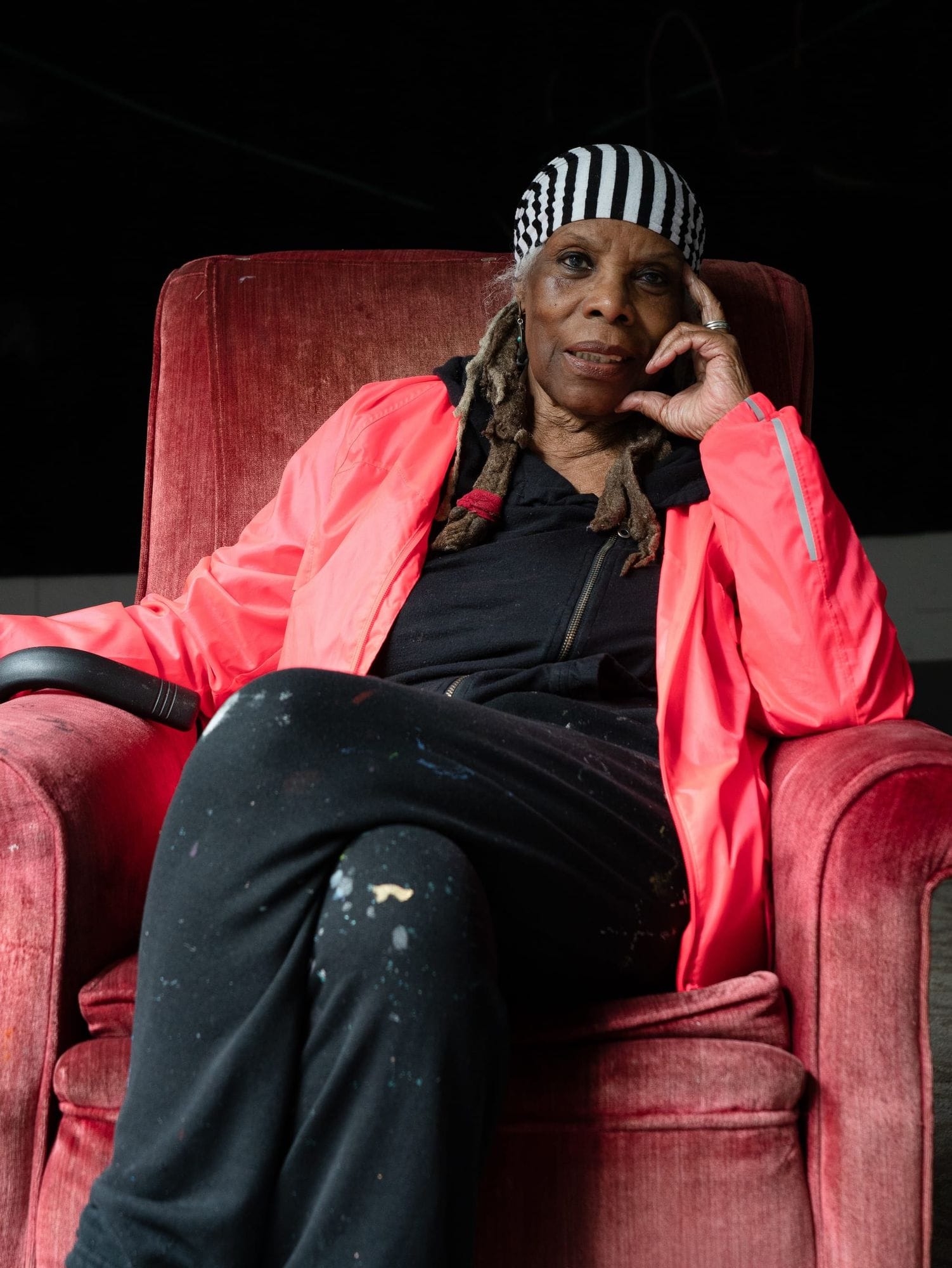
Esteemed painter, educator, and Civil Rights advocate Mary Lovelace O’Neal passed away on May 10 at the age of 84 in Mérida, Mexico, as announced by her galleries, Jenkins-Johnson and Marianne Boesky. She leaves behind her husband, Chilean-American artist Patricio Moreno Toro, with whom she split her time between Mérida and Oakland, California. Lovelace O’Neal was celebrated for her monumental works that seamlessly blended abstraction and figuration, marked by bold gestural strokes and vibrant energy. Her Lampblack series, notable for their use of layered black pigment and punctuated with delicate lines, served as a powerful statement of Black identity.
Art historian and curator Katy Siegel, in a statement to Hyperallergic, described her paintings as “milestone statements in the recent history of painting,” noting their deeper exploration into the metaphysical aspects of life and nature. Born in Jackson, Mississippi, in 1942, Lovelace O’Neal’s formative years were spent in Pine Bluff, Arkansas. The daughter of a music professor, she recounted memories of restricted museum access during the Jim Crow era. Her childhood journeys to Chicago and Gary, Indiana, were influenced by her father’s family migration during the Great Migration.
In 1964, she graduated with a BFA from Howard University, studying under influential figures like Lois Mailou Jones and David Driskell. Lovelace O’Neal became deeply involved in the Civil Rights movement, working alongside activists such as Stokely Carmichael. Her artistic journey led her to the Skowhegan School of Sculpture and Painting in Maine, where she first encountered the impactful lampblack pigment. This medium became a significant element in her work, reflecting profound cultural significance in her black monochromes.
After Howard, Lovelace O’Neal moved to New York for graduate studies at Columbia University, marrying playwright John O’Neal in 1965. She faced pressures to adapt her art towards both Minimalism and social narratives, ultimately finding resolution through her distinctive use of black pigment. Her work was praised for its emotional depth and visual allure, as noted by artist Mildred Howard. Lovelace O’Neal’s later years included a tenure at the University of California, Berkeley, where she was the first Black woman to receive tenure in the Art Practice Department, retiring in 2006.
In recent years, Lovelace O’Neal’s contributions gained broader recognition, with her works featured in prestigious exhibitions such as the Whitney Biennial and acquired by significant institutions like the de Young Museum. Her legacy is marked by awards like the Anonymous Was A Woman Award and the Murray Reich Distinguished Artist Award. Siegel fondly remembered her as a person of remarkable intensity and style, encapsulated in her signature email sign-off: ‘IN THE SERVICE OF ART I REMAIN MLO.’