Fashion photography has long been understood as a highly constructed medium. From its earliest role documenting socialites and celebrities in their finest clothing, it has served as a vehicle for projecting idealized beauty. The Metropolitan Museum of Art takes up that tension in Lillian Bassman: Bazaar and Beyond, a compact survey of the late photographer’s fashion-media work from the 1940s through the 2000s.
Bassman began in the early 1940s as an aspiring illustrator, studying under legendary Harper’s Bazaar art director Alexey Brodovitch. By the late 1940s, she was producing her own covers and editorials for Bazaar, developing a singular approach to fashion photography that both reveals and embraces the medium’s veil of appearance. The exhibition underscores Bassman as an artist fully fluent in the languages of fashion media, while also offering a critical, puckered look at its superficiality.
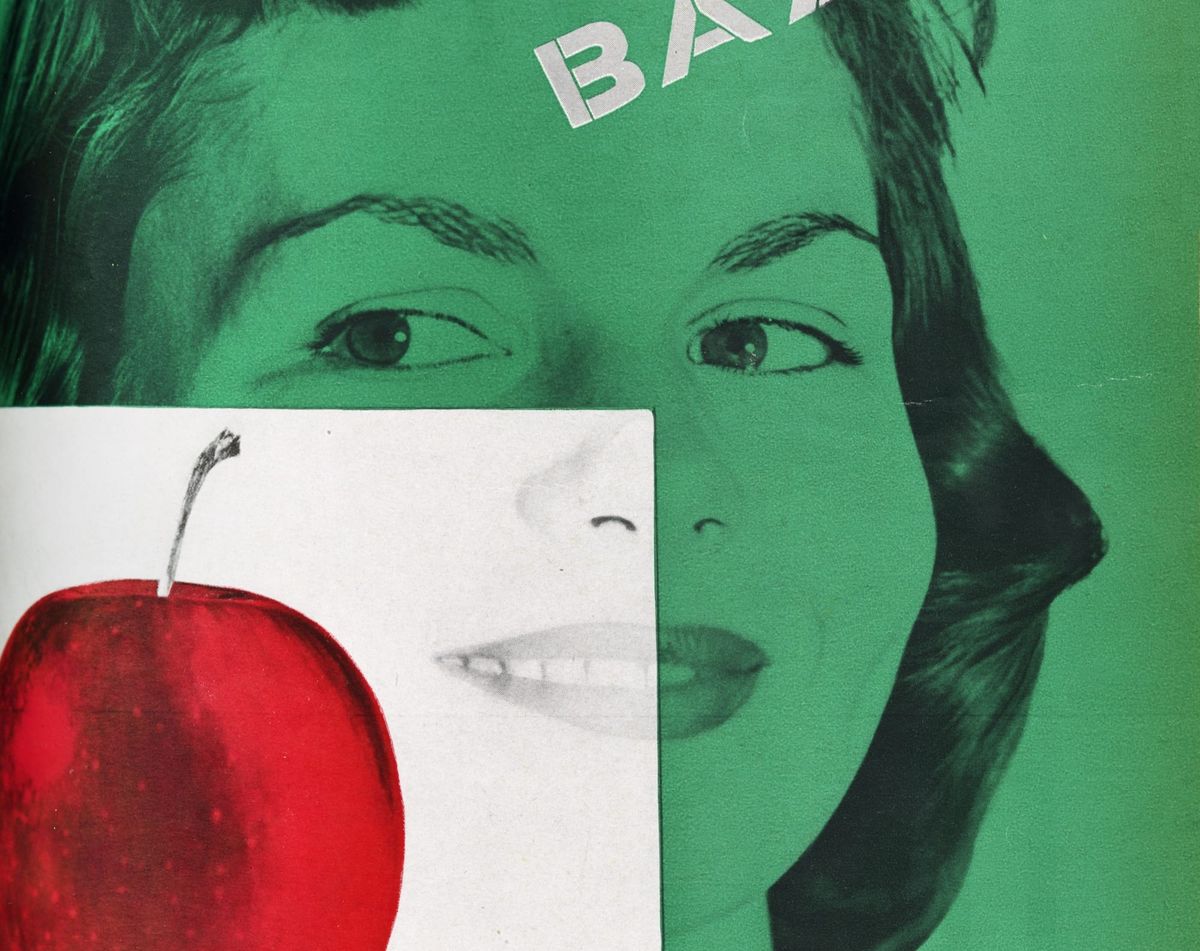
The presentation opens with Bassman’s early years at the magazine and her period as co-director of Junior Bazaar with Brodovitch in the 1940s. On view are photo collages, editorials, magazine covers, photographs, and test prints. Among the most striking early works are pieces shaped by 20th-century modernism, including the photo collage “Vocabulary of Courage maquette” (1944), which recalls Dada artist Hannah Höch, as well as covers and editorials marked by Russian Constructivist graphics — a pointed choice for a fashion publication, given both movements’ anti-capitalist roots. During this period, Bassman embraced a range of experimental techniques, and though these works differ greatly from the glossy images for which she became known, they provide essential insight into her practice.
A 1949 group of gelatin silver test prints for magazine covers connects this section to the next gallery, which highlights Bassman’s darkroom expertise. There she experimented with extreme over- and under-exposure and with selective bleaching. Her process also echoes the way many women shape beauty and femininity in everyday life; Bassman’s bleach-soaked paintbrush is not far removed from makeup brushes and a bottle of Clairol. Like Pop art, these test covers reveal Bassman’s contrarian vision within the polished and tightly controlled world of fashion media.
The remainder of the exhibition centers on Bassman’s fashion photography, including her years at Bazaar, photographic studies, freelance work, and later reprint projects from the 1990s and 2000s. Many of the photographs transform their subjects through camera angle, pose, and darkroom manipulation. Often the models avert their gaze, or their faces are hidden by smoke, shadow, or blur, while bodies and features twist away from the viewer and become silhouettes — ideal hangers for clothing. Bassman’s later reprints, especially the 1990s works, are the exhibition’s most powerful section, as she revisited earlier negatives with heavier exposure adjustments, harsher chemical treatments, and even an early version of Adobe Photoshop.
Two versions of “The Cape Back is Back” from 1949 and 1994 neatly trace Bassman’s artistic evolution. In the original, the model nearly merges with the background; in the later version, Bassman intensifies the contrast between light and dark, creating a moody uncertainty in the figure’s face and elbow. Freed from the demands of editors, designers, and advertisers, she could pursue her own vision rather than the perfect commercial image, allowing artifice to expand and deepen. Lillian Bassman: Bazaar and Beyond continues at the Metropolitan Museum of Art (1000 Fifth Avenue, Upper East Side, Manhattan) through July 26. The exhibition was organized by Virginia McBride, assistant curator in the Department of Photographs.